

Google I/O 2025 put Android XR closer to the center of its AI strategy. Rather than treating extended reality as a separate hardware experiment, Google showed how Gemini could become part of the way people interact with XR headsets and glasses.
The most notable demonstration involved Android XR glasses equipped with cameras, microphones and speakers. In Google's demo, Gemini could understand what the wearer was seeing and hearing, provide directions, translate conversations, send messages and help with everyday tasks. Google also showed how Project Astra's research capabilities are being brought into Gemini and other products.
There is an important distinction, however. The glasses shown at I/O 2025 were prototypes being tested with trusted users, not a finished consumer product available for general purchase. Android XR itself is Google's broader platform for headsets and glasses, developed with partners including Samsung and Qualcomm.
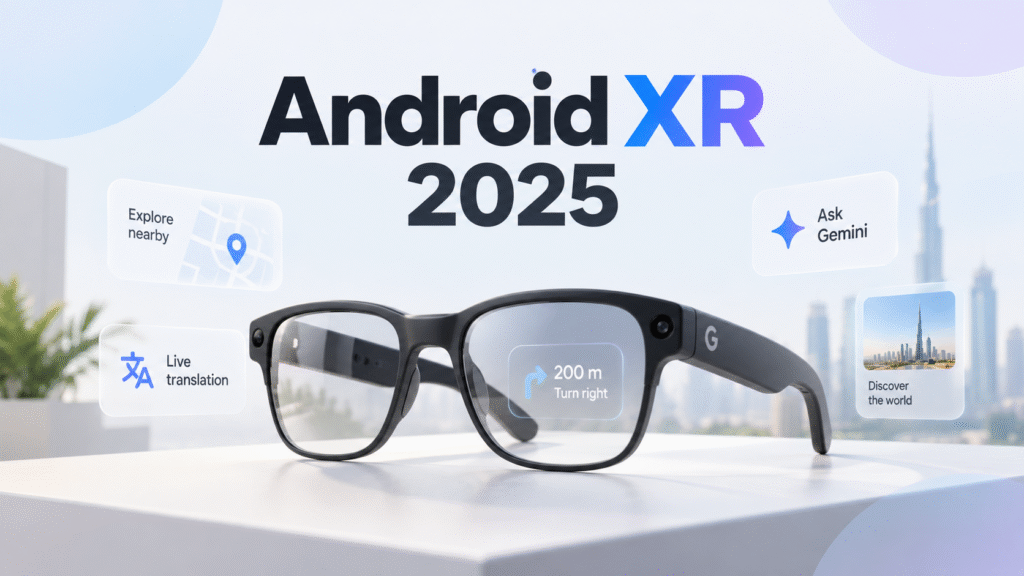
Table of Contents
What Is Android XR?
Android XR is Google's platform for extended-reality devices, including immersive headsets and lightweight glasses.
Google introduced Android XR in December 2024 in collaboration with Samsung and Qualcomm. The platform is built on Android and is intended to support both virtual and augmented experiences while giving developers access to familiar Android development tools and frameworks.
The platform is designed around more than entertainment. Google wants Android XR devices to support productivity, communication, navigation, translation, education and other everyday activities.
Gemini is an important part of that strategy. On XR devices, Google's AI can understand more of the user's surroundings and respond to what is happening in front of them. This creates a different interaction model from a phone or conventional chatbot because the assistant can use visual and spatial context.
Android XR Glasses: What Google Demonstrated
The glasses were one of the clearest demonstrations of Google's direction for Android XR at I/O 2025.
Google showed glasses equipped with a camera, microphones and speakers that work alongside a smartphone. An optional in-lens display can provide information within the user's field of view, while audio allows Gemini and other functions to operate without requiring the user to look down at a phone.
The demonstrations included several practical scenarios.
The glasses could provide turn-by-turn directions while the wearer moved through an unfamiliar area. Google also demonstrated messaging, appointment-related tasks, taking photographs and identifying nearby points of interest.
Live translation was another notable demonstration. Google showed two people communicating in different languages while the glasses provided translated information, illustrating how an AI assistant could connect visual and audio context with language translation.
The concept is different from placing a small version of a smartphone screen in front of someone's eyes. Google is instead trying to make the glasses an interface for information that is relevant to the user's immediate surroundings.
Gemini Is the AI Layer Behind Android XR
Gemini gives Android XR a conversational interface that can understand more than a typed instruction.
On a conventional phone, an assistant generally receives information through text, voice, files or applications. With XR glasses, the system can potentially combine those inputs with what the camera sees and what the microphones hear.
Google demonstrated this approach through scenarios involving navigation, translation, messaging and visual understanding. The company's Android XR announcement describes the glasses as working with Gemini so the assistant can understand the user's context and provide information when it is useful.
This also explains why Google's XR strategy is closely connected to its broader Gemini strategy. The company is not developing AI for glasses as an isolated feature. Gemini is being extended across phones, watches, cars, TVs, headsets and glasses.
For XR, that continuity matters. A user could potentially begin a task on a phone and continue it through an XR device without treating the two as completely separate systems. Google's approach also connects Android XR to the wider development of AI assistants. The growing category of AI chatbots in 2026 shows how conversational AI is moving beyond basic question answering into research, multimodal interaction and task-based assistance.
Project Astra: From Research Demo to Product Capabilities
Project Astra was another important part of Google's I/O 2025 story, but it should not be described as a conventional product launch.
Google DeepMind describes Astra as a research project exploring the capabilities of a universal AI assistant. The project investigates areas such as video understanding, memory, natural voice interaction and the ability to understand the environment around a user.
At I/O 2025, Google explained that capabilities first explored through Astra were being integrated into products including Gemini Live and new experiences in Search. The company also said it was working toward bringing these capabilities to new form factors such as Android XR glasses.
That distinction matters because Astra itself is not simply another chatbot competing with ChatGPT or Gemini. It is better understood as a research program that has helped Google develop capabilities for its broader AI products.
The technology demonstrated at I/O included better memory, natural audio, computer control and improved understanding of video and screens. Some of those capabilities have already moved into Gemini experiences, while others remain part of Google's ongoing research and testing.
Android XR Headsets and Project Moohan
Google's XR strategy is not limited to glasses.
The company is also building Android XR for immersive headsets. Samsung's Project Moohan was presented as the first Android XR device, with Google describing it as a headset designed around immersive experiences and Gemini assistance.
Google's earlier Android XR announcement explained that headsets could provide virtual screens, immersive content and access to Android applications. Gemini could also interact with what users see and help them perform tasks within the XR environment.
This gives Android XR two related but different directions.
Headsets can focus on immersive computing, large virtual displays, entertainment and spatial applications. Glasses are aimed more at lightweight, everyday assistance while keeping the user connected to the physical environment.
The shared Android XR platform gives developers a common foundation across both types of hardware.
Google's Approach Is More Than Virtual Reality
Calling Android XR simply a virtual reality platform misses an important part of Google's strategy.
Virtual reality places the user inside a simulated environment. Augmented reality adds digital information to the physical environment. Extended reality covers a broader range of these experiences.
Android XR is designed to support both immersive headsets and glasses that keep the user connected to the real world. Google's own examples range from virtual screens and immersive content to navigation, translation and hands-free communication.
The addition of Gemini makes the distinction even more important. AI can provide an interpretation layer between the user and the surrounding environment.
Instead of manually opening an application to find information, the user can interact with an assistant that understands the current context and determines what information or action is relevant.
That is one of the main ideas behind Google's XR strategy.
Google Is Building an XR Ecosystem
Google is also approaching Android XR as a platform rather than a single hardware product.
The company has been working with Samsung and Qualcomm on the platform and has announced partnerships with eyewear companies including Gentle Monster and Warby Parker for future Android XR glasses. Google has also said that it is working with Samsung on software and reference hardware for glasses and plans to give developers tools to build for the platform.
This ecosystem model is important because the success of a computing platform depends on more than the hardware.
Developers need tools and distribution. Hardware manufacturers need a software platform. Users need applications that justify buying the devices. Google is attempting to address these parts simultaneously through Android XR.
The platform also builds on familiar Android technologies. Google's initial developer preview included support for tools such as Android Studio, Jetpack Compose, Unity, OpenXR and ARCore.
That could make it easier for developers who already understand Android or existing XR frameworks to begin experimenting with the platform.
Privacy Is a Major Issue for AI Glasses
AI-powered glasses introduce a privacy problem that does not exist to the same degree with a conventional chatbot.
The device can include cameras and microphones while being worn in public spaces. Gemini can then process information related to the user's surroundings. That creates questions around consent, bystanders, recording and how visual and audio information is handled.
Google acknowledged this issue in its Android XR announcements. The company said it began testing prototype glasses with trusted users partly to gather feedback and ensure that the product is designed with privacy considerations for both users and people around them.
This will remain an important part of the product's development. An AI assistant that can see and hear the environment needs different privacy controls from one that only processes information explicitly entered by the user.
For developers, privacy will therefore need to be considered alongside functionality when building experiences for XR glasses.
Other Important Google I/O 2025 Updates
Android XR was part of a much broader Google I/O focused heavily on AI.
Google announced updates across Gemini, Search and its other products. Gemini 2.5 continued to develop as Google's main model family, while Gemini Live incorporated capabilities that originated in Project Astra, including camera and screen-sharing experiences.
Google also expanded AI capabilities in Search. AI Mode began rolling out in the United States, while Deep Search was introduced through Google Labs for more complex research tasks.
On the Android side, Google had already introduced Android 16 and Wear OS 6 through its Android Show before the main I/O keynote. Gemini was also being expanded to watches, Android Auto, Google TV and XR devices.
These announcements fit into the same broader strategy: Google is attempting to make Gemini a consistent AI layer across multiple types of computing devices.
What Android XR Means for Developers
Android XR creates a new development environment where conventional Android applications can interact with spatial interfaces, cameras, sensors, voice and AI.
Google's platform supports existing Android development technologies while also providing access to XR-specific frameworks. This means developers do not necessarily need to abandon familiar Android tools to start experimenting with spatial applications.
The bigger opportunity is in applications that benefit from environmental context.
Navigation apps could provide hands-free directions. Translation tools could display or speak translated information while someone is travelling. Educational applications could combine physical environments with digital information. Productivity tools could use virtual screens and spatial interfaces to expand the user's workspace.
AI adds another layer because Gemini can interpret natural-language requests and visual context rather than requiring users to operate every application manually.
What Was Experimental at Google I/O 2025?
This is one of the most important distinctions in the original article.
Android XR was real, but not every experience shown at I/O 2025 was commercially available.
The Android XR glasses were still prototypes being tested with trusted users. Google was working with hardware and eyewear partners, and developer support for the glasses platform was still being developed.
Project Astra was also a research project rather than a standalone consumer product. Its capabilities were being incorporated into Gemini Live, Search and future devices.
This distinction helps put the demonstrations into perspective. Google I/O showed the direction of the technology and several working prototypes, but it did not mean that every demonstrated feature was immediately available on a consumer Android XR glasses product.
FAQs
Is Android XR a virtual reality platform?
Android XR is broader than virtual reality. Google designed it as a platform for extended-reality devices, including immersive headsets and glasses that can provide information while users remain connected to the physical world.
Are Android XR glasses available to buy?
The glasses demonstrated at Google I/O 2025 were prototypes being tested with trusted users. They were not presented as a generally available consumer product at the event.
What does Gemini do on Android XR?
Gemini can provide conversational assistance while using information from the device and its surroundings. Google's demonstrations included navigation, translation, messaging, photography and visual understanding.
Is Project Astra a separate AI assistant?
Project Astra is a Google DeepMind research project exploring universal AI assistant capabilities. Google has been bringing capabilities developed through Astra into Gemini Live, Search and future form factors such as XR glasses.
What is Samsung Project Moohan?
Project Moohan is Samsung's Android XR headset project and was presented by Google as the first Android XR device. The headset is designed for immersive XR experiences with Gemini integrated into the platform.
Final Thoughts
Google I/O 2025 showed that Android XR is intended to be more than another virtual reality platform. Google is building a broader ecosystem around headsets and glasses, with Gemini providing the AI layer that connects these devices to the user's surroundings and existing digital services.
The Android XR glasses demonstration was particularly significant because it showed how AI could become part of everyday interactions rather than remaining inside a phone or desktop application. Directions, translation, messaging and visual assistance are examples of tasks that can benefit from hands-free computing.
At the same time, the technology shown at I/O should be understood in the right context. The glasses were still prototypes, Project Astra remained a research project, and Google's XR ecosystem was still being developed with hardware, eyewear and developer partners.
The broader direction is clear: Google is bringing Gemini beyond traditional screens and into environments where AI can understand more of the user's physical and digital context. Android XR is the platform Google is using to build that bridge between AI, spatial computing and everyday devices.


