

Fish Audio announced a $52 million seed funding round in July 2026, led by Coreline Ventures and Capital Today. The company plans to use the funding to improve its AI voice models, expand its developer platform, grow its enterprise business, and develop new speech-to-speech and audio-understanding technologies.
Fish Audio says it has reached $21 million in annual recurring revenue, more than 8 million users, and over 2 million community-created voice models. These figures are company-reported and have not been independently audited (source).
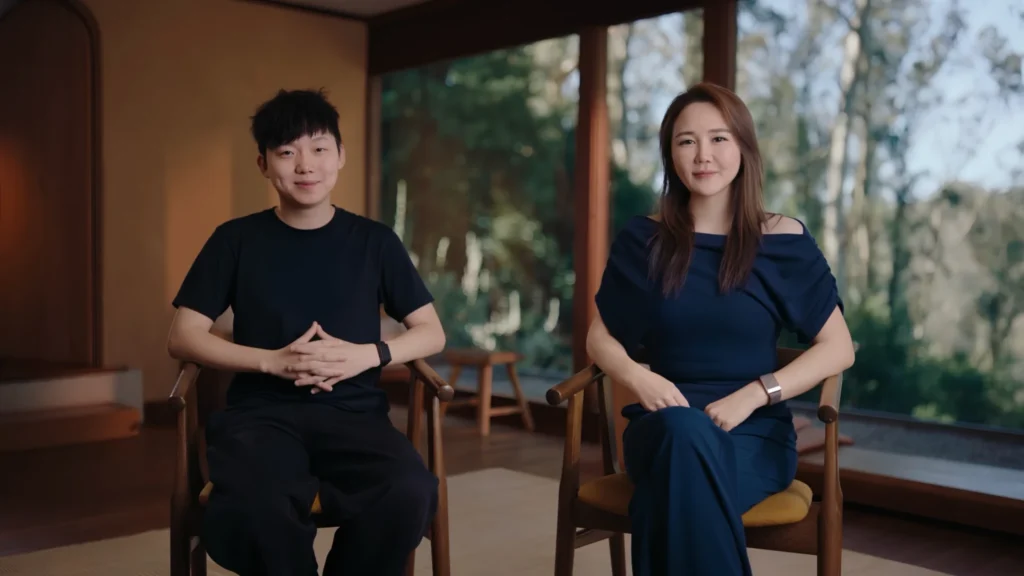
The funding positions Fish Audio as a serious competitor to platforms such as ElevenLabs, Cartesia, PlayAI, and Resemble AI. Its focus is on expressive speech, multilingual voice cloning, low-latency APIs, and AI voice tools for creators, developers, and enterprises.
This review covers how Fish Audio works, its features, pricing, use cases, limitations, and major competitors.
Quick verdict
In this review, we independently evaluated Fish Audio based on its voice quality, cloning capabilities, language support, expressive controls, pricing, developer tools, commercial-use terms, and how it compares with competing AI voice platforms.
Fish Audio is an AI speech platform for generating realistic voices, cloning existing voices, designing original voices, creating multi-speaker dialogue, and integrating speech generation into applications through an API.
Its main differentiators are expressive speech controls, multilingual voice cloning, multi-speaker generation, comparatively affordable API pricing, and an open-weight speech model called Fish Audio S2. The latest hosted model, S2.1 Pro, supports 83 languages and accepts natural-language instructions for emotions, pacing, delivery, and non-verbal sounds.
Fish Audio is particularly attractive to developers, video creators, game studios, audiobook producers, localization teams, and startups building conversational AI products. However, commercial-use terms on the free tier are not completely consistent across the company’s pricing page, API documentation, and legal terms. Businesses should verify their licensing rights before publishing commercial content generated through a free account.
Fish Audio at a glance
| Category | Details |
|---|---|
| Product type | AI text-to-speech, voice cloning and speech platform |
| Company | Operated by Hanabi AI Inc. |
| Latest hosted model | Fish Audio S2.1 Pro |
| Language support | 83 languages |
| Voice cloning requirement | Approximately 10 seconds for an instant clone |
| Professional cloning | 10 to 180 minutes of clean audio |
| Multi-speaker generation | Supported |
| Natural-language voice control | Supported through inline instructions |
| Open-weight model | Fish Audio S2 |
| API starting price | $15 per 1 million UTF-8 bytes |
| Best suited for | Creators, developers, localization, games, audiobooks and voice applications |
| Main alternatives | ElevenLabs, Cartesia, Resemble AI and PlayAI |
Fish Audio is operated by Hanabi AI Inc., according to its current terms of service. The company reported more than 8 million users, more than 2 million community voice models and approximately $21 million in annual recurring revenue when announcing its July 2026 funding round. These business metrics are company-reported rather than independently audited figures.
What is Fish Audio?
Fish Audio is a platform for creating synthetic speech from text. Users can choose an existing voice, clone a voice from a reference recording, or generate an original voice from a written description.
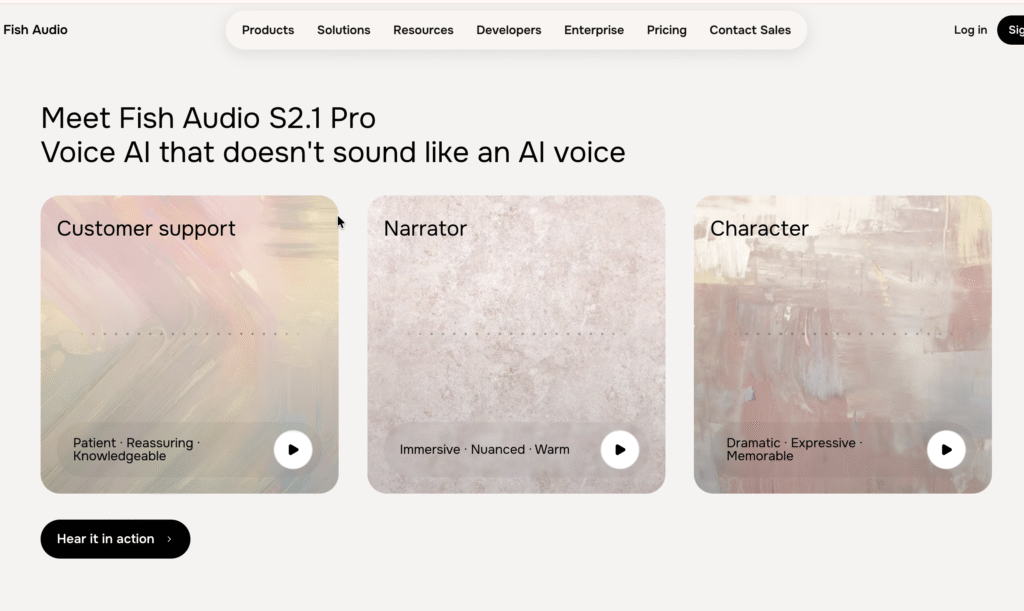
The platform includes:
- Text-to-speech generation
- Instant voice cloning
- Professional voice cloning
- Voice Design
- Multi-speaker conversations
- Speech-to-text
- Voice changing
- Audio translation
- Audio separation
- Sound-effect generation
- Developer APIs and SDKs
The product originated from Fish Speech, an open-source text-to-speech project. Fish Audio has since expanded into a commercial platform with hosted models, subscriptions, developer APIs and a large community voice library.
The hosted service and the open-source project should not be treated as identical. Fish Audio has released the weights, inference code and fine-tuning code for the S2 model, but that does not necessarily mean every hosted feature or future Fish Audio model is available under the same open-source terms.
How Fish Audio works
1. Select or create a voice
A user starts by choosing one of three voice sources:
- A public voice from the Fish Audio library
- A cloned voice created from reference audio
- An original synthetic voice created with Voice Design
An instant clone can be created with a reference recording of roughly 10 seconds. Longer and cleaner recordings generally give the model more information about the speaker’s pronunciation, tone and vocal characteristics. Fish Audio recommends approximately 10 to 30 seconds of reference audio for rapid cloning through its S2 system.
Professional voice cloning is a more involved process. It uses between 10 and 180 minutes of clean audio, normally requires one to two hours of training, and includes live ownership verification. Professional cloning is intended for higher-fidelity and more consistent production voices.
2. Add the script
The user enters the text that should be spoken.
Fish Audio supports ordinary narration as well as multi-speaker dialogue. Different speakers can be assigned within the same generation, making the system useful for conversations, fictional scenes, podcasts and game dialogue.
3. Add delivery instructions
Fish Audio S2 and S2.1 Pro accept inline natural-language controls. These controls can tell the model how a sentence should be delivered.
Examples include:
[whispers][laughs][speaks slowly][angry][super happy][sarcastic tone]
This is one of Fish Audio’s most important differentiators. Instead of adjusting only numerical controls such as stability, pitch or speed, users can describe the intended performance in language that resembles stage direction.
Fish Audio’s S2 technical report states that the system was designed for instruction-following speech generation, including multi-speaker and multi-turn speech. The company reported a 93.3 percent instruction-tag activation rate and an average quality score of 4.51 out of 5 on its own evaluation benchmark. These results were produced using a benchmark introduced by the Fish Audio researchers and should therefore be considered vendor-reported results.
4. Generate speech tokens
At a technical level, Fish Audio does not generate a waveform directly from each written character.
The model converts the text, speaker information and delivery instructions into discrete speech representations. It then predicts semantic and acoustic audio tokens before decoding those tokens into audible speech.
This approach resembles language-model generation, except the model is predicting representations of speech rather than only predicting written words. Reference-audio tokens provide information about the target speaker, while the text and instructions determine what should be said and how it should be delivered.
Fish Audio S2 uses an autoregressive architecture developed for instruction-following, multi-speaker and multi-turn generation. Its inference engine was designed for streaming and reported a real-time factor of 0.195 with time to first audio below 100 milliseconds in the S2 technical report.
5. Stream or export the audio
Generated audio can be streamed in real time or returned as an audio file.
The API supports formats including WAV, PCM, MP3 and Opus, with different sampling rates and bitrate options. Fish Audio recommends uploading reference audio before generation when possible, which can improve efficiency and reduce repeated processing.
The official JavaScript SDK supports both standard conversion and real-time generation through WebSockets. A Python SDK and an OpenAPI specification are also available.
Fish Audio S2.1 Pro
S2.1 Pro is Fish Audio’s current recommended production text-to-speech model.
According to Fish Audio, the model provides:
- Support for 83 languages
- Multi-speaker generation
- Natural-language emotion and performance controls
- Low-latency streaming
- Long-form speech generation
- Voice cloning
- Improved throughput compared with S2 Pro
Fish Audio reported that S2.1 Pro won 61 percent of internal head-to-head comparisons against S2 Pro. The company also reported approximately 70 milliseconds to first audio in certain single-request tests and around 90 milliseconds through its standard API. These are Fish Audio’s own performance measurements and may vary according to network conditions, input length, concurrency and selected settings.
The free S2.1 Pro developer endpoint uses the model identifier s2.1-pro-free. Fish Audio says the endpoint follows the same general API structure as its paid model, but the free service does not include an availability or latency guarantee. Requests submitted to the free endpoint may also be used to improve model quality.
Voice cloning
Fish Audio offers two levels of voice cloning.
Instant voice cloning
Instant cloning is intended for experimentation, creator content and rapid production.
A user uploads a short recording, after which Fish Audio creates a reusable voice model. The platform promotes cloning from approximately 10 seconds of audio, although recording quality can have a major effect on the output.
For better results, the reference should contain:
- One clear speaker
- Minimal background noise
- No music
- Natural pacing
- Consistent microphone distance
- A useful range of sounds and sentence structures
Instant cloning is useful when speed matters more than maximum consistency.
Professional voice cloning
Professional cloning uses significantly more training audio and includes voice ownership verification.
Fish Audio currently asks for approximately 10 to 180 minutes of clean audio. Training usually takes one to two hours. Access depends on the number of professional voice slots included in the user’s subscription.
One important limitation is that completed professional clones currently cannot be deleted through the normal product workflow. Fish Audio states that these models remain permanent while it develops the commercial release and revenue-sharing system for professional voices. Users should understand this limitation before submitting sensitive or valuable voice recordings.
Voice Design
Voice Design creates a new synthetic voice from a text description instead of copying an existing speaker.
A prompt might describe:
- Approximate age
- Gender presentation
- Accent
- Vocal texture
- Energy
- Speaking pace
- Personality
- Emotional tone
For example:
A confident female technology presenter in her early thirties, with a neutral Indian English accent, clear pronunciation, moderate pacing and a warm but authoritative tone.
Fish Audio generates two voice samples for comparison. According to the company, the process normally takes around 15 seconds. Standard pricing is listed as 2,000 credits per successful generation, although the feature has been offered free during its launch period.
Voice Design is valuable for brands and fictional characters because it reduces the legal and ethical risks associated with imitating a real person.
Best Fish Audio use cases
YouTube narration
Fish Audio can generate narration for explainers, product reviews, documentaries, tutorials and faceless YouTube channels.
Its emotion instructions are particularly useful when a script needs variation between explanatory, energetic and serious sections. Creators can also maintain a consistent channel voice by saving a cloned or designed voice.
Human review remains important. Names, technical terms, abbreviations and unusual spellings may need phonetic adjustments.
Podcasts and fictional conversations
Multi-speaker generation makes Fish Audio suitable for scripted podcasts, interviews and fictional audio scenes.
Each speaker can have a separate identity, while inline instructions can produce laughter, hesitation, whispering or emotional reactions. This can sound more natural than generating every line separately and manually assembling the conversation.
Audiobooks and storytelling
Fish Audio can generate long-form narration and character dialogue.
A narrator voice can be combined with different character voices, while delivery instructions help distinguish suspenseful, emotional and conversational passages.
For commercial audiobooks, publishers should confirm that they possess the necessary rights to every cloned voice and that their Fish Audio plan permits commercial use.
Video localization and dubbing
Fish Audio can reproduce a voice across supported languages, making it useful for translating:
- Product demonstrations
- Educational videos
- Marketing videos
- Online courses
- Creator content
- Internal training material
The quality of translated speech still depends on the quality of the translated script. A literal translation may sound unnatural even when the voice model is realistic.
Conversational AI and voice agents
Fish Audio’s streaming API and low time-to-first-audio make it relevant to customer-support agents, sales assistants, virtual receptionists and interactive characters.
The company specifically positions S2.1 Pro for real-time applications and provides WebSocket support through its SDK.
A complete voice-agent system still requires additional components, including speech recognition, interruption handling, turn detection, an LLM, tool execution, memory and telephony infrastructure.
Games and interactive characters
Game developers can use Voice Design to create distinct character identities without cloning actors during early development.
Natural-language instructions make it possible to vary a character’s delivery based on game state. The same character might sound tired, frightened, confident or sarcastic while retaining a consistent underlying voice.
Production use involving professional voice actors should include explicit contractual permission.
E-learning and accessibility
Fish Audio can convert lessons, documents and interface content into speech.
Potential applications include:
- Course narration
- Language-learning exercises
- Reading assistance
- Accessible product interfaces
- Internal employee training
- Personalized educational content
Organizations working with children, healthcare information or regulated content should add human review and appropriate disclosure.
Prototyping branded voices
Companies can use Voice Design or professional cloning to test a recognizable audio identity for advertisements, applications and customer interactions.
A designed voice is generally safer than cloning an employee or public figure because it can be created without imitating a real person.
Fish Audio pricing
Fish Audio offers creator subscriptions and separate usage-based API pricing.
The following prices were displayed on the official pricing page at the time of this review. Fish Audio was running an anniversary promotion, so prices may change after August 31, 2026.
| Plan | Price displayed in July 2026 | Monthly allowance | Key limits |
|---|---|---|---|
| Free | $0 | 8,000 credits, approximately 7 minutes | 500 characters per generation, 3 public voice slots |
| Plus | $5.50 per month with annual billing during promotion | 250,000 credits, approximately 200 minutes | 15,000 characters, 10 private voice slots, 1 professional clone |
| Pro | $37.50 per month with annual billing during promotion | 2 million credits, approximately 1,620 minutes | 30,000 characters, 3 seats, 5 professional clones |
| Max | $749 per month with annual billing during promotion | 25 million credits, approximately 6,250 minutes | 10 seats, 15 professional clones |
| Enterprise | Custom | Custom | On-premises deployment, organization controls and zero data retention options |
API pricing
Fish Audio’s developer API uses pay-as-you-go pricing without a required monthly subscription.
| API model or service | Price |
|---|---|
| S2.1 Pro | $15 per 1 million UTF-8 bytes |
| S2.1 Pro Free | Free during the promotional access period |
| S2 Pro | $15 per 1 million UTF-8 bytes |
| S1 | $15 per 1 million UTF-8 bytes |
| Speech recognition | $0.36 per audio hour |
| Voice Design | $0.01 per successful request |
Fish Audio estimates that 1 million UTF-8 bytes represents approximately 180,000 English words or around 12 hours of generated English speech. Under that estimate, the TTS price is approximately $1.25 per generated hour. Other languages can consume a different number of bytes, so the effective cost may vary.
Important commercial-use warning
The Fish Audio pricing page and legal terms currently provide conflicting signals about the free tier.
The pricing page displays “commercial use” among the free-plan features. However, Fish Audio’s current Terms of Service state that users who do not pay for the service may use generated output only for internal, personal and non-commercial purposes. Paid users are explicitly granted commercial usage rights, subject to the terms.
The free S2.1 Pro API documentation also says that some commercial use cases are restricted and asks products exceeding $1 million in annual recurring revenue to contact Fish Audio.
Because legal terms normally take priority over marketing-page language, businesses should treat free-tier output as non-commercial unless Fish Audio provides written confirmation for their use case. A paid subscription is the safer choice for monetized videos, client work, advertisements, paid applications and commercial products.
Fish Audio API and developer experience
Fish Audio provides a REST API, WebSocket streaming, JavaScript SDK, Python SDK and OpenAPI specification.
Core API operations include:
- Creating a voice model
- Uploading reference audio
- Generating speech
- Streaming speech
- Designing a synthetic voice
- Transcribing audio
- Managing models
The main text-to-speech endpoint accepts JSON or MessagePack input. Generated speech can be returned in common audio formats such as MP3, WAV, PCM and Opus.
Fish Audio also publishes machine-readable API documentation and an llms.txt resource. This makes the documentation easier for coding assistants and AI retrieval systems to interpret. The SDK documentation includes support for distributed tracing through the W3C traceparent standard, which can help developers debug speech requests across larger applications.
How good is Fish Audio?
Fish Audio’s strongest qualities are expression, controllability and voice consistency.
The S2 technical report reported:
- Time to first audio below 100 milliseconds
- Real-time factor of 0.195
- Instruction-tag activation of 93.3 percent
- Average instruction quality score of 4.51 out of 5
- Word error rate of 0.99 percent for English
- Word error rate of 0.54 percent for Chinese
These results come from the Fish Audio research team’s own evaluations. They are useful technical evidence but should not be treated as a completely independent product comparison.
Artificial Analysis, an independent AI model benchmarking platform, ranked Fish Audio S2 Pro as the highest-rated open-weight model on one of its text-to-speech leaderboards, with an Elo score of 1,123 among 92 evaluated models at the time checked.
However, Fish Audio does not lead every benchmark or every evaluation category. S2.1 Pro appeared lower on Artificial Analysis’s controlled-voice leaderboard at the time reviewed. This suggests that Fish Audio is highly competitive, especially among open-weight systems, but it should not be described as universally superior to every commercial voice model.
Fish Audio strengths
Expressive speech control
Natural-language delivery instructions make Fish Audio easier to direct than systems that rely entirely on sliders and numerical parameters.
Fast voice cloning
A usable experimental clone can be created from a short recording, making rapid iteration practical.
Multi-speaker generation
Native multi-speaker support is valuable for podcasts, games and scripted conversations.
Broad language support
S2.1 Pro supports 83 languages, making it useful for international content and localization.
Open-weight foundation
The release of S2 model weights, fine-tuning code and an SGLang-based inference engine gives advanced teams more control than a hosted-only platform.
Competitive API pricing
At $15 per 1 million UTF-8 bytes, Fish Audio can be economical for high-volume English narration, although comparisons with character-based competitors require care because the billing units differ.
Good developer infrastructure
REST APIs, streaming, official SDKs, an OpenAPI schema and machine-readable documentation make integration relatively accessible.
Fish Audio limitations
Inconsistent free-tier licensing language
The pricing page and legal terms do not clearly agree about commercial usage rights for free users.
No default zero-data-retention promise
Fish Audio’s privacy policy says content may be retained as necessary and may be used to improve the service. Zero data retention is listed as an enterprise feature rather than a default setting.
Free API requests may be used for model improvement
This may make the free endpoint unsuitable for confidential scripts, unreleased media or sensitive customer conversations.
Professional clones cannot currently be deleted
This is a significant consideration when submitting a valuable or sensitive voice model.
Quality still depends on the input
Poor reference recordings, awkward scripts, incorrect translations and unsupported pronunciations can reduce output quality.
Fast-moving plans and product terms
Fish Audio is changing quickly. Promotional pricing, model availability, commercial restrictions and feature limits may change after this review’s publication date.
Fish Audio versus competitors
| Platform | Best suited for | Major strength | Main consideration |
|---|---|---|---|
| Fish Audio | Expressive narration, cloning, localization and developer applications | Natural-language emotion control, open-weight S2 and competitive API cost | Licensing and data-handling details require careful review |
| ElevenLabs | Creators and businesses wanting a polished end-to-end platform | Mature creator tools, voice library, dubbing and agent ecosystem | API pricing can be higher, depending on model and usage |
| Cartesia | Real-time conversational AI | Low-latency Sonic models and agent-oriented infrastructure | Smaller creator ecosystem than ElevenLabs |
| Resemble AI | Security-sensitive and enterprise deployments | On-premises options, watermarking and voice governance | Some cloning and enterprise features require higher plans |
| PlayAI | Voice agents and conversational applications | Agent integrations and latency-focused Dialog models | Less transparent public pricing information |
Fish Audio versus ElevenLabs
ElevenLabs is Fish Audio’s most direct competitor.
ElevenLabs offers a broader and more mature collection of creator workflows, dubbing tools, voice libraries and conversational-agent products. Its Eleven v3 model supports more than 70 languages and multi-speaker dialogue, while Flash v2.5 is designed for low latency of approximately 75 milliseconds.
ElevenLabs lists API pricing of approximately $0.05 per 1,000 characters for Flash and Turbo models and $0.10 per 1,000 characters for models such as Multilingual v2 and Eleven v3. Its Starter subscription costs $6 per month and includes a commercial license and instant voice cloning.
Choose Fish Audio when natural-language performance control, open-weight deployment options or lower usage-based pricing are priorities.
Choose ElevenLabs when workflow polish, creator tools, enterprise maturity and a broader voice-product ecosystem matter more.
Fish Audio versus Cartesia
Cartesia is particularly strong for real-time voice agents.
Its Sonic models focus on low-latency speech generation, and Cartesia supports voice cloning from approximately 10 seconds of audio. Sonic supports 42 languages while attempting to preserve the speaker’s identity and emotional qualities across languages.
Cartesia’s Pro plan starts at $5 per month and includes 100,000 credits, commercial rights and instant voice cloning.
Choose Fish Audio for expressive content, storytelling, multilingual generation and open-weight experimentation.
Choose Cartesia for highly interactive agents where latency and conversational infrastructure are the primary requirements.
Fish Audio versus Resemble AI
Resemble AI places greater emphasis on enterprise security, voice authentication and deployment control.
Its Chatterbox system supports rapid cloning from short recordings, professional cloning, voice design, watermarking and on-premises deployment. Resemble also promotes security tools intended to identify or protect synthetic speech.
Choose Fish Audio for content production, expression and developer value.
Choose Resemble AI when watermarking, governance, private deployment and security controls are central purchasing criteria.
Privacy, consent and responsible use
Fish Audio prohibits users from cloning or using another person’s voice without the necessary rights or authorization.
The platform provides an ownership-dispute process that includes live voice verification and human review. A person who believes their voice has been copied can submit a dispute concerning a public model.
Fish Audio’s terms also prohibit misleading people into believing synthetic content was produced entirely by a human. The company encourages disclosure when content is AI-generated.
Users should obtain written consent before cloning:
- Employees
- Voice actors
- Customers
- Influencers
- Public figures
- Friends or family members
- Any person whose voice can be identified
Consent should explain where the voice will be used, whether it can be used commercially, how long it will be stored and whether the voice model can be transferred to other people or systems.
Latest Fish Audio news
March 9, 2026: Fish Audio S2 released as an open-weight model
Fish Audio published the S2 technical report and released model weights, fine-tuning code and an SGLang-based inference engine. S2 introduced natural-language instructions, multi-speaker generation and multi-turn speech capabilities.
June 2026: Voice Design and professional cloning expanded
Fish Audio introduced Voice Design for creating original voices from written descriptions. It also expanded professional voice cloning with longer training samples and live ownership verification.
June 23, 2026: S2.1 Pro free API access announced
Fish Audio opened temporary free API access to S2.1 Pro. The promotion was later extended through August 31, 2026. The free endpoint does not include a service-level agreement, and submitted requests may be used for model improvement.
July 2026: Voice ownership dispute system introduced
The company introduced a formal process for disputing unauthorized public voice models, including live voice verification and manual review.
July 28, 2026: Fish Audio announced a $52 million seed round
Fish Audio announced $52 million in seed funding led by Coreline Ventures and Capital Today.
The company said it had reached more than 8 million users, more than 2 million community voice models and approximately $21 million in annual recurring revenue with a team of 22 people. The funding is intended to support model development, developer tooling, speech-to-speech technology and an Audio Understanding Language Model.
Is Fish Audio worth using?
Fish Audio is worth considering for teams that need expressive, multilingual and controllable speech generation without committing immediately to the highest-priced voice AI platforms.
It is especially compelling for:
- Developers building speech-enabled products
- Creators generating frequent narration
- Game studios prototyping character voices
- Localization teams
- Audiobook and fiction producers
- Researchers interested in open-weight TTS
- Startups that need affordable API access
It is less suitable when:
- Zero data retention is required without an enterprise agreement
- The voice recordings are highly confidential
- Commercial licensing must be completely unambiguous on a free plan
- A company needs an established enterprise governance program
- A user plans to submit a professional clone but may later need it deleted
Final verdict
Fish Audio has developed into one of the most important challengers in the AI voice market.
Its combination of expressive natural-language control, multilingual support, rapid voice cloning, multi-speaker speech, open-weight technology and relatively affordable API access gives it a strong position among both creators and developers.
The product is not without risk. Free-tier commercial rights need clarification, free API data may be used for model improvement, and professional voice models currently have deletion limitations. Buyers should evaluate these issues before using Fish Audio for confidential, regulated or high-value voice assets.
For experimentation, content production and developer prototypes, Fish Audio offers exceptional value. For sensitive enterprise deployments, it should be used only after reviewing data retention, voice ownership, licensing and contractual protections.
Frequently asked questions
Is Fish Audio free?
Yes. Fish Audio offers a free creator plan with 8,000 monthly credits. It has also made S2.1 Pro temporarily free through its developer API until August 31, 2026. Free API access does not include an SLA or latency guarantee.
Can Fish Audio be used commercially?
Paid Fish Audio plans explicitly include commercial usage rights. The current legal terms restrict unpaid users to internal, personal and non-commercial use, despite the pricing page displaying commercial use for the free plan. Commercial users should select a paid plan or obtain written clarification from Fish Audio.
Is Fish Audio open source?
Fish Audio has released the weights, fine-tuning code and inference engine for Fish Audio S2. The complete hosted platform and every current model should not automatically be assumed to use the same open-source license.
How much audio is needed to clone a voice?
An instant clone can be created from approximately 10 seconds of reference audio. Professional cloning uses approximately 10 to 180 minutes of clean audio.
How many languages does Fish Audio support?
The current S2.1 Pro model supports 83 languages.
Does Fish Audio support multiple speakers?
Yes. Fish Audio S2 and S2.1 Pro support multi-speaker generation, allowing several voices to appear within one dialogue or audio scene.
Can Fish Audio generate emotions?
Yes. Users can insert natural-language directions such as [whispers], [laughs] or [angry] into a script. The model uses these instructions to change the performance.
Can Fish Audio be used for real-time voice agents?
Yes. Fish Audio provides streaming APIs and WebSocket support. S2.1 Pro is designed for low-latency generation, although real-world response time depends on the full agent architecture and network conditions.
Does Fish Audio use submitted data for training?
Fish Audio’s terms and privacy policy permit certain content and usage data to be used to develop or improve its services. The free S2.1 Pro API documentation specifically says requests may be used to improve model quality. Enterprise plans advertise zero data retention as an available feature.
What is the best Fish Audio alternative?
ElevenLabs is the strongest general alternative for creators and companies wanting a mature end-to-end voice platform. Cartesia is a strong alternative for low-latency conversational agents, while Resemble AI is better suited to security-sensitive and on-premises deployments.
Is Fish Audio better than ElevenLabs?
Fish Audio can be the better choice for expressive controls, open-weight experimentation and cost-conscious API usage. ElevenLabs can be the better choice for workflow maturity, creator tools, dubbing and its broader commercial ecosystem. The best option depends on the voice, language, latency and production workflow required.
Review methodology
This is a research-based product review rather than a controlled listening test.
The review was prepared using:
- Fish Audio’s official product pages
- Current pricing and legal terms
- Fish Audio developer documentation
- Fish Audio’s GitHub documentation
- The Fish Audio S2 technical paper
- Independent Artificial Analysis leaderboard data
- Official competitor pricing and documentation
- User-generated content, including public voice samples, creator demonstrations, community discussions, and customer feedback
We also reviewed user-generated audio examples to understand how Fish Audio performs in practical use cases such as narration, voice cloning, multilingual speech, and expressive dialogue. UGC findings were used as qualitative evidence and were cross-checked against official documentation where possible.
Vendor-provided benchmark results have been clearly identified as vendor-reported. No numeric audio-quality rating has been assigned because we did not conduct a fully controlled, reproducible, side-by-side listening test across all competing platforms.


