

AI startup Instinct has raised $1 billion in Series C funding at a $10 billion valuation, just one month after announcing a previous funding round that valued the company at $2.5 billion. The latest investment includes Sequoia Capital, Benchmark Capital, and Coatue.
Founded by Noah Shinn, Instinct is developing a personal AI agent that can handle everyday tasks, from booking restaurant reservations to making purchases and managing subscriptions. The company's rapid fundraising comes as investors show growing interest in AI assistants that can take action rather than simply answer questions.
However, Instinct is entering an increasingly competitive market. Established technology companies are developing similar assistants, while questions about privacy and the practical reliability of autonomous AI agents remain unresolved.
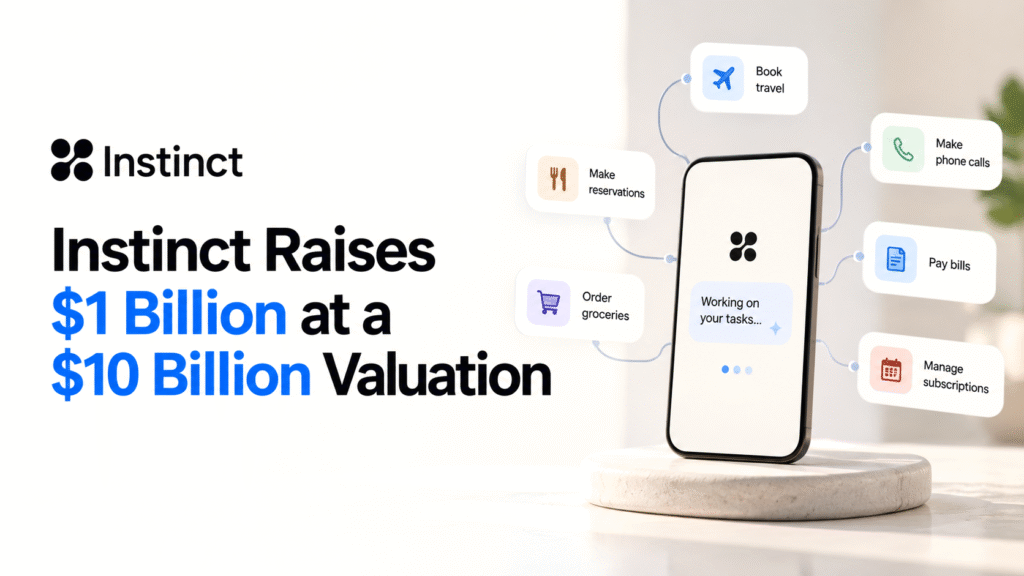
Table of Contents
Instinct Raises $1 Billion in Series C Funding
Instinct announced its $1 billion Series C funding round on September 28, 2026. The investment brings the company's valuation to $10 billion, up from $2.5 billion following its previous $350 million funding announcement in August.
Sequoia Capital, Benchmark Capital, and Coatue participated in the latest round. The rapid increase in valuation is notable given that Instinct launched its invite-only service in August 2026.
The fundraising reflects investor interest in a new category of consumer AI products. Rather than focusing exclusively on generating text or answering questions, these products aim to complete tasks on behalf of users.
Instinct has attracted attention with its approach to personal AI, but the company has not publicly disclosed detailed user numbers or revenue figures alongside its latest funding announcement.
What Does Instinct's AI Agent Do?
Instinct is developing an AI assistant designed to handle everyday activities that usually require users to switch between applications, websites, and phone calls.
Users interact with the assistant through text messages. When given a task, Instinct uses its own phone number and computer to carry it out. This allows it to handle activities that go beyond conventional chatbot conversations.
Its capabilities include booking travel and restaurant reservations, making purchases, paying bills, cancelling subscriptions, conducting research, and ordering groceries.
One of its newer features, Concierge, allows the AI agent to make phone calls on behalf of users. This can be useful for arranging appointments with businesses that do not offer online booking.
Instinct has also introduced a Trusted Person Network. It allows one user's AI agent to coordinate plans with the agents of other users. For example, people arranging a group outing could use their assistants to coordinate plans.
These capabilities reflect Instinct's focus on making AI useful for routine personal activities. Instead of providing instructions for completing a task, the assistant is designed to perform the task itself.
Privacy Concerns Surround Instinct's Personal AI
An AI assistant that can make purchases, arrange appointments, and manage personal activities needs access to sensitive information. This creates privacy and security concerns that are less significant with a chatbot that only generates answers.
Instinct faced criticism over its initial privacy policy, which raised questions about the amount of personal information users might need to disclose. The company has since updated the policy.
However, privacy remains an important consideration for personal AI agents. Users need to understand what information an assistant collects, how it is stored, and which actions it can perform on their behalf.
The ability to make purchases or communicate with other people also makes appropriate permissions and user oversight important. As these assistants take on more responsibilities, maintaining user trust will be an important challenge for companies developing them.
Instinct Faces Competition From Meta's Muse
Instinct is not the only company developing an AI assistant capable of performing everyday tasks. Meta's Muse offers several similar capabilities and has an advantage through its integration with the company's existing social platforms.
Muse can monitor and summarize Instagram direct messages and Facebook Groups, track Marketplace listings, and perform other tasks connected to Meta's services. These integrations give it access to activities that are already part of many users' daily routines.
Meta's assistant has also reached millions of downloads and risen to the top of U.S. app stores. Instinct, in contrast, currently relies on SMS and text messaging and does not have a dedicated mobile application.
The two companies are taking different approaches to personal AI. Instinct is building an assistant that can operate through its own phone number and computer, while Meta is incorporating AI into its existing ecosystem of social applications.
For Instinct, competing with companies that already have established consumer platforms could be a significant challenge. Its ability to offer useful features and build user trust will matter as the market develops.
What Does the Funding Mean for Instinct?
The $1 billion investment gives Instinct additional capital to expand its service and continue developing its personal AI technology. Founder Noah Shinn said the funding would help the company bring Instinct to more people and continue building its vision for personal AI.
The investment also highlights the level of investor interest in AI agents that can perform actions in the real world. Companies are exploring ways to move beyond conversational AI and develop assistants that can manage more complex tasks.
However, a high valuation and substantial funding do not necessarily translate into a sustainable business. Instinct has not disclosed detailed revenue figures or user growth metrics, making it difficult to assess its commercial performance independently.
The company will need to demonstrate that users find its assistant useful enough to adopt regularly. It will also need to address the costs of operating its service, maintain reliable task execution, and establish appropriate privacy protections.
These challenges are relevant to the broader personal AI market. An assistant that can book a restaurant or make a purchase must do more than generate a convincing response. It needs to complete the requested task correctly and handle situations where it cannot.
What's Next for Instinct?
Instinct's immediate focus is on expanding access to its personal AI assistant and continuing product development. Its latest funding round provides significant financial resources for that work, although the company has not announced a detailed expansion roadmap.
Competition from Meta's Muse and other AI assistants will make product differentiation increasingly important. Instinct's ability to coordinate everyday tasks through messaging and its own computer-based operations is central to its current approach.
At the same time, the company will need to demonstrate that its assistant can handle personal tasks reliably and securely. Users may be willing to delegate routine activities to AI, but mistakes involving purchases, appointments, or personal information could undermine that trust.
Instinct's next stage will therefore involve more than expanding its user base. The company will need to show that its product can deliver consistent value as it moves beyond its initial invite-only launch.
FAQs
How much funding has Instinct raised?
Instinct announced a $1 billion Series C funding round on September 28, 2026. This followed a $350 million funding announcement in August 2026.
What is Instinct's current valuation?
Instinct is valued at $10 billion following its latest Series C funding round. Its previous announced valuation was $2.5 billion in August 2026.
Who invested in Instinct's Series C round?
Sequoia Capital, Benchmark Capital, and Coatue participated in Instinct's $1 billion Series C funding round.
What does Instinct's AI assistant do?
Instinct is a personal AI agent designed to complete everyday tasks, including booking reservations, making purchases, ordering groceries, managing subscriptions, and making phone calls.
Who founded Instinct?
Instinct was founded by Noah Shinn. The company launched its invite-only AI assistant service in August 2026.
Does Instinct have a mobile app?
As of September 2026, Instinct communicates with users primarily through SMS and text messaging and does not have a dedicated mobile app.
Conclusion
Instinct's $1 billion Series C funding round marks a significant development for the personal AI agent market. Its valuation has increased from $2.5 billion to $10 billion in just one month, attracting investment from major venture capital firms.
The company's approach focuses on an AI assistant that can perform everyday tasks rather than simply respond to questions. However, competition from Meta's Muse, privacy concerns, and the challenge of achieving reliable task execution will influence its future.
The latest funding gives Instinct resources to expand, but its long-term success will depend on whether it can turn investor interest into sustained user adoption and a viable business.
Related Reading
Want to learn more about AI agents and their role in business? Explore our guides on building AI agents for business operations and understanding how AI agents work.


