

Prompt injection has become a practical security problem for teams deploying AI applications, RAG systems, copilots, and autonomous agents. An attacker does not always need to break the model itself. A malicious instruction hidden in a user prompt, document, webpage, email, tool response, or other external content can influence what the AI system does.
That changes the security requirement. A simple keyword filter may catch obvious attacks, but modern AI applications need controls that can inspect context, identify suspicious behavior, protect sensitive data, and enforce policies at runtime. This is where prompt injection detection tools and LLM firewalls fit.
This guide compares 10 tools based on prompt attack detection, runtime enforcement, agent and tool protection, deployment options, security coverage, pricing, and practical enterprise use. The list also distinguishes dedicated prompt protection products from broader AI security platforms, developer guardrail frameworks, and AI security testing tools.
What Is Prompt Injection Detection?
Prompt injection detection is the process of identifying instructions or content that attempt to manipulate an AI application's intended behavior. A direct attack can come from a user deliberately changing the instructions given to an LLM. An indirect attack can be hidden inside a webpage, document, email, retrieved database content, or another source that an AI system processes.
The risk goes beyond unwanted text generation. If an AI application has access to sensitive information, external tools, APIs, or business workflows, a successful injection can potentially influence data access or actions. The 2025 OWASP Top 10 for LLM Applications classifies Prompt Injection as LLM01 and specifically identifies direct and indirect injection as separate attack forms. OWASP's prompt injection guidance also recommends layered controls such as input and output filtering, least privilege, external-content separation, and adversarial testing.
Detection is not the same as prevention. A tool can identify a suspicious prompt, but the security architecture also needs to decide what happens next. Depending on the product, that may mean blocking the request, generating an alert, sanitizing the content, redacting sensitive information, or allowing the interaction to continue under a defined policy.
What Is an LLM Firewall?
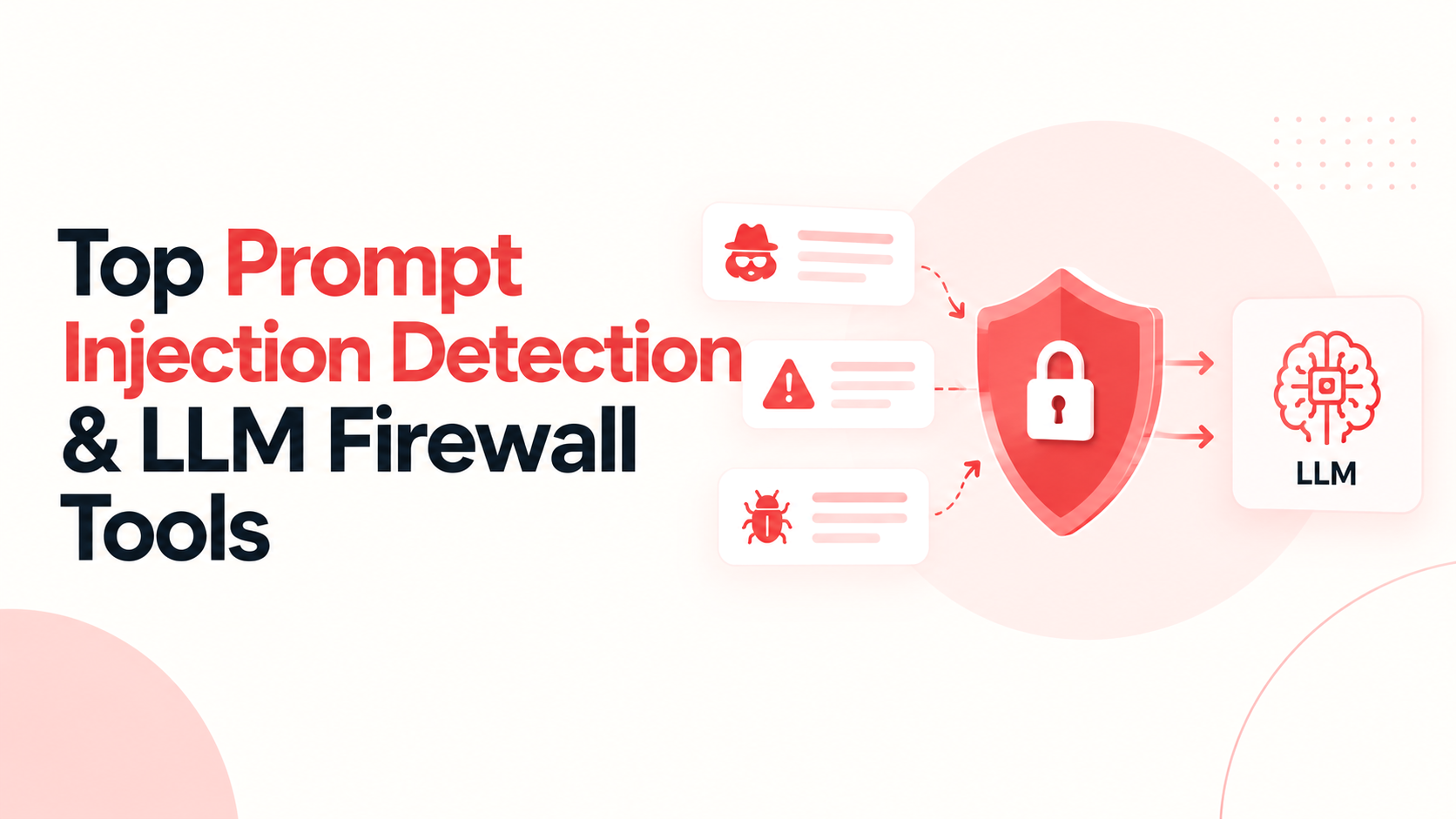
An LLM firewall is a security layer placed around AI interactions. It can inspect prompts, model responses, retrieved content, tool calls, or other AI traffic and apply security policies before information reaches the model or application.
The enforcement point can vary. Some products operate through an AI gateway or reverse proxy, while others provide APIs, SDKs, application integrations, or runtime agents. For agentic systems, the security layer may also need to inspect tool calls and responses because the risk is no longer limited to what the model says.
Not every product in this category is technically an LLM firewall. Some tools focus on security testing, some provide application-level guardrails, and others cover the wider AI security lifecycle. This comparison keeps those differences visible instead of treating every product as interchangeable.
How We Selected These Prompt Injection Detection & LLM Firewall Tools
Prompt attack coverage: We looked at documented support for direct prompt injection, indirect injection, jailbreaks, obfuscation, malicious external content, and related AI-specific threats.
Runtime enforcement: Detection is more useful when a product can apply an action. We considered capabilities such as blocking, alerting, sanitization, redaction, policy enforcement, and runtime inspection.
Agent and tool protection: Modern AI systems increasingly connect models to APIs, databases, MCP servers, and business tools. Products with documented coverage beyond simple chat interactions were evaluated accordingly.
Deployment: We considered gateways, APIs, SDKs, application integrations, cloud deployments, and other documented implementation patterns.
Product scope: The list includes dedicated prompt security products as well as broader AI security platforms and developer frameworks where prompt injection protection is a meaningful part of the product.
Pricing and practical fit: Pricing structures, published plans, open-source availability, and enterprise sales models were considered. Enterprise pricing changes frequently, so buyers should verify current commercial terms before purchasing.
Prompt Injection Detection & LLM Firewall Tools at a Glance
| Platform | Best For | Key Limitation |
|---|---|---|
| Lakera | Runtime prompt and AI application protection | Enterprise-focused product and pricing |
| Prompt Security | AI gateway and enterprise AI usage security | Primarily aimed at enterprise deployments |
| Mindgard | AI security testing and adversarial validation | More focused on testing than a standalone inline firewall |
| Lasso Security | Real-time prompt injection protection | Enterprise-oriented deployment model |
| Prisma AIRS | Enterprise AI runtime security | Broader platform may be more than a team needs for prompt filtering alone |
| Rebuff | Open-source prompt injection experimentation | Repository is archived and the project describes itself as a prototype |
| Guardrails AI | Developer guardrails and AI validation | Broader guardrail framework rather than a dedicated enterprise firewall |
| Cisco AI Defense | Enterprise AI runtime and agent protection | Broader enterprise AI security scope |
| HiddenLayer | AI runtime and agent security | Designed for broader runtime security requirements |
| Fiddler | AI observability with real-time guardrails | Security capabilities are part of a broader observability platform |
Here Are 10 Prompt Injection Detection & LLM Firewall Tools for 2026
1. Lakera
Lakera is focused on protecting AI applications and agents from runtime threats, with prompt defense forming a central part of its product. Its current documentation covers direct and indirect prompt attacks, jailbreaks, data leakage, and other AI-specific risks. Lakera was acquired by Check Point in October 2025, so it now sits within Check Point's broader AI security strategy.
The platform is particularly relevant for teams that need protection around live AI interactions rather than relying only on model-level safety features. Check Point's current AI Guardrails documentation describes detection and enforcement modes, including the ability to monitor attacks or apply blocking and warning actions.
Best for: Enterprise teams looking for runtime protection against prompt attacks, data leakage, and related AI application risks.
Pricing: Enterprise pricing is handled through sales.
Key limitation: Lakera is positioned primarily for organizations with production AI security requirements, so smaller teams looking only for a lightweight developer library may need a simpler option.
2. Prompt Security
Prompt Security focuses on securing enterprise AI usage through visibility, policy enforcement, and runtime protection. Its AI Gateway provides a centralized layer between applications or users and the AI services they access, allowing organizations to inspect and control AI traffic without rebuilding security controls independently in every application.
Prompt Security is now part of SentinelOne's AI security strategy. Its current product direction extends beyond conventional chatbot protection into agentic AI, MCP usage, policy enforcement, and runtime controls. SentinelOne has also announced an integration between Prompt Security and Amazon Bedrock AgentCore that uses Prompt Security detection signals for prompt injection, data exposure, tool-use validation, and response monitoring.
Best for: Security teams that want centralized AI governance, gateway-based protection, and runtime controls across enterprise AI usage.
3. Mindgard
Mindgard approaches prompt injection from the testing and adversarial security side. Rather than treating a security filter as the entire defense, its platform focuses on finding vulnerabilities through automated security testing, red teaming, and continuous validation.
This distinction matters because a runtime control can only enforce the policies it has been configured to enforce. Security teams also need to understand whether their AI application can be manipulated in the first place. Mindgard's current research recommends layered defense involving detection, mitigation, least privilege, and adversarial testing rather than relying on prompts alone.
Best for: AppSec and AI security teams that want to test prompt injection defenses and validate AI systems before or during deployment.
Pricing: Enterprise pricing is available through sales.
Key limitation: Mindgard is more naturally positioned as an AI security testing and validation platform than as a simple inline LLM firewall.
4. Lasso Security
Lasso Security provides real-time prompt injection protection across AI agents, chatbots, and LLM applications. Its current product uses an intent-based approach designed to identify attacks that may be difficult to catch with traditional keyword or pattern matching.
The platform also addresses indirect attacks hidden in external content. Its documentation describes protection for documents, websites, emails, and API responses that AI systems may process. Deployment options include gateway, SDK, and API approaches, which gives security teams several ways to introduce protection into existing applications.
Best for: Teams that need dedicated real-time prompt injection detection across applications and agentic workflows.
Pricing: Contact sales.
Key limitation: Lasso is primarily positioned for enterprise security deployments, making its commercial model less transparent for smaller development teams.
5. Prisma AIRS (formerly Protect AI)
Prisma AIRS is the current home for technology that was previously associated with Protect AI. Palo Alto Networks completed its acquisition of Protect AI in July 2025, and Prisma AIRS now provides a broader AI security platform covering AI applications, models, data, agents, runtime security, and red teaming.
Its AI Runtime Security component is particularly relevant to this comparison. Palo Alto Networks describes it as a runtime security layer that monitors AI traffic and can detect and block threats such as prompt injection, malicious content, and sensitive data leakage. Prisma AIRS also includes an AI Runtime API and AI Runtime Firewall for different deployment patterns.
Best for: Enterprises that want prompt injection protection as part of a broader AI security and runtime security platform.
Pricing: Contact sales.
Key limitation: Prisma AIRS covers a much wider AI security lifecycle than prompt injection alone, which can add complexity for teams looking for a narrowly focused control.
6. Rebuff
Rebuff takes a very different approach from the enterprise products in this list. It is an open-source prompt injection detector that combines several detection layers, including heuristics, LLM-based detection, vector similarity, and canary tokens.
That makes it useful for developers who want to understand how multiple prompt injection defenses can work together or experiment with application-level protection. However, its current status needs to be understood before using it in a production security architecture. The GitHub repository was archived in May 2025, and the project explicitly describes itself as a prototype rather than a complete solution.
Best for: Developers and security researchers experimenting with open-source prompt injection detection.
Pricing: Open source.
Key limitation: The project is archived and should not be treated as an actively maintained enterprise security platform.
7. Guardrails AI
Guardrails AI provides a developer-oriented framework for adding validation and policy controls around AI applications. Its ecosystem includes validators for different types of input and output risks, including jailbreak detection, PII detection, and prompt injection.
The platform is broader than a dedicated LLM firewall. Developers can use validators to check model inputs and outputs and build application-specific guardrail logic around the model. This makes it useful when security and reliability requirements need to be embedded directly into the application rather than handled entirely through an external gateway.
Best for: AI engineering teams that want programmable guardrails and validation within their applications.
Pricing: Pricing depends on the deployment and product configuration.
Key limitation: Teams looking for a centralized enterprise firewall with extensive network-level controls may need a dedicated runtime security product instead.
8. Cisco AI Defense
Cisco AI Defense provides runtime protection as part of a wider enterprise AI security platform. Its current architecture covers AI discovery, supply chain risk, model and application validation, and runtime protection.
For prompt injection specifically, Cisco provides an AI Defense Inspection API that can inspect prompts and responses and allow an application to decide whether content should be permitted or blocked. Runtime protection can also be deployed through an AI Defense Gateway or other Cisco security components. Cisco's current AI Defense documentation extends runtime protection to agent and MCP interactions, including inspection of tool calls and resources.
Best for: Enterprise security teams that need AI runtime protection alongside broader AI discovery, validation, and infrastructure controls.
Pricing: Contact Cisco for commercial pricing.
Key limitation: Cisco AI Defense is designed as a broad enterprise platform, so implementation may involve more infrastructure and security planning than a focused prompt detection API.
9. HiddenLayer
HiddenLayer focuses on AI runtime security for applications, agents, and agentic workflows. Its current runtime platform addresses prompt injection and indirect attacks alongside sensitive data exposure and unsafe agent actions.
The product becomes particularly relevant as AI applications move from simple question-and-answer interfaces toward systems that can execute actions. HiddenLayer's current runtime security positioning includes inline enforcement, allowing security teams to detect threats while AI applications and agents are operating.
HiddenLayer has also expanded its runtime security offering to AI coding agents. Its Agent Harness Security announcement in August 2026 describes protection against prompt injection, secret exposure, and unsafe command execution at runtime.
Best for: Organizations securing production AI applications, agents, and coding-agent workflows.
Pricing: Contact sales.
Key limitation: The platform targets broad AI runtime security needs, so teams interested only in basic prompt filtering may find its scope larger than necessary.
10. Fiddler
Fiddler combines AI observability with real-time guardrails. Its security capabilities include detection for prompt injection, jailbreak attempts, PII and PHI exposure, toxicity, and other risks, while the wider platform provides observability and evaluation capabilities for AI and agentic systems.
This combination is useful for teams that do not want security controls and AI observability to exist in separate systems. Fiddler's current pricing page lists real-time guardrails in its Free plan and a Developer plan priced at $0.002 per trace. Enterprise customers can choose SaaS, VPC, or on-premises deployment options.
Best for: AI teams that want runtime guardrails combined with observability, evaluation, and production monitoring.
Pricing: Free plan available, Developer from $0.002 per trace, and Enterprise pricing by quote.
Key limitation: Prompt injection protection is one part of a much broader AI observability and security platform.
How to Choose a Prompt Injection Detection Tool
Start with the attack surface. A chatbot that only accepts user text has different requirements from an agent that reads documents, accesses databases, calls APIs, and uses MCP servers. If your AI system processes external content, indirect prompt injection should be part of the evaluation.
Decide where enforcement should happen. An AI gateway can centralize protection across multiple applications, while an SDK or API approach can give developers more control over how security decisions are handled inside an application. Larger environments may use more than one enforcement point.
Look beyond keyword matching. Attackers can change wording, use encoding, split instructions across multiple turns, or hide instructions inside content that the AI system retrieves. A useful evaluation should therefore include semantic manipulation and indirect attacks rather than only obvious phrases such as "ignore previous instructions."
Evaluate what happens after detection. Detection without an enforcement strategy leaves the application responsible for making the final decision. Check whether the product can block, alert, sanitize, redact, quarantine, or route suspicious interactions for additional review.
Check agent and tool coverage. An LLM firewall designed around prompt and response traffic may not provide sufficient visibility into an agent's tool calls. If your system can send emails, access files, execute code, modify records, or interact with MCP servers, those actions should be part of the security evaluation.
Measure the operational cost. Security controls add another component to the AI architecture. Evaluate latency, logging, policy management, integration effort, false positives, deployment requirements, and the amount of engineering work needed to maintain the protection.
If you are evaluating the wider AI security category rather than prompt injection alone, ToolJunction's guide to LLM security tools covers additional controls across the enterprise AI security stack.
Prompt Injection Detection vs. LLM Firewalls
These terms are related but should not be treated as synonyms.
Prompt injection detection focuses on identifying malicious or manipulative instructions. It can be implemented as a standalone detector, application library, API, or part of a larger security platform.
An LLM firewall generally describes a broader enforcement layer around AI traffic. Depending on the product, it may inspect prompts and responses, apply security policies, detect sensitive data, identify malicious content, and control which interactions are allowed to reach the model.
Agent runtime security goes one step further. When an AI system can use tools, security controls may need to inspect tool arguments, tool responses, external content, and actions. This is why modern products increasingly combine prompt security with agent and MCP protection.
For a broader comparison of products designed specifically around agents, ToolJunction's guide to AI agent security platforms covers that adjacent category.
Prompt Injection Detection Tool Pricing
Pricing varies significantly because these products target different buyers. Enterprise AI security platforms such as Lakera, Prompt Security, Lasso Security, Prisma AIRS, Cisco AI Defense, and HiddenLayer generally use sales-led pricing rather than publishing a simple monthly plan.
Developer-focused options can be more transparent. Rebuff is open source, although its repository is archived. Fiddler currently publishes usage-based pricing for its Developer plan at $0.002 per trace, alongside Free and Enterprise options.
The cost of a prompt security product should not be evaluated only by the subscription price. Security teams should also consider traffic volume, inspection frequency, deployment infrastructure, engineering time, integration work, and the operational cost of investigating false positives.
FAQs
What is a prompt injection detection tool?
A prompt injection detection tool identifies instructions or content that may attempt to manipulate an AI application's behavior. Depending on the product, it may inspect direct prompts, retrieved content, model responses, tool interactions, or other AI traffic.
What is an LLM firewall?
An LLM firewall is a security layer that monitors and controls interactions between AI applications, users, models, data sources, and sometimes tools. It can provide detection and policy enforcement for threats such as prompt injection, data leakage, unsafe content, and other AI-specific risks.
Can an LLM firewall prevent prompt injection?
An LLM firewall can detect and block many prompt injection attempts, but no single control should be treated as a complete solution. OWASP recommends layered measures including input and output filtering, least privilege, external-content separation, human approval for high-risk actions, and adversarial testing.
What is indirect prompt injection?
Indirect prompt injection occurs when malicious instructions are placed inside external content that an AI system later processes. Examples include webpages, documents, emails, retrieved knowledge-base content, and tool responses. The model may interpret the hidden instruction as part of its context and change its behavior.
Do prompt injection tools protect AI agents?
Some do. Products such as Lakera, Prompt Security, Lasso Security, Prisma AIRS, Cisco AI Defense, and HiddenLayer have current capabilities or product positioning that extend into agentic AI security. The exact coverage differs, so buyers should check whether the product inspects tool calls, MCP interactions, retrieved content, and agent actions.
Can traditional firewalls detect prompt injection?
Traditional network firewalls and web application firewalls are not designed to understand the semantic behavior of LLM prompts. They can remain important parts of the infrastructure, but AI applications generally require additional controls that understand prompts, model responses, context, and AI-specific attack patterns.
Is prompt injection the same as jailbreaking?
They overlap but are not identical terms. Prompt injection is the broader category of manipulating an AI system through crafted instructions or content. Jailbreaking generally refers to prompt injection intended to bypass a model's safety restrictions or policies.
Which prompt injection detection tool should enterprises evaluate?
The right shortlist depends on the architecture. A team primarily concerned with runtime prompt defense may evaluate dedicated platforms such as Lakera or Lasso Security. Organizations looking for broader AI security may consider Prisma AIRS, Cisco AI Defense, or HiddenLayer. Teams focused on AI testing can evaluate Mindgard, while application developers may prefer programmable guardrail approaches such as Guardrails AI.
Final Verdict
Prompt injection security is becoming less about adding one filter in front of an LLM and more about controlling how AI systems interact with users, data, tools, and external services.
Lakera and Lasso Security are closely aligned with runtime prompt protection. Prompt Security brings AI gateway and enterprise usage controls into the same conversation. Mindgard approaches the problem through adversarial testing, while Guardrails AI gives developers programmable validation and policy controls.
Prisma AIRS, Cisco AI Defense, and HiddenLayer take a broader enterprise security approach that extends beyond prompt inspection into runtime AI and agent protection. Fiddler combines guardrails with AI observability, while Rebuff remains an open-source reference point for developers interested in prompt injection detection, although its archived status limits its suitability for new production deployments.
The most important buying decision is therefore not simply whether a product says it detects prompt injection. Security teams should examine where detection occurs, which attack types are covered, what happens after an attack is detected, whether indirect content is inspected, and whether agent and tool activity is included.
For production AI, the strongest architecture is rarely a single defensive layer. Prompt detection, runtime enforcement, least-privilege access, secure tool design, external-content isolation, monitoring, and adversarial testing all contribute to reducing the impact of an attack.


