

With an unmetered dedicated server, the meter that counts your terabytes is switched off. Instead of paying for the volume of data you transfer, you pay for a fixed port speed and use it as hard as you want. For workloads that move serious traffic, like streaming, CDN delivery, large file downloads, game servers, and busy ecommerce, that shift from per-terabyte billing to a flat monthly cost is often the difference between a predictable invoice and an ugly surprise.
The catch is that unmetered is one of the most loosely used words in hosting. Your real ceiling is the port, so a provider's network quality, routing, and honesty about fair-use policies matter far more than the headline number. The five providers below are the ones worth shortlisting in 2026, with a clear note on what each does best.
What unmetered actually means
Unmetered means the provider does not bill you on data transferred. The only limit is the speed of your network port. A 1 Gbps port maxed out around the clock moves roughly 330 TB in a month, while a 10 Gbps port moves far more, and you pay the same flat rate regardless of how close you run to that ceiling.
Metered plans work the opposite way. You get a monthly transfer quota, for example 20 TB or 100 TB, and you pay overage fees once you cross it. Unmetered removes that cap, which is why it suits continuous, high-volume traffic. One caveat to read carefully: many providers attach a fair-use policy that lets them investigate or throttle genuinely abusive patterns, so true cost predictability depends on the provider being transparent about it.
How we compared them
The headline port speed is only the starting point. These are the factors that actually separate a strong unmetered provider from a weak one:
- Port speed and sustained throughput: whether the provider holds stable speeds under continuous load, not just in a quick test.
- Network and routing: peering quality, carrier diversity, and how close the data centers sit to major internet exchanges.
- Deployment and scalability: how fast servers provision and how easily you can scale port speed or hardware later.
- Pricing transparency: clearly stated port speeds, no hidden overage or burst fees, and a readable fair-use policy.
- Support quality: responsive, hands-on teams that understand high-bandwidth setups.
Quick comparison
Here is how the five providers line up at the time of writing. Port options, pricing, and availability change often, so confirm current configurations directly with each provider before you commit.
| Provider | Max unmetered port | Key locations | Standout strength |
| ServerMania | Up to 4 x 25 Gbps | Canada, US, Europe (7 data centers) | Customizable enterprise builds with no overage billing |
| Hivelocity | Up to 40 Gbps | US plus global edge presence | High-port capacity with DDoS protection on every server |
| ReliableSite | Up to 10 Gbps | New York, Miami, Los Angeles, Amsterdam | Honest pricing, in-house support, free DDoS to 10 Gbps |
| OVHcloud | Up to 25 Gbps public | Europe, North America, Asia-Pacific | Massive global footprint and predictable pricing |
| Leaseweb | Up to 10 Gbps | Europe, North America, Asia, Australia | Strong European routing and flexible bandwidth billing |
1. ServerMania: Best for customizable enterprise builds
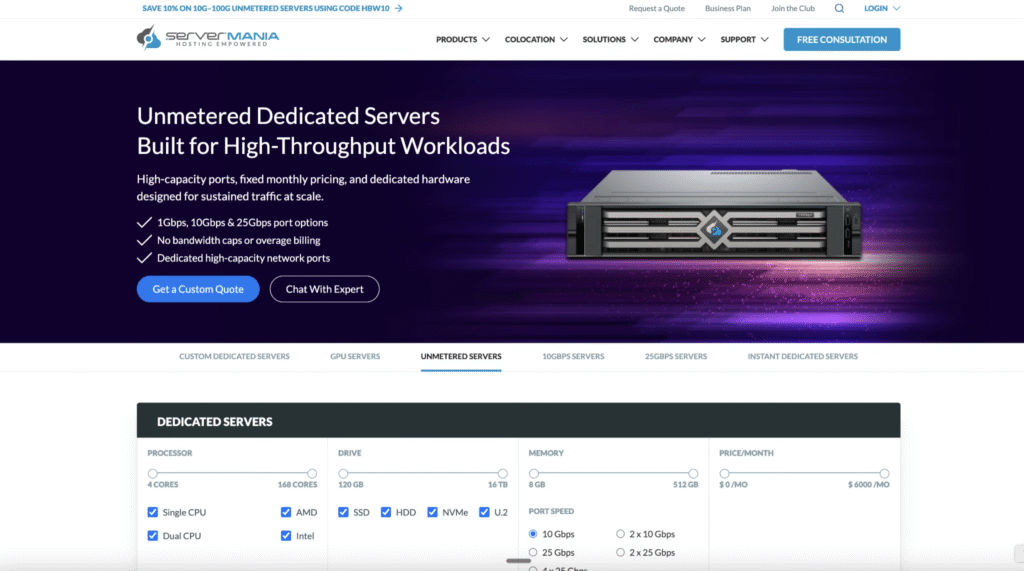
ServerMania pairs unmetered dedicated servers with colocation and a full cloud platform called AraCloud, and the whole ecosystem leans toward hardware flexibility, data center diversity, and strong SLAs. On the network side it stands out with unmetered port options reaching up to 4 x 25 Gbps with no overage billing, plus 1 Gbps, 10 Gbps, and 25 Gbps unmetered tiers for lighter needs.
Data centers span Canada, North America, and Europe, including New York, Los Angeles, London, Montreal, Vancouver, Amsterdam, and Buffalo. The Amsterdam facility sits close to the AMS-IX exchange and adheres to GDPR, which helps for European routing and compliance. Servers are backed by a 99.99 percent uptime SLA, transparent fixed pricing with no hidden bandwidth charges, enterprise chassis with NVMe storage, and free 24/7 support plus consultations with bandwidth specialists. The main trade-off is that highly customized builds are enterprise-oriented and can require some provisioning time.
It is the strongest fit for high-throughput enterprise infrastructure, bandwidth-heavy CDN and content distribution, and data-intensive AI or machine learning work. ServerMania also breaks down the trade-offs in depth in its guide to the best unmetered dedicated server hosting providers, which is worth reading if you want the full side-by-side comparison.
Best for: teams that want fully customizable, high-port enterprise hardware with predictable pricing and hands-on support.
2. Hivelocity: Best for high-port capacity with DDoS protection
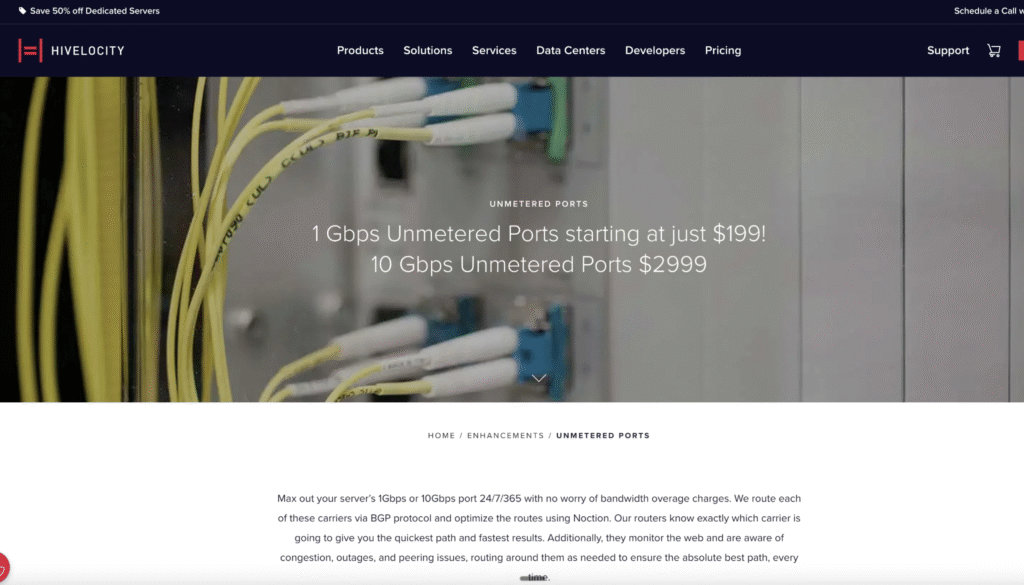
Hivelocity offers unmetered ports ranging from 1 Gbps up to 40 Gbps, all running on a performance-based global network, and every server ships with standard DDoS protection. That combination makes it a popular choice for game servers, streaming, and any workload where both raw port capacity and attack resilience matter.
Hardware is customizable across NVMe and SATA SSD options with fast provisioning, and the company backs it with 24/7/365 support that reviewers consistently praise for responsiveness. Standard dedicated plans include a set monthly transfer amount, and you upgrade to an unmetered port when you need to remove that cap, so confirm the exact port and policy for your configuration.
Best for: game servers, streaming, and US or globally distributed delivery that needs high port speeds plus built-in DDoS protection.
3. ReliableSite: Best value for US-focused production workloads
ReliableSite has done one thing since 2006: bare metal hosting, with its own hardware, on-site technicians, and network. Every server includes a 1 Gbps unmetered port as the baseline, with upgrades to 2, 3, 5, and 10 Gbps unmetered, and the company is widely recommended for genuinely strong support and honest, readable pricing.
All servers come standard with free DDoS protection up to 10 Gbps, backed by in-house controls that let you filter specific IPs or set attack size limits, and the network carries a 100 percent uptime SLA. Data centers are in New York, Miami, Los Angeles, and Amsterdam. The main limitation is geographic concentration, since the footprint is primarily US-centric, which is less ideal for truly global infrastructure.
Best for: US-focused production workloads, high-traffic media and download sites, and teams that want strong value with built-in DDoS protection.
4. OVHcloud: Best for global reach and predictable pricing
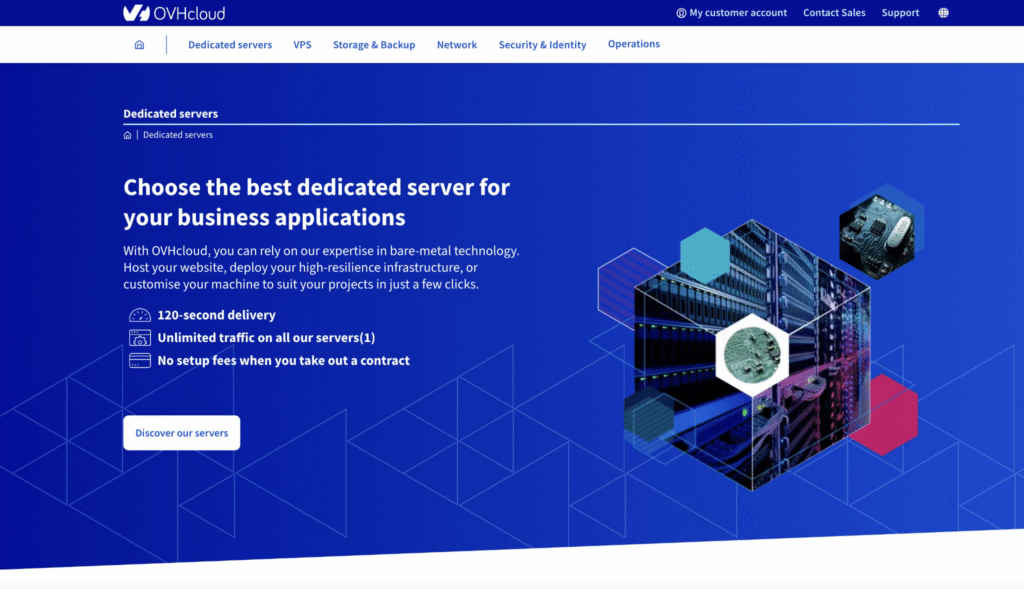
OVHcloud is a bandwidth-focused provider with one of the largest footprints in the market, spanning Europe, North America, and Asia-Pacific. Its dedicated server families are tailored to specific use cases while keeping customization high, and it offers guaranteed public bandwidth options up to 25 Gbps with transparent monthly billing and no overage fees on its unmetered tiers.
The platform is technically mature, energy efficient through its water-cooled infrastructure, and supported by a deep knowledge base. The trade-off is scale: smaller teams sometimes find the support experience less hands-on than with specialized providers, but for multi-region, bandwidth-heavy hosting, OVHcloud remains one of the strongest options available.
Best for: large-scale, bandwidth-heavy environments that need broad geographic coverage and predictable, transparent pricing.
5. Leaseweb: Best for European routing and flexible bandwidth billing
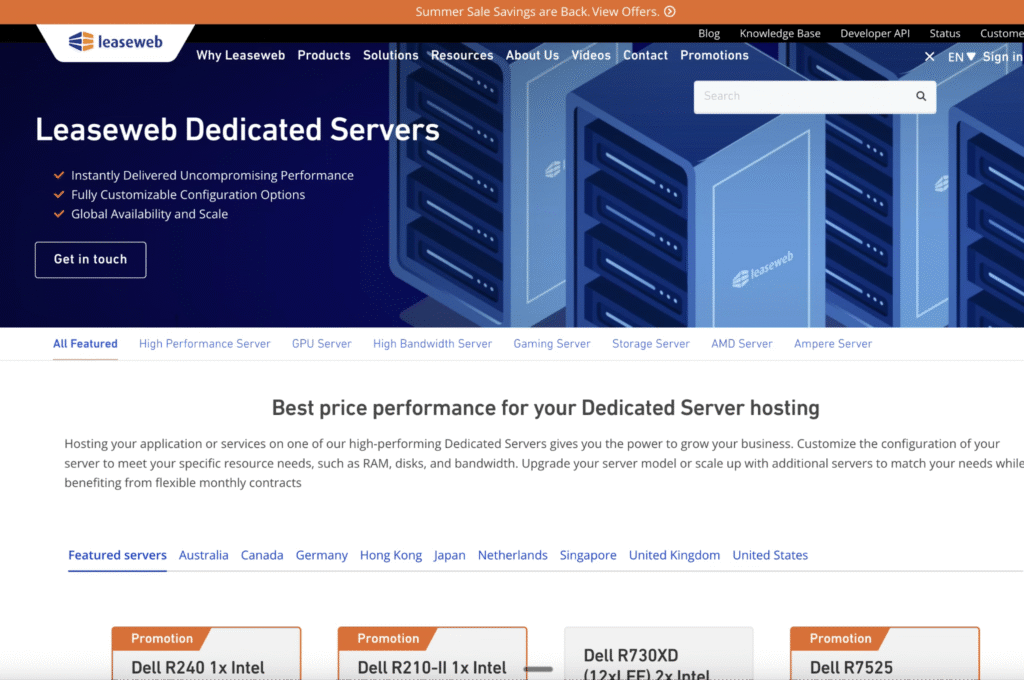
Leaseweb spans dedicated servers, cloud, colocation, and hybrid setups across more than ten regions, with a particularly strong presence in Amsterdam. It supports unmetered connectivity up to 10 Gbps alongside flexible 95th percentile billing models, and pairs a large server inventory with highly customizable hardware, networking, and private interconnect options.
A 99.99 percent uptime SLA and quick provisioning make it a dependable enterprise pick, with pricing that typically starts around 95 dollars per month depending on configuration. The main consideration is its support structure, where the most responsive tiers come at additional cost, so factor that in if you expect to lean on support heavily.
Best for: enterprises that want contractual reliability, strong European routing, and the flexibility to tailor bandwidth and hardware.
How to choose the right provider
The best unmetered dedicated server comes down to your traffic pattern and where your users are. If you want fully custom enterprise hardware with hands-on support, ServerMania is the strongest overall fit. Hivelocity leads on raw port capacity with built-in DDoS protection, ReliableSite is the value pick for US production workloads, OVHcloud wins on global reach and pricing predictability, and Leaseweb is the choice for European routing and flexible bandwidth billing.
Whichever you shortlist, verify three things before committing: that the port is genuinely dedicated and unmetered, that the fair-use policy is written in plain language, and that the underlying hardware, especially storage, can actually saturate the port you are paying for. A 10 Gbps port is wasted if SATA drives bottleneck it, so NVMe in RAID is usually the right pairing for high-speed plans.
Final thoughts
Unmetered dedicated servers turn unpredictable bandwidth bills into a flat, plannable cost, which is exactly what high-traffic businesses need. The five providers here each earn their place for different reasons, so match the provider to your workload, confirm the network claims against the fine print, and run a real test before you scale. Get those basics right and unmetered hosting becomes one of the most cost-effective ways to serve heavy traffic at scale.


