

Glean vs Microsoft Copilot is a decision many enterprises face when choosing how employees should find and use company knowledge.
Glean and Microsoft 365 Copilot can both help employees find information and get answers from company data, but they approach the problem differently.
Glean is built around a company-wide knowledge layer that connects information across many business systems, making it part of the broader category of enterprise AI search platforms. Microsoft 365 Copilot is deeply integrated with Microsoft 365, while Copilot Search now also reaches external systems through more than 100 connectors.
That makes the old comparison of "Glean searches everything, Copilot searches Microsoft" too simplistic. The better question is where your organization's knowledge lives, how external data needs to be connected, and which platform fits the way your teams already work.
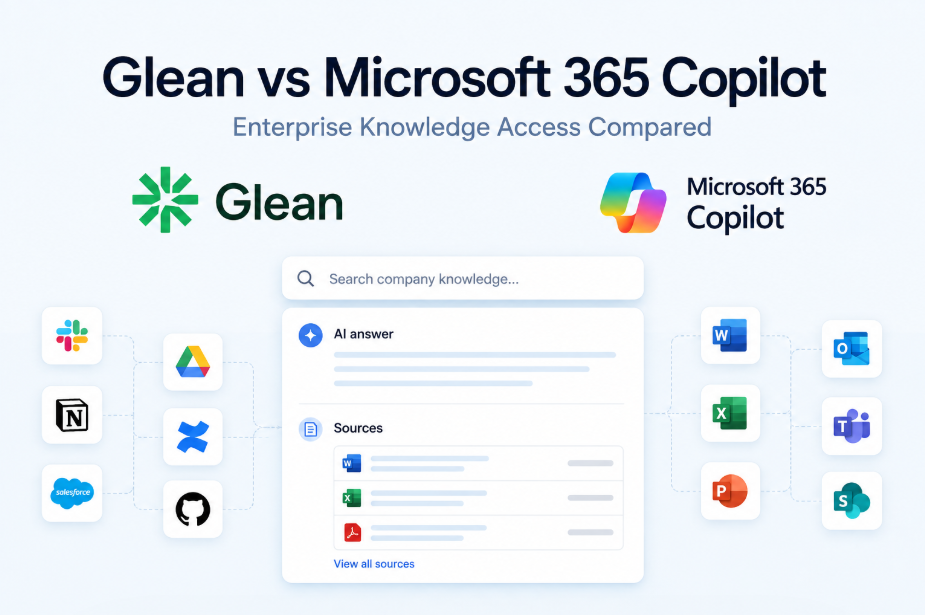
Table of Contents
Coverage Beyond the Microsoft Estate
This is probably the biggest consideration for companies comparing Glean and Copilot.
Glean currently advertises more than 275 out-of-the-box connectors covering applications such as Microsoft 365, Salesforce, Jira, Confluence, GitHub, ServiceNow and Slack. It also supports custom connectors and MCP-based connections.
Microsoft 365 Copilot has also moved well beyond Microsoft-only search. Copilot Search supports more than 100 prebuilt connectors for Microsoft and non-Microsoft systems, including Salesforce, ServiceNow, Confluence, Jira, GitHub and Google Drive.
So connector count alone is not enough to choose between them.
The more useful question is how your important systems connect.
For example, a company using Microsoft 365, Salesforce, Jira, Slack and Confluence needs to evaluate whether each platform provides the required connector, how much configuration it requires, what data can be searched, and how permissions are handled.
Glean has a broader dedicated connector catalog. Copilot has the advantage of putting connected external information inside the Microsoft search and Copilot environment.
If most company knowledge already lives in Microsoft 365, Copilot may cover a large part of the requirement without introducing another enterprise search layer. If knowledge is spread heavily across many non-Microsoft applications, Glean becomes more compelling.
Permissions & Governance
Enterprise search cannot be useful if it exposes information employees should not see. That makes enterprise AI security an important part of evaluating any AI system connected to company data. Enterprise search cannot be useful if it exposes information employees should not see.
Both platforms are designed around permission-aware access, but the implementation and administration model differ.
Glean says its connectors inherit and enforce source-system permissions, with permission changes reflected in search results. Its platform is designed to create a unified knowledge layer while retaining the access boundaries of connected applications.
Microsoft 365 Copilot also respects permissions, but administrators need to configure connector access correctly. Microsoft allows connector permissions to be set so that only people with access to the source can retrieve the connected information, or, where appropriate, to make content visible more broadly.
This creates an important practical point: permission-aware does not mean permission configuration can be ignored.
A poorly configured connector can create oversharing risks regardless of which platform is being used.
For an organization comparing the two, the right questions are:
- Where are permissions defined?
- How are changes synchronized?
- Can administrators audit access?
- How are external sources governed?
- How much connector-specific configuration is required?
For Microsoft-heavy organizations, Copilot has an obvious advantage in being connected to Microsoft's existing identity and administration environment. Glean is attractive when governance needs to span a wider collection of enterprise applications.
Answer Accuracy
It is tempting to ask which platform gives better answers. There is no reliable universal answer to that question.
Answer quality depends heavily on what information the system can retrieve and how effectively it can use that information.
Glean builds indexes and knowledge graphs across connected data and uses signals about content, people and activity to create enterprise context.
Copilot Search combines Microsoft 365 information with connected external data and uses Microsoft Graph and its search infrastructure to personalize results.
The difference becomes clearer with a cross-system question.
Suppose a sales manager asks:
"What did we promise this customer, what is the current delivery status, and who owns the next action?"
The answer might require information from email, a CRM, project management software and internal documentation.
The best platform is the one that can retrieve the relevant information from those systems, respect the user's access rights, and provide enough context for the answer to be trusted.
That is more useful than simply asking which platform has the better AI model.
Admin Controls
Microsoft has a major advantage for organizations already invested heavily in the Microsoft ecosystem.
Copilot administration sits alongside Microsoft's broader identity, security, compliance and management infrastructure. Connector configuration and access permissions can be managed through the Microsoft 365 administration environment.
Glean provides a dedicated enterprise AI and search administration layer instead.
That can be useful when AI search needs to span many applications rather than primarily extending an existing Microsoft environment.
The distinction is therefore less about which product has "better admin controls" and more about where the organization wants those controls to live.
A Microsoft-first company may prefer keeping identity, access and AI administration within its existing Microsoft environment. A company with a heterogeneous application stack may prefer a dedicated enterprise knowledge layer that sits across those systems.
Licensing Math at 1,000 Seats
Pricing becomes more complicated than comparing two monthly per-seat numbers.
Microsoft currently lists Microsoft 365 Copilot for enterprise at $30 per user per month when paid yearly, with a qualifying Microsoft 365 plan required. (Microsoft Learn)
At 1,000 seats, the Copilot add-on works out to:
| Calculation | Annual cost |
|---|---|
| $30 × 1,000 users × 12 months | $360,000 |
That $360,000 is the Copilot license cost. It does not represent the organization's complete Microsoft 365 cost because the qualifying Microsoft subscription is separate.
Glean does not provide a standard public enterprise price that can be used for a reliable 1,000-seat comparison. Its enterprise pricing requires a quote.
That means buyers should not treat an estimated Glean figure from a third-party article as equivalent to a negotiated enterprise contract.
The real comparison should include licensing, existing Microsoft commitments, implementation, connector setup, administration and any additional usage or infrastructure costs.
Rollout Effort
The easiest deployment is usually the one that fits the environment you already have.
For a company deeply invested in Microsoft 365, Copilot can have a natural starting point because employees already work in Teams, Outlook, Word, Excel and other Microsoft applications.
The calculation changes when the company wants Copilot to search external systems.
External connectors still require configuration, permissions and synchronization choices. Microsoft documentation also distinguishes between indexed connector data and federated connectors that retrieve information from the source system at query time.
Glean takes a different approach by making enterprise-wide search and connected knowledge a central part of its platform.
For a company with dozens of important non-Microsoft systems, that can simplify the decision to introduce a dedicated knowledge layer. For a Microsoft-first company with relatively little information outside Microsoft 365, adding another platform may create unnecessary complexity.
Which Fits Which Org
Choose Glean when your organization has a highly fragmented knowledge environment and employees regularly move between systems such as Slack, Salesforce, Jira, Confluence and Microsoft 365. Its broad connector ecosystem and dedicated enterprise knowledge layer make it well suited to cross-system search.
Choose Microsoft 365 Copilot when Microsoft 365 is already the center of your employees' work and the main requirement is bringing AI into applications such as Teams, Outlook, Word and Excel. Copilot can also extend search beyond Microsoft through its connector ecosystem, so an external-data requirement does not automatically rule it out.
Consider using both when Microsoft 365 is the primary productivity environment but company knowledge is distributed across a much wider application stack.
That setup can make sense when Copilot handles AI assistance inside Microsoft applications while Glean provides a broader enterprise knowledge and search layer.
The decision is ultimately less about choosing the "better AI" and more about choosing the right information architecture.
FAQs
Is Glean better than Copilot?
Neither is universally better. Glean is generally the stronger fit for organizations that need a dedicated enterprise knowledge layer across many applications. Microsoft 365 Copilot is a natural fit for organizations centered on Microsoft 365 and its existing identity, productivity and governance environment.
Does Copilot search Slack and Notion?
Copilot can reach external systems through its connector ecosystem, including third-party and federated integrations. The important question is whether the required connector supports the specific data and access model your organization needs.
What is the real per-seat cost?
Microsoft 365 Copilot is currently listed at $30 per user per month when paid yearly, plus a qualifying Microsoft 365 plan. At 1,000 users, that is $360,000 per year for the Copilot licenses alone. Glean requires enterprise pricing, so a reliable like-for-like per-seat figure cannot be calculated from public pricing.
Can you run both?
Yes. An organization can use Microsoft 365 Copilot for work inside Microsoft applications while using Glean for broader enterprise search and knowledge access. The useful question is which platform should be the primary interface for each type of work.


