

Getting SEO right on a product page isn’t complicated when you have 50 products. You write a clear description, fill in the meta title and meta description, add image alt text, and move on. The problem is that most ecommerce stores don’t stay at 50 products.
At 500 products, manual SEO starts to slip. At several thousand, maintaining consistent coverage becomes genuinely difficult without dedicated tooling and team resources. Fields get left blank, descriptions get copied across similar products, and whole categories end up with no targeted keywords at all. Those gaps show up directly in organic performance. BrightEdge research found that organic search accounts for approximately 41% of traffic to retail and ecommerce websites, making it the largest single channel for most stores.
Pages that aren’t optimized capture significantly less of it. Ahrefs analysis across billions of web pages found that 96.55% of all indexed pages on the web receive zero organic traffic from Google. When unoptimized product pages make up a large share of a catalog, that statistic becomes a direct revenue concern.
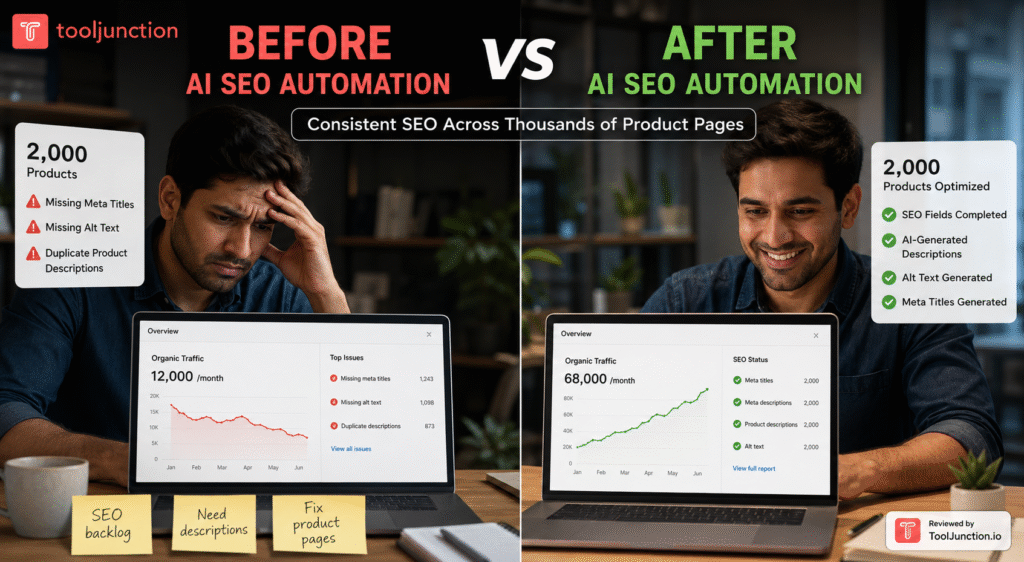
AI tools are increasingly being used to address this. Not to produce thin, disposable content, but to apply consistent SEO logic across thousands of product pages at a speed no human team can match. This article covers what product page SEO actually involves, where the process fails at scale, and what separates purpose-built ecommerce tools from general AI writing assistants.
What product page SEO actually involves
Product page SEO isn’t a single task. It’s a set of content fields, each with a distinct role in how a page gets discovered and presented in search results.
Product descriptions
Product descriptions are the main body text on a product page. Search engines read them to understand what the product is and whether it’s relevant to a given query. A well-written description targets a specific keyword, covers the product’s key attributes, and reads naturally for the visitor. A generic or duplicated description does none of that.
Meta titles
Meta titles are the clickable headlines that appear in search results. They carry significant weight in how a page ranks for its primary keyword and also affect click-through rate. A meta title that matches the searcher’s intent gets clicked; a vague or keyword-stuffed one gets ignored.
Meta descriptions
Meta descriptions are the short summaries beneath the meta title in search results. They don’t directly influence rankings, but they affect whether a user clicks. A meta description that speaks to what the user is looking for can lift click-through rates meaningfully; a generic one gets passed over.
Image alt text
Image alt text describes product images for search engines and accessibility tools. Missing alt text means images contribute nothing to the page’s SEO relevance. Alt text that includes a natural keyword reference adds useful context.
Category descriptions
Category descriptions sit at the top of collection pages. These pages often rank for broader, higher-volume terms than individual product pages, so their content matters significantly for stores organized by product type, brand, or use case.
These five fields together determine how well a product page can compete in organic search. Leave any of them consistently empty or poorly written, and you’re limiting what the page can rank for.
Why product page SEO breaks at scale
The process above is manageable at low volume. It becomes a different problem as a catalog grows.
To illustrate the pace: an experienced content writer might complete 10 to 15 well-researched product descriptions per day. With two writers, that’s roughly 20 to 30 per day as a working estimate. A catalog of 2,000 products takes three to four months to cover at that pace, and that figure doesn’t include meta fields, alt text, and category copy. During those months, new products arrive, existing ones get updated, and rankings shift. By the time the team completes a first pass, the earliest pages may already need revision.
There’s also the keyword research problem. Finding the right keyword for each product requires checking search volume, assessing difficulty, and reviewing what’s already ranking. Doing that properly for hundreds of products takes time most teams don’t have, so it often doesn’t happen. Products end up targeting whatever keyword was most obvious rather than the term with the best combination of volume and achievable ranking.
Then there’s consistency. Different writers apply different standards. Meta titles get formatted differently from one writer to the next. Some descriptions run 300 words; others 50. Some include the target keyword in the first paragraph; others bury it or skip it entirely. That variation is difficult to audit across a large catalog and harder still to correct manually.
The result: SEO applied patchily across a catalog, with a significant share of product pages doing very little work in search.
What AI tools bring to this problem
AI tools for product content don’t just write faster. The better ones are built around the specific logic that makes product page SEO work at scale.
- Keyword research built into the content workflow. Rather than requiring a separate research step, purpose-built ecommerce tools identify relevant keywords for each product before generating any copy. They analyze the product’s name, attributes, and, in some cases, product images alongside live SEO data sources to surface terms worth targeting. They can also detect when two pages are targeting the same keyword and competing against each other.
- Bulk generation with consistent output. AI tools can generate descriptions, meta titles, meta descriptions, image alt text, and category descriptions together, applying the same structural logic to every product. This removes the variance that comes from different writers working at different times.
- Content aligned with search intent. Ecommerce searches skew toward transactional and commercial intent. A user searching “buy lightweight running shoes men” is much closer to a purchase than one searching “types of running shoes.” Tools built for ecommerce factor in these intent types when surfacing keyword suggestions, helping content target terms that align with where the product sits in the buyer’s journey.
- Platform-native publishing. Most standalone AI writing tools produce text that still needs to be copied, formatted, and pasted into each product field, one by one. Tools that integrate directly with WooCommerce, Magento, or Shopify populate fields directly and publish without manual entry.
Content update suggestions as rankings develop. Good product page SEO isn’t a one-time task. A page that ranks well for a low-difficulty keyword can eventually target something more competitive as its authority builds. Some tools monitor keyword performance and flag pages that are ready for an upgrade, giving teams a clear queue of optimization opportunities rather than requiring them to audit manually.
What to look for in an AI tool for this use case
Not all AI content tools are equal for product page SEO. The following criteria separate tools built specifically for ecommerce from general AI writing assistants applied to the problem.
| Feature | Why it matters |
|---|---|
| Built-in keyword analysis | Ensures content targets terms with real ranking potential, not just obvious ones |
| Cannibalization detection | Prevents multiple products from competing for the same keyword |
| Bulk generation | Makes it practical to cover an entire catalog, not just individual pages |
| Coverage of all SEO fields | Descriptions, meta titles, meta descriptions, alt text, and category copy should all be handled together |
| Platform integration | Direct publishing into the store removes manual entry and reduces errors |
| Multilingual support | Relevant for any store selling across multiple markets |
| Tone and style controls | Maintains brand voice consistently across a large catalog |
| Keyword progression tracking | Identifies when pages are ready to target more competitive terms |
Most standalone AI writing tools do not provide these capabilities out of the box. They can write product descriptions, but they don’t run keyword analysis inside your store, detect cannibalization across your catalog, publish content directly to product fields, or monitor ranking progress. If product page SEO at scale is the actual goal, the tool needs to be built for that specifically.
How WriteText.ai handles product page SEO at scale
WriteText.ai is an ecommerce content automation platform built natively inside WooCommerce, Magento, and Shopify. It handles the full set of product page content fields: product descriptions (short and long), meta titles, meta descriptions, Open Graph text, image alt text, and category descriptions. Every piece of content is generated through a process that starts with keyword analysis rather than skipping it.
For each product, WriteText.ai identifies keywords by analyzing the product name, attributes, and product images alongside SEO data, then clusters them by topic and difficulty into a keyword optimization pipeline. Content is generated to target lower-difficulty terms first. As rankings develop, the platform identifies when a page is ready to move to a more competitive keyword and surfaces those opportunities for the team to review and action, with both time-based and ranking-based trigger options available.
Cannibalization detection is part of the workflow. WriteText.ai generates a report showing which products across the catalog share keyword targets, so overlapping assignments can be resolved before content is finalized. For stores with large catalogs, the bulk generation function covers thousands of products in a single run, writing content directly into the relevant store fields. New products added to the catalog can be detected automatically and queued for keyword analysis and the next generation run.
WriteText.ai also generates “FAQ blocks” and “People Also Ask” sections, which may help improve visibility in AI-generated search(GEO) experiences alongside traditional search results(SEO).
Explore how WriteText.ai applies this across a full catalog at WriteText.ai.
Final note
Product page SEO is a solvable problem at small scale. At large scale, it becomes an operational one. The tools available now make it realistic to apply consistent, keyword-informed SEO across a full catalog, not by cutting corners on quality, but by removing the manual work that makes it impractical to do well. For any store where the catalog is growing faster than the team can keep up, that shift is worth exploring.






Leave a Reply