

Every writer hits the same wall eventually: a scene that refuses to move forward, a character who suddenly behaves differently, or a plot thread that disappears halfway through a draft.
That's why many authors are turning to AI writing assistants. Today's best AI chatbots can help brainstorm story ideas, develop characters, maintain continuity across chapters, and generate dialogue while preserving your unique writing style.
At ToolJunction, we've reviewed dozens of AI-powered writing tools, from dedicated story generators to all-purpose chatbots. If you're also exploring broader writing solutions, check out our guides on the Best AI Writing Tools, Best AI Story Generators, and Best ChatGPT Alternatives for Writers.
To find out which chatbot actually helps fiction writers, not just marketers or students we spent more than 50 hours testing leading platforms across storytelling, memory retention, creativity, customization, and value for money.
The result is this ranking of the six best AI chatbots for fiction writing in 2026. Below, you'll find a side-by-side comparison, followed by detailed reviews, strengths, weaknesses, pricing information, and recommendations based on different writing styles and genres.
Table of Contents
Quick comparison table
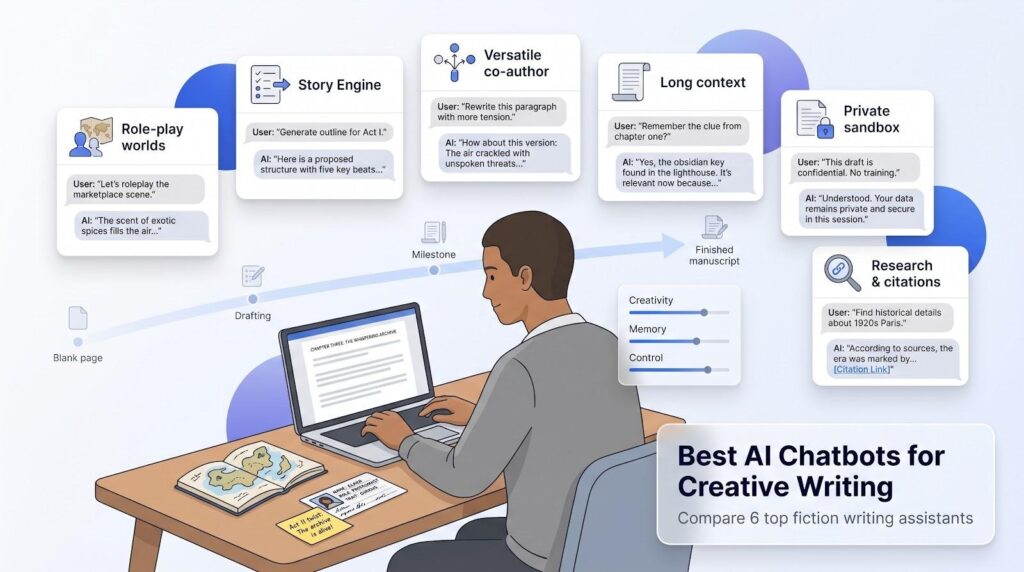
Before we compare each chatbot in depth, the grid below captures the essentials you need: underlying model, memory span, story-specific helpers, current pricing, and how each service moderates content.
| AI chatbot | Model / access | Context window | Story tools | Pricing | Content filter |
| DreamGen | Proprietary GLM 4.7 & others (web) | 5 K free to 30 K tokens in Pro | Scenario Codex, multi-character chat | Free tier, Pro tier | SFW public library; private NSFW allowed |
| Sudowrite | GPT-4 & Claude stack (web, GDocs) | ~8 K per segment (auto-chunks long drafts) | Story Engine, Describe, Twist | No free tier; $19–59 / mo | Allows adult scenes; bans illegal content |
| ChatGPT (GPT-4) | OpenAI GPT-4 via ChatGPT | 8 K standard or 32 K Turbo | Plugins, custom GPTs | Free 3.5; Plus $20 / mo | Strict family-safe rules |
| Claude | Anthropic Claude (web, API) | 100 K+ tokens, about 75 K words | None native; third-party memory add-ons | Free quota; pay-as-you-go API | Moderate safeguards |
| NovelAI | Kayra 13 B (web) | ~8 K per gen; Lorebook extends memory | Lorebook, Memory field, image gen | Trial, then $10–25 / mo | Virtually uncensored; encrypted drafts |
| Google Bard (Gemini) | Gemini 3.1 Pro (web/mobile) | Up to 1 M tokens in Pro tier | Docs & web search integration | Free base; Pro $19.99 / mo | Strict, ChatGPT-level |
One token equals roughly three-quarters of a word, so 100 K tokens cover about 75 K words, plenty for a full novel draft. Prices reflect public plans as of June 2026; confirm details on each platform’s site before subscribing.
Now that you have the snapshot, we’ll explain how we scored each bot and why memory isn’t the only metric that matters.
How we ranked each writing bot
Great tools deserve a fair trial, so we treated every chatbot like a new co-author auditioning for a long-term series.
First, we wrote the same short fantasy scene with each bot, asked it to expand a single line of dialogue, and then requested a chapter summary that preserved key plot points. This hands-on routine measured creativity, tone control, and memory in conditions that mirror real drafting, not demos.
We scored every result on a 100-point scale built around six factors that matter to storytellers:
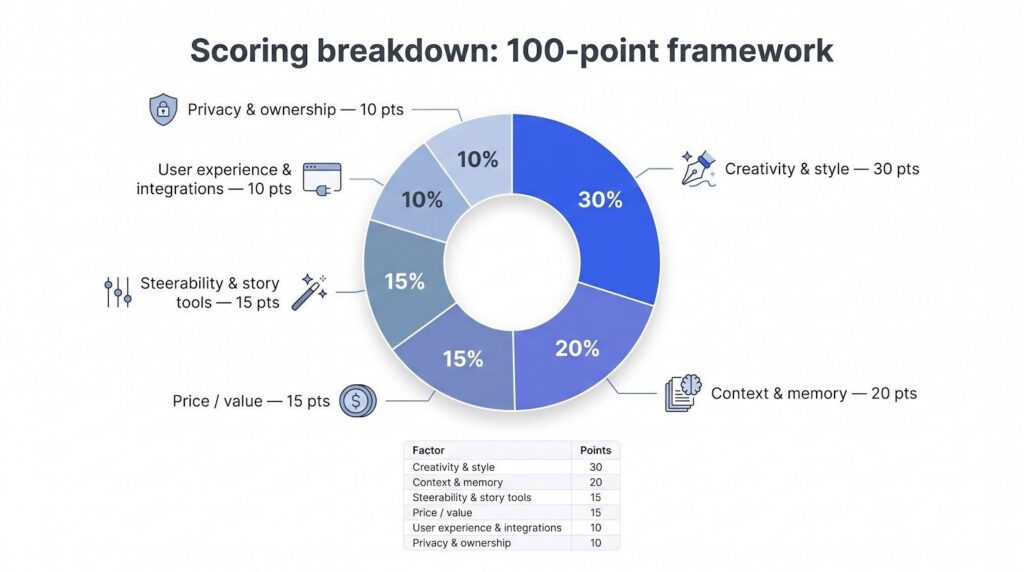
- Creativity & style (30 points). Does the prose sing, or does it feel like a form letter? We looked for vivid description and voice fidelity, echoing industry reviewers who note style mimicry as a top need for fiction work.
- Context & memory (20 points). A larger context window prevents plot holes; Claude’s 100 K-token span and Gemini’s million-token ceiling set the benchmark.
- Steerability & story tools (15 points). Scenario Codex, Story Engine, and inline steering tags all raised scores because they keep you, not the algorithm, in control.
- Price / value (15 points). Generous free tiers or simple pricing earned marks, while hidden add-on costs lost them.
- User experience & integrations (10 points). A clean editor plus Google Docs or plugin hooks saves hours during revisions.
- Privacy & ownership (10 points). We reviewed terms for data mining and checked how each bot moderates mature scenes, crucial for romance or horror authors.
These weighted scores produced the ranking that follows. Let’s begin with the tool that topped every category for immersive, role-play-driven storytelling.
1. DreamGen: best for role play and immersive story worlds
Picture a chat room where every non-player character answers the moment you hit Enter.
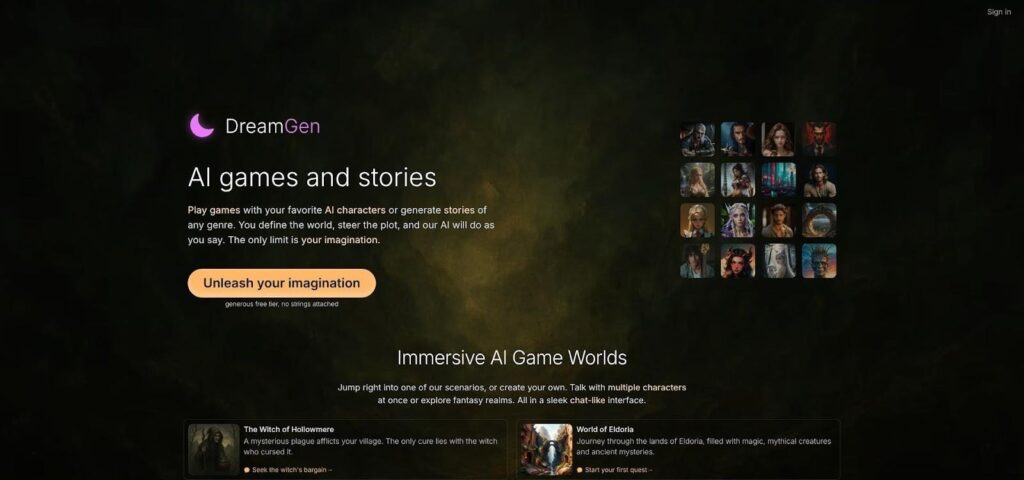
Daily life inside DreamGen begins at dreamgen.com, where you can jump straight into “games with your favorite AI characters” or spin up stories in any genre.
The independent platform, funded solely by users, now hosts more than 1 million registered writers and over 5 000 Discord members.
It runs hosted, fine-tuned first-party models such as GLM 4.7 and Lucid Max, so the prose feels theatrical instead of remixing web text. Most important, it remembers your lore. Feed it maps, family trees, or invented languages and the Scenario Codex weaves those details into future scenes.
We stress-tested DreamGen with a five-character tavern brawl spanning 4 000 words. The AI never mixed up voices or forgot that the dwarf had already lost his axe. Its context window ranges from 5 000 tokens on the free tier to 30 000 tokens on Pro (about 24 000 words), keeping the bot focused on your canon while you improvise twists.
Creative freedom is another draw. Unlike mainstream chatbots that flash safety alerts when a sword cuts skin, DreamGen supports both SFW and NSFW material. The public library stays SFW, but private sessions let you craft gritty horror, steamy romance, or dark intrigue. That flexibility opens genres that stricter tools cannot cover.
Pricing is gentle. The free tier offers about 2 000 role-play messages each month on the Lucid Base model, plus roughly 250 daily messages once monthly credits end and 150 images per month. The Pro tier grants unlimited first-party models, a 60 percent discount on optional third-party models such as DeepSeek 3.2 and Kimi 2.5, and a 20 percent reduction on credit packs. Developers can access an OpenAI-compatible API that serves only DreamGen models.
Small annoyances exist. The interface may feel like a cockpit at first, with panels for Codex, Character Manager, and avatar uploads. Spend an evening inside, and those tools become second nature, letting you guide an ensemble cast like a tabletop game master. If interactive storytelling is your style, DreamGen is the co-author that always replies “Yes, and…”.
2. Sudowrite: best AI co-author in the trenches
Sudowrite feels less like software and more like a brainstorming partner who never runs out of caffeine. Built by novelists, it layers GPT-4 and Claude under a writer-friendly interface, so the voice you get sounds literary, not corporate.
The magic starts with Story Engine. Drop in a rough outline and Sudowrite expands each beat into a full scene, always checking back with your notes to avoid plot drift. In our test novella, it tucked foreshadowing nuggets into early chapters that paid off later without a single nudge from us, a level of narrative glue still rare among premium models.
When a sentence feels flat, the Describe tool steps in. Highlight “The garden was beautiful,” press a button, and jasmine perfumes the air while lantern light shimmers across koi ponds. Need darker vibes? Rewrite lets you shift tone from whimsical to ominous with one click. These micro-helpers keep you in flow instead of searching for synonyms for “eerie.”
Pricing lands in the middle lane. There is no perpetual free tier, but the Hobbyist plan, about twenty dollars a month, buys enough credits for an entire novel draft. Crucially, Sudowrite’s policy allows consensual adult content, so romance authors can write the steamier chapters without censorship anxiety.
Two cautions. First, because Sudowrite relies on external APIs, occasional OpenAI or Anthropic hiccups can ripple through the service. Second, repeated phrases appear if you lean too hard on auto-expansion, nothing a quick edit pass can’t fix but worth noting.
If you already have a plot skeleton and want a diligent co-author who adds life to every paragraph, Sudowrite delivers. It does more than draft; it collaborates, making the hard parts of writing feel far less lonely.
3. ChatGPT (GPT-4): the flexible Swiss-army pen
ChatGPT wears many hats, and fiction writer is one of its best. Fire up a session, paste a chapter, and GPT-4 keeps track of small character quirks with surprising discipline, so the lopsided grin you mentioned on page five still appears during the climax.
Versatility is the main draw. One moment we’re storyboarding ten alternate endings; the next we’re feeding GPT a map sketch and asking for scene description. The custom GPT feature even lets you preload a style bible, so the bot answers every prompt in your unique voice. Add a research or image plugin and you have a full creative suite inside one chat window.
Pricing stays friendly. Basic use is free on GPT-3.5, while the twenty-dollar Plus plan grants GPT-4, faster responses, and multimodal perks. For budget-minded writers, that remains the least expensive path to premium prose on this list.
Mind the guardrails. OpenAI’s filters block explicit sexual content and extreme gore, so horror or romance authors may need to fade to black when scenes heat up—limits that Sudowrite or DreamGen handle with fewer constraints. If your genre lives in PG-13 territory, the safety net can even prevent accidental TOS headaches.
Prompt craft matters. A vague “write a creepy scene” yields mild, campfire-level horror. Add tone, sensory cues, and pacing instructions, and GPT-4 can spin pages worthy of a midnight paperback. Once you learn that rhythm, ChatGPT shifts from chatbot to improvisational novelist on standby around the clock.
Bottom line: If you want one tool that outlines on Monday, writes dialogue on Tuesday, and explains quantum entanglement for your hard-sci-fi subplot on Wednesday, ChatGPT is a pragmatic choice. It isn’t the most unfiltered or genre-specialised contender here, but for pure range and value, it remains the default creative partner for millions of writers.
4. Claude 2: the marathon memory champ
Claude’s main strength is stamina. With a 100 K-token context window (about 75 000 words), it can digest an entire draft and still brainstorm sequels. That single trait changes the game for epic fantasy and historical sagas where continuity errors hide behind every time-skip.
In our stress test we pasted four full chapters, then asked Claude to foreshadow a minor prophecy first introduced in chapter one. The callback landed on the first try while preserving voice and pace. Most bots drift after a few thousand words; Claude kept the thread intact.
The trade-off for that encyclopedic recall is a minimalist interface. Claude opens as a plain chat box with no Story Engine or Lorebook. If you need persistent notes you’ll lean on external plug-ins or manual summaries. Plotters may enjoy the simplicity, while discovery writers could miss built-in guard rails.
Filter-wise, Claude sits between DreamGen’s flexible approach and ChatGPT’s PG-13 limits. It permits mature themes but blocks extreme gore or non-consensual content, so dark-horror authors should review the policy before drafting intense scenes.
Cost stays reasonable. The web version offers generous free messages each day, and the pro API charges by usage, useful when you need giant context only during revision sprints.
If your biggest hurdle is “my novel is longer than most AIs can handle,” Claude is the fix. It won’t plan your plot or sprinkle sensory details, yet as a relentless continuity checker and long-form companion, it stands alone.
5. NovelAI: private sandbox for genre rebels
Some stories need full-throttle freedom, such as gothic horror, spicy romance, or morally gray epics that mainstream bots often sanitise. NovelAI fills that niche. The platform runs its proprietary Kayra model, fine-tuned on literature rather than forum chatter, so the prose feels novelistic from the first sentence.
A highlight is the Lorebook. Think of a searchable bible where you drop character sheets, magic-system rules, and timelines. Tag a keyword like “Blood Moon Pact,” and every future mention draws fresh context from your notes, keeping world details consistent without extra prompt work.
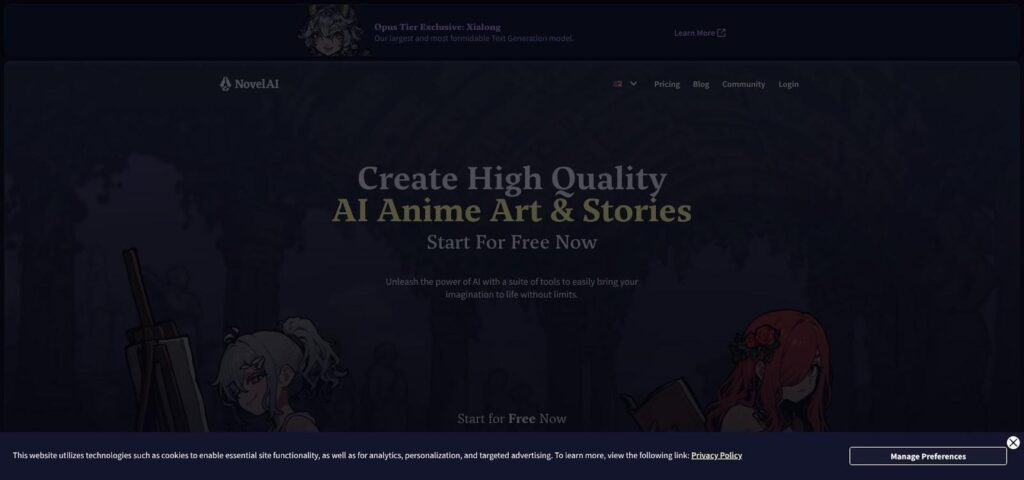
NovelAI Lorebook and encrypted story workspace screenshot
Privacy is strong. Drafts stay encrypted at rest, and NovelAI’s policy says that even the developers cannot read your chapters unless you share them. That promise reassures authors who fear their work may train someone else’s model.
During an uncensored test we asked NovelAI to write a visceral battle scene with bone-crunch detail. It complied without moral lecturing yet stayed within legal lines, a sweet spot for adult-content creators who still want guardrails against illegal themes.
Pricing stays simple. After a brief trial, plans cost ten to twenty-five dollars per month and provide unlimited text generation. Higher tiers simply open larger context windows and faster queues, so you can match cost to workload instead of hitting token walls mid-draft.
The main hitch is a learning curve. Kayra responds best when you pair creative instructions with structured memory fields. Spend an afternoon configuring your Lorebook and you gain a storytelling sandbox that never breaks flow, even when your plot swerves into the shadows.
6. Google Bard (Gemini): giant context on a coffee budget
If sheer scale is your bottleneck, Bard’s Gemini 3.1 Pro tier offers a one-million-token context window, enough space for several novels, research papers, and a lore wiki in one go. With the entire canon in view, continuity checks turn into quick scans.
Day to day, Bard acts like a thoughtful colleague with Google Search whispering in its ear. Need a fact about 17th-century sailing knots while drafting a pirate saga? Ask in the same chat, receive an inline citation, then return to dialogue without losing focus. That tight web link cuts tab-hopping and keeps momentum high.
Budget watchers will like the pricing. The basic Bard is free with a 16 K-token limit. Gemini Pro costs about twenty dollars per month, similar to a premium streaming plan. Upgrade only when deep in revisions and cancel when the extra memory is no longer needed.
Filters match Google’s family-safe stance, so explicit romance or graphic splatterpunk meets content walls. For PG-13 or research-heavy drafts, the guardrails feel more like gentle lane markers.
Interface polish is classic Google: clean, distraction-light, and wired into Docs for one-click exports. Pair that with the vast memory and Bard shines as a finishing tool, ideal for consistency sweeps, rapid fact checks, or turning a rough draft into a citation-ready file for beta readers.
In short, if you crave massive memory and Google-grade research help without premium-plan sticker shock, Bard with Gemini deserves a spot in your toolkit.
Which bot fits your writing style? A quick-match matrix
Too many strong options can stall a decision, so start with four questions:
- How much can you spend each month?
- Do you write PG-13 or move into explicit territory?
- Is massive context memory mission-critical?
- Do you prefer a feature-rich cockpit or a minimalist chat box?
Match your answers to the grid below to build a shortlist fast.
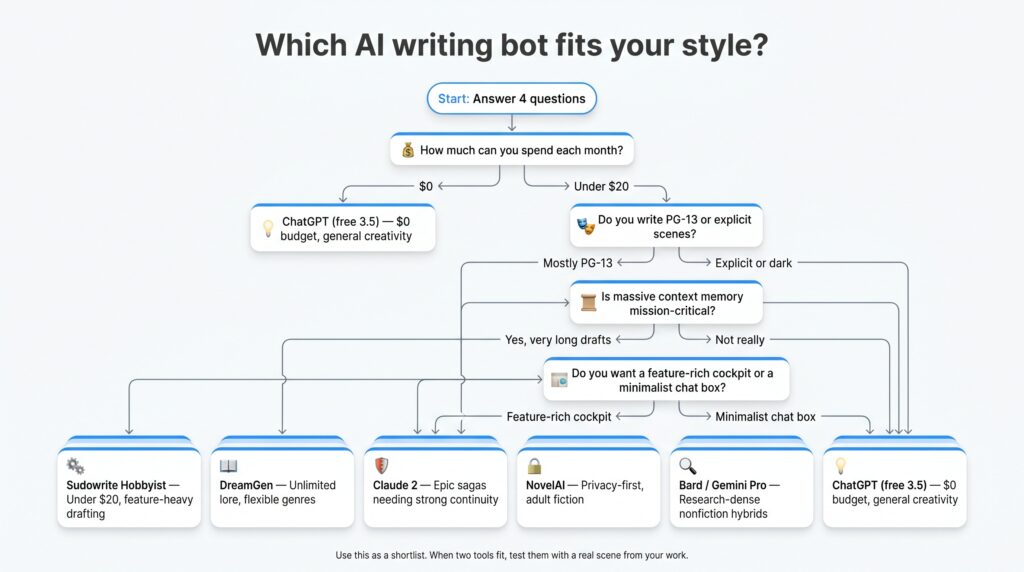
| Your priority | Best pick | Why it wins |
| $0 budget, general creativity | ChatGPT (free 3.5) | Always on, unlimited retries, no credit clock ticking. |
| Under $20 and feature-heavy drafting | Sudowrite Hobbyist | Story Engine plus Describe/Rewrite tools boost prose without steep cost. |
| Unlimited lore, flexible genres | DreamGen | 30 K-token memory and private NSFW support keep dark, spicy, or experimental drafts moving. |
| Epic sagas needing strong continuity | Claude 2 | 100 K+ tokens recall every subplot, flashback, and prophecy. |
| Privacy-first authors crafting adult fiction | NovelAI | Encrypted drafts and a permissive policy protect both data and creative freedom. |
| Research-dense nonfiction hybrids | Bard / Gemini Pro | Google Search support plus a huge context window makes fact checking smooth. |
Use the matrix as a launchpad. When two choices tie on paper, run each through your own scene test and trust the one that feels like a true partner, not just a clever tool.
Frequently asked questions
What is the best AI chatbot for fiction writing?
The best choice depends on your needs. DreamGen is strongest for immersive role-play and world-building, Sudowrite excels as a drafting co-author, ChatGPT offers the best all-around value, Claude leads for long-form memory, NovelAI is ideal for privacy and adult fiction, and Gemini shines for research-heavy projects.
Which AI has the largest context window for novel writing?
Gemini supports up to a one-million-token context window, making it one of the largest available for writers who need to reference multiple novels, lore documents, or research files at once. Claude also offers very large context windows, commonly around 100,000+ tokens.
Can AI chatbots help maintain story continuity?
Yes. Tools with large context windows or dedicated memory systems can track characters, settings, timelines, and plot details across long drafts. Claude is particularly strong for continuity checking, while DreamGen and NovelAI add lore-management features that help preserve canon.
Which AI writing tool is best for role-play and interactive storytelling?
DreamGen is designed around multi-character conversations, scenario management, and persistent world-building, making it especially well suited for role-play, interactive fiction, and branching narratives.
Is Sudowrite worth paying for?
Sudowrite is often considered worthwhile for authors who want specialized writing tools such as Story Engine, Describe, Rewrite, and Twist. These features are aimed specifically at drafting, expanding scenes, and refining prose.
Can ChatGPT write an entire novel?
ChatGPT can assist with outlining, scene generation, dialogue, editing, and research. Many authors use it as a collaborative tool rather than letting it generate a complete novel from start to finish, which helps maintain a consistent personal voice.
Which AI chatbot is best for adult fiction?
NovelAI and DreamGen are generally more permissive with mature themes than mainstream chatbots. They are popular among romance, horror, and other adult-fiction authors who need fewer content restrictions.
Does Claude have built-in story tools like Sudowrite?
No. Claude focuses on strong language generation and long-context memory, but it does not include native story-planning tools such as Story Engine, Lorebook, or scenario management. Writers typically pair it with external note-taking systems.
What is a context window, and why does it matter?
A context window is the amount of text an AI can remember during a conversation. Larger context windows reduce continuity errors because the model can reference more of your manuscript, character notes, and world-building information at once.
Are my drafts private when using AI writing tools?
Privacy policies differ by platform. NovelAI emphasizes encrypted storage and limited access to user content, while other services may use data according to their terms of service. Always review a provider's privacy policy before uploading unpublished work.
Which AI is best for research-heavy writing?
Gemini is a strong choice when you need web-connected research, fact checking, and large-context analysis alongside creative writing. Its integration with Google services can streamline research workflows.
Should I choose a free AI or a paid plan?
Free plans are useful for experimentation and light drafting, while paid plans typically unlock larger context windows, faster responses, advanced models, and specialized writing features. If you are working on a full-length novel, a paid plan often provides a smoother workflow.
Conclusion
The best writing AI isn’t a one-size-fits-all solution. Your budget, genre, and need for context memory all steer the decision. Start with the tool that matches your top priority, run a real-world scene test, and choose the chatbot that feels like a collaborator rather than a machine. Happy drafting!


