
An AI application can return a perfectly normal response and still have something seriously wrong underneath.
Maybe the model is taking too long to answer. Maybe token usage has quietly doubled. A RAG application could be pulling irrelevant documents, or an agent could be making several unnecessary tool calls before reaching the answer. From the user’s side, you might only see the final response.
That makes debugging production AI different from debugging a normal application. You need to see what happened between the user’s request and the final output.
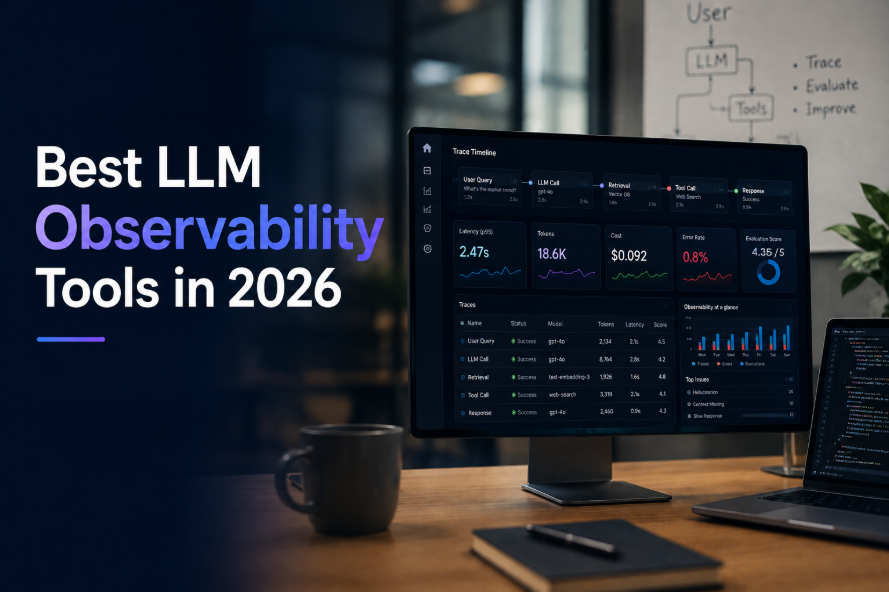
That’s what LLM observability tools are built for. They let teams inspect model calls, traces, retrieval steps, agent actions, costs, latency, and evaluation results in one place. The question is no longer whether you need visibility. It’s how much visibility you need, and which platform fits the way your AI system is built. If you want to see where observability fits into the wider architecture, our guide to what an AI stack is breaks down the different layers that make up a modern AI system.
Table of Contents
What Should an LLM Observability Tool Actually Monitor?
A useful observability platform should show more than whether an API request succeeded.
Traces are one of the starting points. They let you follow an AI request through the different steps it took, including model calls, retrieval and agent actions. That’s particularly useful when an application has several moving parts and you need to find where things went wrong.
Then there are the numbers that affect both performance and your bill: latency, token usage and model costs.
For RAG applications, you also want visibility into what was retrieved and whether the retrieved context actually helped the response. Agent-based systems add another layer because you need to see tool calls and multi-step workflows.
Good platforms go further with evaluations, so you can compare outputs and catch quality regressions instead of waiting for users to report them. Prompt and model changes matter too. If changing a prompt suddenly makes responses worse, your observability data should help you spot that.
So, when comparing LLM monitoring tools, don’t just ask, “Does it have tracing?” Ask what you can actually see and what you can do with that data afterward.
Best LLM Observability Tools at a Glance
There isn’t one obvious winner for every team. The better choice depends heavily on your stack, deployment requirements and what you’re trying to diagnose.
| Tool | Best for | Deployment | Starting price |
|---|---|---|---|
| Langfuse | Open-source and self-hosting | Cloud + self-hosted | Free / paid cloud |
| LangSmith | LangChain/LangGraph teams | Cloud + enterprise deployment options | Free / $39 seat |
| Braintrust | Evaluations and quality workflows | Cloud | Free / $249 |
| Arize | Evaluation, RAG and drift | Cloud + Phoenix OSS | Free / $50 |
| Opik | Open-source + budget | Cloud + self-hosted | Free / $19 |
| Portkey | Gateway + observability | Cloud + self-hosted | Free / $49 |
| AgentOps | Agent debugging | Cloud | Free / $40 |
Pricing can depend on usage, seats, retention and plan limits, so the headline price isn’t enough for a serious comparison.
1. Langfuse
Best for: open-source and self-hosted LLM observability
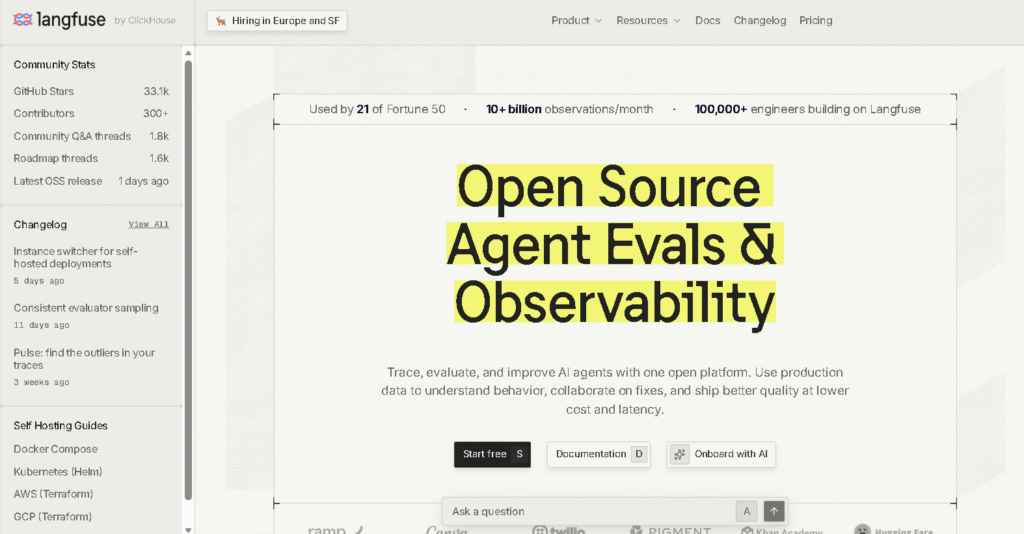
Langfuse is probably the first platform I’d look at if self-hosting is important.
It covers the core observability layer you’d expect, including tracing LLM and agent activity, monitoring costs and latency, evaluations, prompt management and experiments. It also uses OpenTelemetry and supports integrations across different AI frameworks and SDKs, so you’re not forced into one particular application framework.
The other major advantage is its open-source model. Teams can use the cloud version or run Langfuse themselves when they need more control over their data and infrastructure.
Pricing starts with a free tier, followed by paid cloud plans. The bigger question for an enterprise isn’t simply the monthly subscription, though. It’s how the pricing changes as trace volume grows and whether self-hosting is worth the additional operational work.
2. LangSmith
Best for: LangChain and LangGraph teams
LangSmith makes the most sense when LangChain or LangGraph is already a significant part of your stack.
Its advantage isn’t just that it provides tracing. It connects observability with the rest of the agent development process, including evaluations, production monitoring, debugging and deployment. You can trace an agent’s full run, inspect individual steps, monitor cost and latency, and evaluate production traces.
It has also moved beyond being a LangChain-only product. LangSmith now describes itself as framework-agnostic and supports custom agent stacks, along with SaaS, hybrid and self-hosted deployment options for enterprise customers.
The catch is simpler: if you’re not using LangChain or LangGraph and don’t need its broader agent engineering platform, you should compare it more carefully against general-purpose options such as Langfuse or Arize.
3. Braintrust
Best for: evaluation and quality workflows
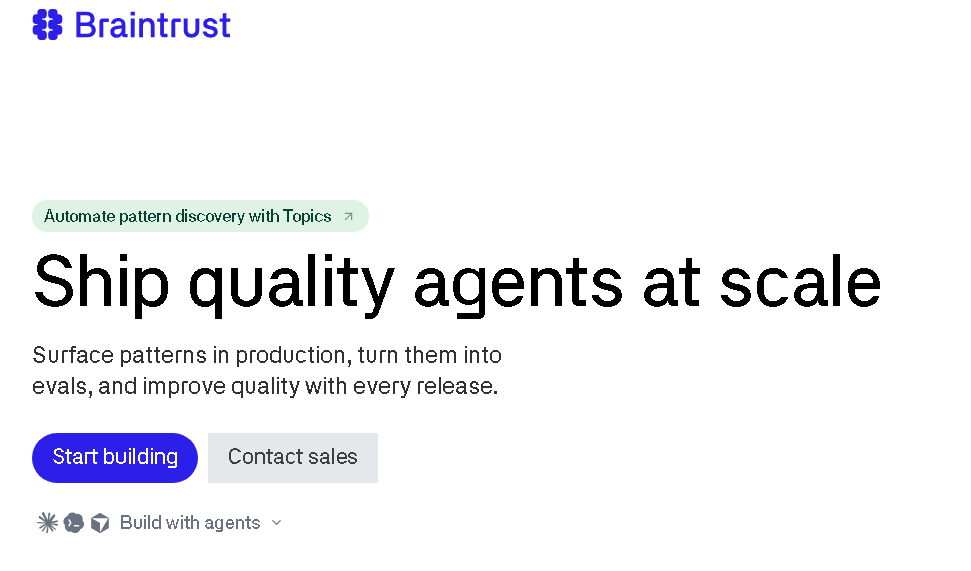
Braintrust takes a slightly different route.
Instead of treating observability as the end goal, it puts a lot of emphasis on using production data to improve AI quality. You can trace what happened, turn patterns from production into evaluations, compare experiments and use scoring workflows to catch regressions before they reach users.
That’s particularly useful for teams that are constantly changing prompts, models or agent logic and need a reliable way to answer a simple question: did the new version actually get better?
Braintrust is therefore a stronger fit when evaluation is central to your workflow. If your main requirement is simply collecting traces, tracking token costs and watching latency, some of the more observability-first platforms may be a better fit.
4. Arize
Best for: production evaluation, RAG and drift detection
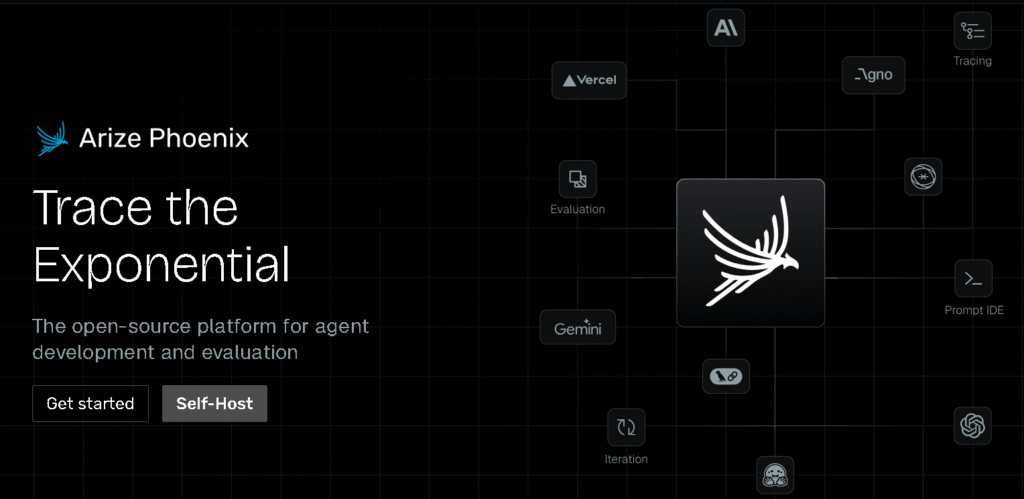
Arize is a little confusing at first because there are really two things to know about: Arize AX and Phoenix.
Phoenix is the open-source side. It can be hosted locally and is built around tracing and evaluation for LLM applications. Arize AX is the broader commercial platform, aimed at teams that need production-scale observability, evaluation and workflows for improving AI agents.
That distinction matters if you’re comparing platforms based on deployment. You can start with Phoenix without buying into the full Arize platform, while AX adds the enterprise layer around production AI development.
Arize also puts more emphasis on evaluation and understanding why an AI system is getting better or worse, rather than treating observability as simply collecting traces. For teams working heavily with RAG or agent systems, that’s a useful difference.
5. Opik
Best for: open-source teams on a budget
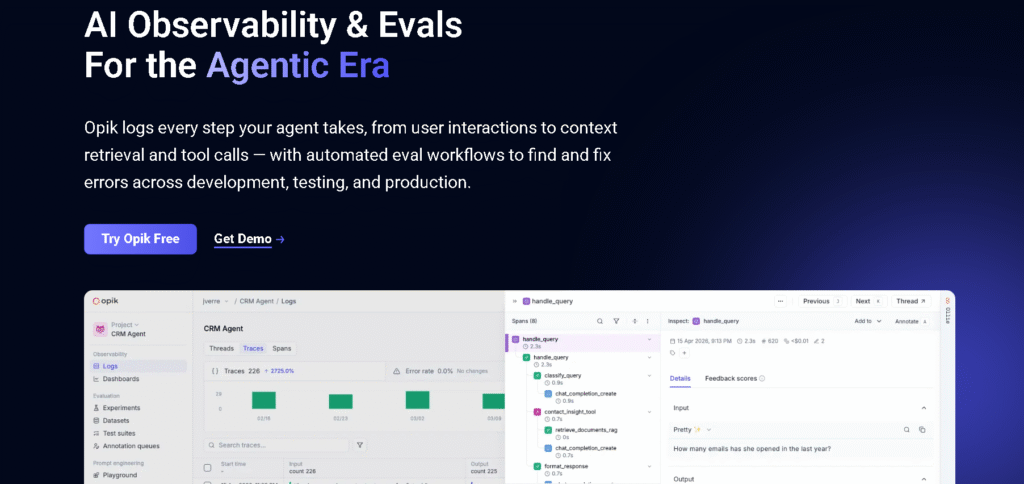
Opik is worth looking at if you like the idea of an open-source observability platform but don’t want to jump straight into a larger enterprise product.
It covers tracing, evaluations and agent analysis, and you can run it yourself or use the cloud version. The free cloud tier also makes it relatively easy to test without committing to a large subscription.
The interesting part is that Opik isn’t trying to win purely on “we have tracing.” It combines observability with evaluation and experimentation, which makes it useful when you’re still figuring out how your AI application should be measured.
For a small team, though, I’d compare it directly with Langfuse before choosing. Both can cover the open-source use case, but their ecosystems and workflows aren’t identical.
6. Portkey
Best for: AI gateway + observability
Portkey is one of the tools I’d be careful about putting in exactly the same bucket as Langfuse.
Its main strength is the AI gateway. Instead of only observing what your application is doing, Portkey can sit between your application and model providers and handle things such as routing, retries, fallbacks and provider management. Observability comes along with that layer.
That can be useful if you’re working with several model providers and don’t want your application tightly coupled to one API.
So if your problem is, “I need to understand every trace in my agent,” Langfuse may be the more natural starting point. If it’s, “I need one layer for routing multiple AI providers and monitoring those requests,” Portkey becomes much more interesting.
7. AgentOps
Best for: AI agent debugging
AgentOps is much more focused on agents than some of the broader observability platforms on this list.
The useful part isn’t just seeing that an agent failed. You can inspect agent sessions, replay what happened and dig into individual steps in a multi-stage workflow. It also tracks things such as LLM usage and costs.
That becomes valuable once an agent stops behaving like a simple request-response application. If an agent makes a bad decision after several tool calls, looking only at the final answer doesn’t tell you much. You need to reconstruct the run.
You need to reconstruct the run. If you’re interested in how these agent workflows are used beyond debugging, our guide to building AI agents for scalable business operations looks at how they work in real business processes. That’s where AgentOps makes sense.
For a basic chatbot or straightforward LLM application, though, you may not need a platform this focused on agent debugging.
8. Helicone
Best for: proxy-based monitoring
Helicone takes a relatively simple approach to observability. Instead of rebuilding your application’s instrumentation from scratch, you can route model requests through its gateway and use that layer to collect information about requests, latency, costs and providers.
That makes it attractive when the priority is getting visibility into AI API usage quickly.
There is, however, an important caveat for a 2026 comparison. Helicone’s current status needs to be checked before treating it as a normal actively competing platform. Current industry references indicate that Helicone moved into maintenance mode following its acquisition by Mintlify.
So I’d still include it because it appears in existing comparisons and is relevant to the category, but I wouldn’t put it in the same recommendation tier as Langfuse, LangSmith or Braintrust without explaining that qualification.
How These Tools Actually Differ
The easiest mistake when comparing LLM observability platforms is assuming they’re all selling the same thing.
They’re not.
Langfuse vs. LangSmith is partly a question of priorities. Langfuse is attractive when open-source deployment and flexibility matter, while LangSmith has a particularly strong connection to the LangChain and LangGraph ecosystem.
Braintrust vs. Arize is less straightforward. Braintrust leans heavily into evaluation, experiments and quality workflows. Arize combines observability and evaluation with a strong focus on production AI systems, RAG and agent performance.
Portkey vs. Langfuse is an even different comparison. Portkey brings an AI gateway into the picture, while Langfuse is more centered on observability, tracing and evaluation.
And AgentOps isn’t really trying to replace every observability platform. Its strength is much narrower: understanding and debugging what happened inside an AI agent.
That’s why a feature checklist alone won’t tell you which platform is actually the better choice. The right one depends on what is going wrong in your AI system in the first place.
Which LLM Observability Tool Should You Choose?
By this point, the differences between these platforms should be clearer. The harder question is deciding which one actually makes sense for your setup.
If self-hosting and control over your data are high on the list, start with Langfuse. It gives you tracing, evaluations, prompt management and cost monitoring without locking you into a particular model or framework.
If your application already relies heavily on LangChain or LangGraph, LangSmith is the easier choice to justify. Its observability, evaluation and agent development features are closely connected, so you don’t have to stitch together separate tools for the development workflow.
If you’re mainly worried about AI quality, take a closer look at Braintrust. Its strength is turning production data into evaluations and using those evaluations to compare prompts, models and releases. That’s particularly useful for teams making frequent changes to an AI application.
Arize makes more sense when RAG, evaluation and production AI performance are major concerns. Its Phoenix project also gives teams an open-source route, while Arize AX provides the broader commercial platform.
Want something open-source without a large starting bill? Opik is worth testing alongside Langfuse.
If you’re dealing with several model providers and need routing, fallbacks and observability together, Portkey is a different kind of option. It sits closer to the gateway layer.
And if your biggest headache is an autonomous agent doing something you can’t easily reconstruct, AgentOps is more focused on session replay and agent debugging than a general observability platform.
The point is that the “best” tool changes depending on the problem you’re trying to solve.
What Should You Look for Before Paying?
Don’t compare these platforms by looking at the number printed next to “$/month” and stopping there.
A $50 plan can be more expensive than a $200 plan if your application generates far more traces than the cheaper plan includes.
Look at trace or span limits, data retention and how usage is billed. Then check whether you can self-host if that’s important for your company. Data residency can matter just as much, particularly when prompts or retrieved documents contain sensitive information.
I’d also check OpenTelemetry support, framework integrations and evaluation capabilities before signing anything. An observability platform that works beautifully with your current stack is usually more useful than one with a longer feature list.
For larger teams, add the less exciting questions too: SSO, RBAC, audit logs, enterprise support and deployment options.
In other words, compare what the price actually buys you, not just the starting price.
Final Verdict
There isn’t one LLM observability platform that’s the right choice for every production AI system. The better option depends on your architecture and what you actually need to monitor.
For most teams, Langfuse is the strongest overall choice, especially if self-hosting, flexibility and broad observability matter. It covers tracing, evaluations, prompt management, cost monitoring and latency without tying you closely to one AI framework.
If you’re already building heavily with LangChain or LangGraph, LangSmith is the more natural choice because observability and agent development are closely connected.
For teams where AI evaluation and quality improvement are the priority, Braintrust deserves a closer look. If you’re working heavily with RAG, production evaluation and drift, Arize is another strong option.
For open-source teams on a tighter budget, Opik is worth comparing with Langfuse. If you need an AI gateway alongside observability, Portkey makes more sense, while AgentOps is better suited to teams whose main challenge is debugging complex AI agents.
So rather than choosing the platform with the longest feature list, start with the problem you need to solve. Langfuse is the best general starting point, but the right platform is the one that fits your AI workflow.
FAQs
What is LLM observability?
LLM observability is the practice of tracking what happens inside an AI application, from the initial model call to the final response. It can show traces, token usage, latency, model costs, retrieval steps, tool calls and evaluation results. This helps teams understand not just whether an AI application failed, but why it behaved the way it did.
Do I need LLM observability if I already use Datadog?
Not necessarily. Datadog now provides LLM and agent observability, so teams already using Datadog can monitor AI workloads alongside their application and infrastructure metrics. However, dedicated platforms such as Langfuse can provide deeper LLM-specific workflows, including evaluations, prompt management and self-hosting. Many teams can use both, with Datadog handling broader infrastructure monitoring and a dedicated platform handling LLM engineering workflows.
Which LLM observability tools support self-hosting?
Langfuse, Opik and Arize Phoenix are among the options that support self-hosting. Langfuse is open source under the MIT license and offers self-hosting through Docker, Kubernetes and other deployment options. Opik and Phoenix also provide open-source deployment options. The right choice depends on whether you need basic tracing, evaluations, RAG monitoring or a broader production platform.
What does LLM observability cost at 10M traces per month?
There isn’t a single price because observability platforms measure usage differently. Some charge by traces or units, while Datadog charges by LLM spans. For example, at 10 million traces per month, a system generating an average of four LLM spans per trace would produce about 40 million billable LLM spans in Datadog. At its published annual rate, that would put the base observability cost at roughly $14,125 per month before retention add-ons. Your actual cost can be very different depending on the number of model calls, retention requirements and the platform you choose.

Leave a Reply