

Enterprise AI security has moved beyond protecting a model from a bad prompt. Production AI systems now connect models to company data, retrieval systems, APIs, plugins, tools, agents, and sometimes external MCP servers. That creates several places where an attacker can influence the system or extract information.
The current OWASP LLM risk list includes prompt injection, sensitive information disclosure, supply-chain risks, data and model poisoning, improper output handling, excessive agency, system prompt leakage, and vector and embedding weaknesses.
That is why the phrase “LLM security tool” can be misleading. A runtime guardrail, AI DLP product, red-team platform, model scanner, and enterprise AI security platform may all appear in the same search results, but they protect different parts of the stack.
For enterprise buyers, the better approach is to match the security layer to the AI deployment.
Table of Contents
The GenAI Attack Surface
A simple chatbot has a relatively narrow path:
User → Prompt → Model → Response
An enterprise AI application is usually more complicated:
User → Application → Model → RAG/Data → Tools → APIs → Agent → Action
Every connection adds another security boundary.
For example, an attacker does not necessarily need to convince a model to produce a harmful answer. An indirect prompt injection hidden inside a document could influence an agent after the document is retrieved. An overly permissive tool could then allow the agent to perform an action that the original user never intended.
Recent security research has demonstrated this broader problem. OWASP’s 2026 exploit roundup includes incidents involving prompt injection, sensitive information disclosure, improper output handling, agent goal hijacking, and tool misuse.
This changes what enterprise teams should look for in LLM security tools.
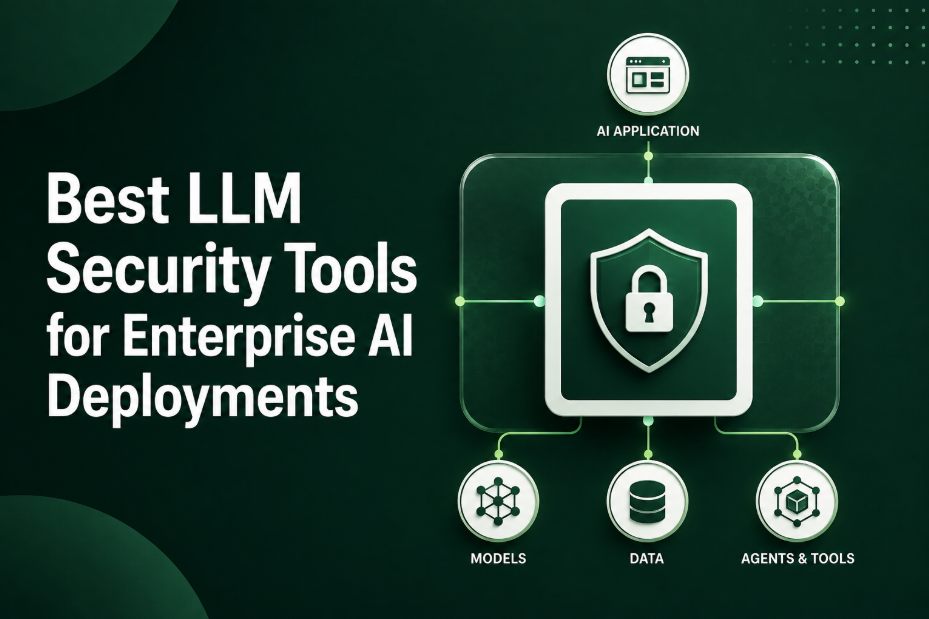
A useful platform should be evaluated against at least four layers:
| Layer | Main security concern | Typical control |
|---|---|---|
| Input | Prompt injection, jailbreaks | Runtime detection |
| Data | Sensitive information exposure | DLP, access controls |
| Model/application | Unsafe behavior, vulnerabilities | Testing, red teaming |
| Agent/action | Tool misuse, excessive agency | Runtime policy and authorization |
The more autonomous the AI system becomes, the more important the last layer is. This becomes particularly important for production agents, where security teams also need visibility into tool calls, execution paths, failures, and unexpected behavior.
Prompt Injection & Jailbreak Defence
Prompt injection remains one of the most important LLM application risks. OWASP defines it as an attack in which crafted inputs alter the model’s behavior or output in unintended ways.
Jailbreaks are related but not identical. A jailbreak generally attempts to bypass a model’s safety restrictions, while prompt injection can manipulate the application or model into following attacker-controlled instructions.
For enterprise deployments, indirect prompt injection is particularly important.
Consider a research agent that reads websites, summarizes documents, and then calls internal tools. A malicious instruction embedded in one of those documents could become part of the agent’s context. The attack therefore enters through data rather than directly through the user’s prompt.
This is why simply adding a stronger system prompt is not enough.
Runtime security products can inspect prompts and outputs, but agent deployments increasingly require controls around tool calls, retrieved content, and actions as well.
Current platforms reflect this shift. Prisma AIRS, for example, provides runtime security alongside agent security, while HiddenLayer’s current runtime product monitors inputs and outputs and its agentic runtime security is designed around multi-turn sessions and tool calls.
The important buying criterion is therefore not just whether a product “blocks prompt injection.”
Look at:
- Direct and indirect prompt injection coverage
- Jailbreak detection
- Multi-turn attacks
- RAG-aware protection
- Tool-call inspection
- Agent behavior monitoring
- Blocking versus alerting
- Custom policy support
No runtime product should be presented as making prompt injection permanently solved. It is one layer in a larger security design.
Data Leakage / DLP for LLMs
Sensitive information disclosure is another major LLM security problem. OWASP includes personal information, financial data, health records, credentials, confidential business information, and proprietary model information among the types of data that can be exposed through LLM applications.
The leakage path can occur in several places.
An employee may paste confidential information into a public AI service. A RAG application may retrieve information the current user should not see. An agent may send sensitive information to a tool. Or the model may include confidential information in its response.
This is why AI DLP should not be treated as only a prompt filter.
Enterprise buyers should check whether the product can inspect:
- User prompts
- Model responses
- Retrieved content
- Tool arguments
- Tool responses
- Files and documents
- Employee AI usage
- Sensitive data patterns
- Organization-specific policies
WitnessAI, for example, positions its platform around company-wide visibility across employees, applications, models, and agents, with real-time redaction and policy enforcement. SentinelOne’s acquisition of Prompt Security also expanded its capabilities around AI usage visibility, data leakage prevention, prompt injection, and MCP gateway security.
For organizations primarily concerned with employees sending sensitive information to public AI tools, this type of capability may be more valuable than buying a model scanner.
Runtime Guardrails vs Scanners
This is one of the most important distinctions when comparing LLM security tools.
A scanner primarily answers:
Can we find a weakness before the application reaches production?
A runtime control answers:
Can we detect or block a dangerous interaction while the application is running?
These are complementary.
| Capability | Security scanner | Runtime guardrail |
|---|---|---|
| Pre-production testing | Strong | Limited |
| Red teaming | Strong | Usually limited |
| Prompt inspection | Testing context | Real-time |
| Output inspection | Testing context | Real-time |
| Blocking live attacks | No | Yes, depending on product |
| Regression testing | Strong | Limited |
| Agent/tool monitoring | Depends on product | Increasingly common |
| Production enforcement | No | Yes |
HiddenLayer, for example, separates AI Attack Simulation from AI Runtime Security. Prisma AIRS similarly combines AI Red Teaming with AI Runtime Security and AI Agent Security.
That architecture makes sense.
A red-team system can expose an attack path. Runtime protection can then enforce a policy against that class of behavior in production.
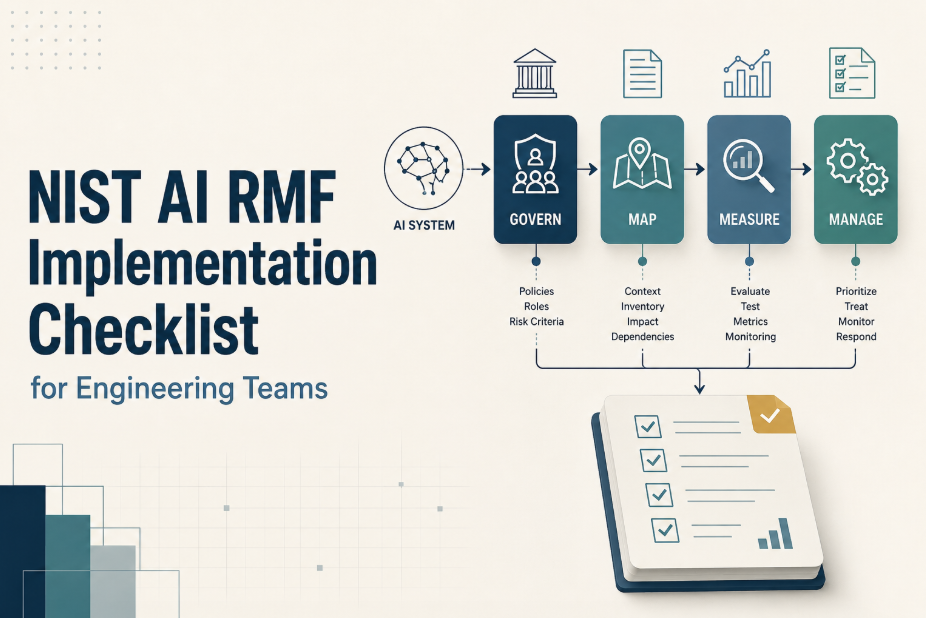
Enterprise teams should therefore be cautious about choosing a product solely because it has an impressive attack-detection benchmark. The important question is what happens after the detection. Security tooling is only one part of a broader AI risk-management process, so teams should also map these controls to the governance framework they use internally.
Can the platform block the request?
Can it redact sensitive information?
Can it stop a tool call?
Can it require human approval?
Can it produce an audit record?
Those capabilities determine how useful the security layer becomes in production.
Platform Comparison
The current market is also changing quickly through consolidation.
Protect AI was acquired by Palo Alto Networks in July 2025 and its capabilities were integrated into Prisma AIRS. Lakera was acquired by Check Point, and Prompt Security was acquired by SentinelOne in 2025.
That means older articles that list Protect AI, Lakera, and Prompt Security as independent vendors are already outdated.
| Platform | Primary strength | Runtime | Testing | DLP | Agent security | Best fit |
|---|---|---|---|---|---|---|
| Prisma AIRS | Broad AI security lifecycle | Yes | Yes | Yes | Yes | Large enterprises wanting one AI security platform |
| Check Point AI Security | Runtime and enterprise AI protection | Yes | Yes | Yes | Yes | Check Point environments and enterprise AI workloads |
| SentinelOne AI security | AI usage, runtime and agent security | Yes | Yes | Yes | Yes | Enterprises already using SentinelOne |
| HiddenLayer | AI lifecycle security | Yes | Yes | Yes | Yes | Security teams wanting discovery, model security, testing and runtime controls |
| Robust Intelligence AI Firewall | Application runtime protection | Yes | Via AI Validation | Yes | Partial | Teams needing API-based AI application protection |
| WitnessAI | Enterprise AI visibility and governance | Yes | Yes | Yes | Yes | Organizations securing employee and agent AI usage |
| Google Model Armor | Managed AI interaction screening | Yes | No | Yes | Increasing | Google Cloud and API-centric deployments |
| Microsoft Prompt Shields | Prompt and indirect injection defense | Yes | No | Yes | Partial | Microsoft/Azure AI environments |
The table should be read as a capability map rather than a universal ranking.
Prisma AIRS has expanded considerably beyond its original model-security and AI-testing roots. Its current platform includes AI Runtime Security, AI Model Security, AI Red Teaming, AI Agent Security, posture management, and an AI Gateway. Its 2026 releases also include agentic testing and AI Gateway functionality.
HiddenLayer similarly combines discovery, AI supply-chain security, attack simulation, and runtime security. Its current documentation describes runtime protection that can detect, redact, or block malicious input and output, with a newer agentic runtime layer for tool-based systems.
Robust Intelligence is more focused on application protection through its AI Firewall and AI Validation products. Its AI Firewall provides runtime guardrails for threats including prompt injection, data leakage, and unsafe model behavior.
WitnessAI takes a broader enterprise-control approach, covering employee AI use as well as applications and agents. Its platform includes AI discovery, policy enforcement, runtime protection, redaction, and agent/MCP controls.
Cloud-native options also deserve consideration. Google Model Armor provides managed screening for AI interactions, while Microsoft’s Prompt Shields focus on detecting malicious user prompts and indirect attacks hidden in external content. These can make sense when an organization already has a strong commitment to the corresponding cloud ecosystem.
Deployment Models
The deployment point can matter as much as the feature list.
Application-level SDK
The security control sits directly inside the AI application.
This gives developers detailed control and can work well for individual applications. The downside is that every application may need its own integration and policy configuration.
AI gateway or proxy
A gateway creates a centralized enforcement point for multiple applications and models.
This can simplify enterprise policy, monitoring, routing, and auditing. It also introduces an architectural dependency that should be evaluated for availability and latency.
Cloud-managed service
Managed controls such as Google Model Armor or cloud-native guardrails can be attractive when the AI workload already runs heavily within one cloud environment.
The trade-off is platform dependency and, depending on the service, potentially narrower coverage outside that ecosystem.
Endpoint or browser controls
These are more appropriate for employee-facing AI usage.
They can address shadow AI, sensitive data submission, and approved-tool policies, but they are not substitutes for runtime protection inside a production AI application.
Self-hosted or customer-controlled deployment
This can matter for organizations handling sensitive data or operating under strict residency requirements.
The trade-off is additional operational responsibility.
How to Choose LLM Security Tools
Start with the attack surface rather than the vendor list.
| Primary concern | Security layer to prioritize |
|---|---|
| Employees entering sensitive data into AI | AI DLP and usage controls |
| Public-facing LLM application | Runtime guardrails |
| RAG application | Data access controls plus runtime security |
| Autonomous AI agent | Agent and tool security |
| Third-party model risk | Model and supply-chain security |
| Pre-production vulnerabilities | AI security testing and red teaming |
| Multiple AI systems across the enterprise | Broader AI security platform |
Latency should also be tested rather than taken from a vendor benchmark.
Runtime inspection can introduce additional processing, but the impact depends on the architecture, payload size, detection methods, deployment region, and number of inspection points. For production workloads, measure your own p95 and p99 latency with representative traffic.
Price needs the same treatment.
Many enterprise AI security products use quote-based or usage-based pricing. Instead of comparing headline prices, identify what actually drives the bill:
- Number of users
- AI interactions
- Tokens
- Applications
- Agents
- Models
- Data volume
- Environments
- Retention requirements
A cheaper product can become expensive if it charges heavily for every request or requires substantial engineering work to operate.
Verdict
There is no single LLM security tool that is the right choice for every enterprise.
A company mainly worried about employees leaking sensitive information into public AI needs a different control layer from a company deploying autonomous agents against internal systems.
For broad AI lifecycle protection, platforms such as Prisma AIRS and HiddenLayer cover a wide range of discovery, testing, model security, runtime protection, and agent security capabilities.
For application-focused runtime protection, Robust Intelligence’s AI Firewall is a more specialized option.
For organizations concerned with enterprise-wide AI usage, governance, and agent activity, WitnessAI and SentinelOne’s expanded AI security capabilities are worth evaluating.
The more useful buying principle is to identify where an attack can enter, what the AI can access, and what it can do when something goes wrong.
A scanner can find a weakness. A runtime control can enforce a policy. DLP can protect sensitive information. Agent security can constrain actions. Model security can address threats before a model reaches production.
Enterprise AI deployments increasingly need several of these layers working together.
FAQs
What is an LLM firewall?
An LLM firewall is a security layer that sits between an AI application and its users, models, data sources, or tools to inspect AI interactions and enforce security policies. Depending on the product, it may detect or block prompt injection, jailbreaks, sensitive information, unsafe outputs, or malicious tool activity.
The term is not standardized, so buyers should examine the actual enforcement point and capabilities rather than relying on the “LLM firewall” label.
Can LLM security tools stop prompt injection?
They can detect and block many prompt-injection attempts, but no security product should be treated as a complete solution to prompt injection.
OWASP identifies prompt injection as a major LLM application risk, and modern agentic systems introduce additional attack paths through retrieved content, tools, and external data.
Runtime detection should therefore be combined with least privilege, authorization, input and output controls, testing, monitoring, and limits on what an AI system can actually do.
Do LLM security tools add latency?
Runtime security controls can add processing overhead because prompts, responses, retrieved content, or tool interactions may need to be inspected.
The actual impact varies considerably by architecture and vendor. Enterprises should test p95 and p99 latency using production-like traffic rather than relying only on advertised averages.
How do LLM security tools compare on price?
There is no reliable universal price ranking because enterprise products often use usage-based, user-based, token-based, or custom pricing.
Compare what generates cost and estimate it against your expected AI traffic, users, applications, agents, and data volume. Also include engineering and operational effort when calculating the total cost of ownership.
Leave a Reply