

Choosing AI tools for regulated industries is a different job from choosing them anywhere else. In most industries, it is a feature and pricing comparison. In a regulated industry, it is a vendor-risk decision. The tool will touch data that carries legal obligations, and the buyer, not the vendor, answers for how that data is handled.
Quick answer: To choose an AI tool in a regulated industry, start with your own obligations: which data the tool will touch and which rules apply. Then verify the vendor’s security evidence behind the badges, get training use, retention and deletion terms in writing, check that you can audit what the tool does, and pick a deployment model based on where model inference actually happens.
Treating it as a vendor-risk decision changes what a good evaluation looks like. A polished security page and a row of compliance badges are starting points, not answers. A SOC 2 report covers specific systems and controls. A signed BAA does not settle a terms-of-service clause that contradicts it. “HIPAA compliant” is a marketing phrase: HHS does not certify vendors or products as HIPAA compliant.
This checklist covers the areas where AI vendor evaluations in regulated industries actually succeed or fail: security, data handling, auditability, AI-specific risks, and deployment. It is written for teams in healthcare, financial services, legal, and other regulated sectors. It is general information, not legal advice. Your obligations depend on your sector and jurisdiction, so treat the legal points as questions to settle with your compliance team or counsel, not as conclusions.
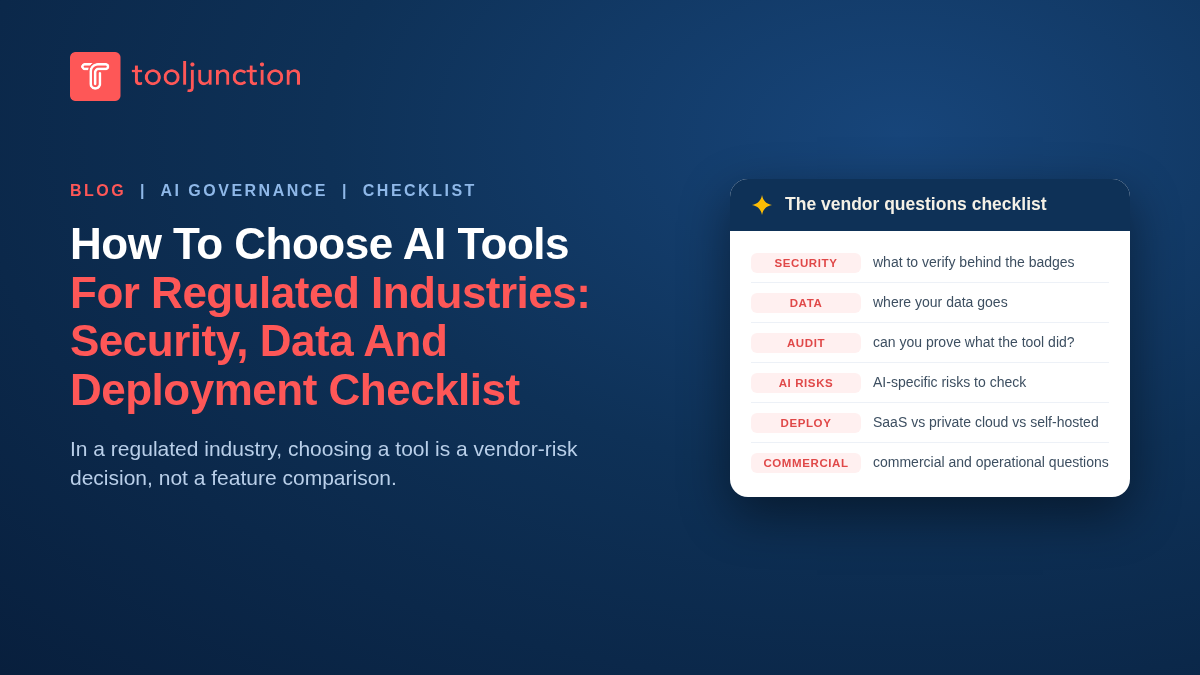
Table of Contents
Start With Your Own Obligations, Not the Vendor’s Marketing
Before comparing vendors, write down what your organization is actually required to protect. Vendors cannot do this for you, because the same AI tool can be acceptable for one team and unacceptable for another inside the same company.
Three things to define first:
Which data classes will the tool touch. Customer personal data, employee data, patient information, financial records, privileged legal material, source code, and anonymized telemetry are different risk tiers. Many evaluations get easier the moment you decide that certain data classes simply never go into the tool.
Which rules apply to you. Obligations are sector- and jurisdiction-specific, and they sit with you as the buyer:
- Healthcare: Providers and their vendors in the US handle protected health information under HIPAA, which requires a business associate agreement (BAA) before a vendor may handle PHI.
- Financial services: Rules on vendor and outsourcing risk usually apply to AI tools too. Examples include the GLBA Safeguards Rule in the US, DORA’s ICT third-party risk requirements in the EU, and the RBI’s Master Direction on Outsourcing of IT Services in India. Expect to document due diligence, audit rights, and exit plans for the vendor.
- Legal: Client confidentiality and privilege are the main concerns. Bar regulators have started publishing guidance on generative AI, such as the American Bar Association’s Formal Opinion 512, which covers confidentiality, competence, and client communication when lawyers use AI tools.
- Personal data (EU): Organizations handling EU personal data work under GDPR, which requires a data processing agreement and regulates cross-border transfers.
- Personal data (India): India’s Digital Personal Data Protection Act is coming into force in phases: the DPDP Rules were notified on 14 November 2025 with an 18-month period for phased compliance, so the core obligations apply from May 2027. If you handle the personal data of people in India, check which obligations apply to you at signing, especially for multi-year deployments.
- EU AI Act: Buyers in the EU should also track the EU AI Act. Most obligations land on providers, but deployers of high-risk systems have their own duties, including human oversight and log retention. The Act applies in stages, and the AI Omnibus moved some dates: Article 50 transparency obligations apply from 2 August 2026 (the watermarking duty in Article 50(2) moved to 2 December 2026 for systems already on the market), Annex III high-risk obligations from 2 December 2027, and Annex I high-risk obligations from 2 August 2028. We cover the details in our EU AI Act compliance guide.
Who signs off internally. In a regulated industry, the evaluation is not complete when the team that wants the tool is satisfied. Security, privacy, legal or compliance, and the data owner each need a defined checkpoint. Deciding this before the pilot prevents the common pattern where a tool is “approved” in practice because everyone assumed someone else was reviewing it.
Security: What to Verify Behind the Badges
Every serious AI vendor shows security badges. The useful skill is reading past them.
SOC 2: check type and scope, not just presence. A Type 1 report assesses whether controls were suitably designed on a specific date. A Type 2 report assesses whether those controls operated effectively over a period, which is meaningfully stronger evidence. Ask for the report under NDA and check two things: the period covered (a report from two years ago tells you little) and the scope (whether it covers the actual product and entities you are buying, or only part of the company).
ISO 27001 and ISO 42001. ISO 27001 certifies an information security management system. ISO 42001, a newer standard, certifies an AI management system specifically. Neither guarantees any single product behavior, but a current certificate shows the vendor runs audited processes rather than improvised ones.
Penetration testing and vulnerability handling. Ask when the last independent penetration test ran, whether a summary is shareable, and whether the vendor runs a bug bounty or a responsible disclosure program.
Access controls your admins will actually use. For a regulated deployment, the baseline is SSO (SAML or OIDC), SCIM provisioning so departing employees lose access automatically, and role-based access control. Check whether these features are locked to an enterprise tier; many are. If the tool is an AI agent that can act inside other systems, also check what it is allowed to read, write, and send. Our guide to AI agent permissions covers least privilege and approval gates in more detail.
Encryption and key management. Encryption in transit and at rest is table stakes. The differentiating questions are who manages the keys, whether the vendor supports customer-managed keys (BYOK), and how key rotation and revocation work.
A useful rule for the whole section: an attestation tells you an auditor examined something. It never tells you the tool is suitable for your specific regulated use. That judgment stays with you.
Data: Where Your Data Goes
This is the section where most AI evaluations in regulated industries are won or lost, because AI tools send your data to a model, and what happens next is a contract question, not a settings toggle.
Model training on your data. The first question for any AI vendor is whether your inputs, outputs, or files are used to train models, and under which plan. Defaults differ by product tier in ways that matter. For example, OpenAI states that API and business-tier data is not used for training by default, and Anthropic states the same for its commercial products, with narrow exceptions such as data you explicitly opt in to share, while consumer tiers of AI products can have different default settings. Individual features can also carry their own data terms, so check the terms for the exact features you will use. Never assume the enterprise default applies to the plan you are actually buying, and never rely on a sales answer: get the training-use terms in the contract or the current written policy, and re-check them at renewal.
Retention and deletion. Ask how long prompts and outputs are retained, what the deletion process is, and how long deletion takes to complete. Some vendors offer reduced- or zero-retention options for sensitive workloads; OpenAI’s zero data retention program for eligible API customers is one example. Retention terms can also differ by model within the same vendor, and they change quickly. Anthropic, for example, began retaining 30 days of customer data from its most advanced Fable and Mythos models in June 2026, then announced new enterprise controls in September 2026 that let business customers store and manage that data themselves, with a phased rollout from fall 2026. If your regulator or policies limit retention, the vendor’s retention window for the exact model and plan you use is a compliance fact you need in writing.
Subprocessors. Your data may pass through cloud providers, model providers, and analytics tools. A serious vendor publishes a subprocessor list and gives notice before changing it. No list, or a refusal to share it, is a problem.
Data residency. If your sector or jurisdiction restricts where data can be stored or processed, ask which regions the vendor supports for processing, not just storage, and whether the model inference itself happens in-region.
The contract stack. Depending on your situation this can include a data processing agreement, a BAA for healthcare PHI in the US, and standard contractual clauses for cross-border transfers. Read these documents together with the vendor’s standard terms, and check the order-of-precedence clause that says which document wins in a conflict. If the standard terms grant the vendor broad rights over customer data and are not clearly overridden, that conflict can weaken the protection your BAA or DPA was meant to give.
Incident history. Ask whether the vendor has disclosed security incidents, how they notified customers, and what changed afterward. A vendor with a clean, well-handled disclosure record is often a better bet than one claiming nothing has ever happened.
Auditability: Can You Prove What the Tool Did?
Regulators and auditors rarely ask whether you bought a secure tool. They ask what the tool did, who used it, and who checked the result. If you cannot answer those questions from records, the tool is hard to defend in a regulated workflow.
Activity and admin logs. Check that the tool logs who used it, when, and which workspace or data source was involved, and that admin changes such as new users, permission changes and connected apps are logged too. Your security team should be able to export these logs to your own SIEM or storage, not only view them in the vendor’s dashboard.
Prompt and output records. For some workflows, such as credit decisions, clinical documentation or legal advice, you may need to keep a record of what was asked and what the AI returned. Confirm whether the tool can retain these records under your control, and how that fits with the retention limits in the previous section. Zero retention at the vendor and full records on your side can both be true if the logs are stored in your environment.
Human review records. If your policy requires a person to check AI output before it is used, the tool or your workflow should record who reviewed it and when. An approval step that leaves no trace is hard to prove during an audit.
Model and version tracking. Ask whether you can see which model and version produced a given output. When a vendor updates the underlying model, results can change, and you may need to show which version was in use on a specific date.
AI-Specific Risks to Check
A standard SaaS vendor review covers most of the checklist above. AI tools add a few risks that traditional software reviews tend to miss.
Silent model changes. Vendors regularly swap or update the model behind a product. That can change output quality, behavior, and even where data is processed. Ask whether the vendor gives notice before changing the underlying model and whether you can pin a version for critical workflows.
Wrong or invented outputs. AI tools can produce answers that sound correct but are not. In a regulated workflow, decide in advance which outputs must be checked by a person, and test the tool on your own examples before rollout rather than relying on vendor benchmarks.
Prompt injection. If the tool reads emails, documents or web pages, hidden instructions in that content can try to make it leak data or take unwanted actions. Ask how the vendor defends against this. Our comparison of prompt injection detection and LLM firewall tools covers the main approaches.
Agent actions. AI agents that can send messages, update records or connect to other apps create a bigger risk surface than chat tools. Check which actions need human approval and whether that approval can be enforced by admins. Our guide to OpenAI Dots privacy and permissions shows what these questions look like for one agent product.
Deployment Models: SaaS vs Private Cloud vs Self-Hosted
Deployment decides how much of the security burden stays with the vendor and how much moves to you. The main options:
| Model | What it means | Typical fit | Main trade-off |
| Multi-tenant SaaS | Vendor hosts everything; you share infrastructure with other customers | Most teams, when data classes allow | Least control over data location and isolation |
| Single-tenant or private cloud | A dedicated environment in the vendor’s cloud or yours | Regulated data with a vendor you trust | Higher cost, longer setup |
| Private connectivity | Traffic routed through private links (for example AWS PrivateLink) instead of the public internet | Teams with network-level requirements | Only solves transport, not retention or training use |
| Self-hosted / on-prem | Software or open-weight models run in your environment | The strictest data-residency or air-gap needs | Your team owns operations, patching, and model quality |
| Hybrid | SaaS product, but inference or storage pinned to your region or cloud | Residency-driven requirements | Feature lag behind the main SaaS product |
Two practical notes. First, deployment model and data policy are separate: self-hosting an orchestration layer does not help if prompts still leave for a third-party model API with weak terms. Trace where inference actually happens. Second, “we can deploy in your VPC” sometimes means “we will sell you an expensive enterprise contract,” so confirm pricing and minimums before the technical evaluation invests further.
| Area | Evidence to request | Warning sign |
|---|---|---|
| Security | Current SOC 2 Type 2 report with scope and period; penetration test summary | Only a badge on a web page, or a Type 1 report from long ago |
| Data | Written training-use, retention and deletion terms for your exact plan; subprocessor list | Sales answers that differ from the contract |
| Auditability | Exportable user, admin and AI activity logs; model and version records | Logs visible only in the vendor dashboard |
| Deployment | Where model inference runs for each option, plus pricing for private connectivity | "Deploy in your VPC" with no price or technical detail |
The Vendor Questions Checklist
These are the questions to send in writing. Evasive answers are themselves an answer.
Security
- Do you have a current SOC 2 Type 2 report, and does its scope cover the product we are buying?
- When was your last independent penetration test, and can you share a summary under NDA?
- Do you support SSO, SCIM, and role-based access control, and on which plans?
- Do you support customer-managed encryption keys?
Data
- Is our data used to train models, on the exact plan we are buying? Where does the contract say so?
- What are your default retention periods for prompts and outputs, for the specific models we will use, and what reduced-retention options exist?
- What is your deletion process and completion timeline?
- Can you share your current subprocessor list, and do you notify before changes?
- In which regions is data processed, including model inference?
- Will you sign our DPA or BAA, and which document takes precedence if it conflicts with your standard terms?
Auditability
- Which user, admin, and AI activity is logged, and can we export those logs to our own systems?
- Can we keep records of prompts, outputs, and human reviews under our control?
- Can we see which model and version produced a given output?
AI-specific risks
- Will you notify us before changing the underlying model, and can we pin a version?
- How do you protect against prompt injection and data leakage through connected content?
- Which agent actions require human approval, and can admins enforce that?
Deployment
- Which deployment models do you offer, and which do customers in our sector typically use?
- Where does model inference physically happen for each deployment option?
- If we require private connectivity or regional processing, what changes in price and features?
Commercial and operational
- Which security and compliance features are gated to higher tiers?
- What happens to our data if we cancel, and in what format and timeline can we export it?
- Have you disclosed security incidents in the past three years, and how were they handled?
Red Flags
Walk away, or escalate to your compliance team, when you see:
- “HIPAA compliant” or “GDPR compliant” claims with no report, no BAA, and no specifics. There is no official HIPAA certification, and GDPR certifications are scheme-specific and rare, so a bare “compliant” label proves nothing.
- Refusal to share a SOC 2 report or subprocessor list under NDA.
- Training-use terms that differ by plan, with the sales team unable to say which applies to yours.
- A BAA or DPA offered alongside standard terms that contradict it, with no clear order-of-precedence clause.
- No written retention or deletion timeline.
- No exportable logs, or no way to tell which model produced an output.
- Model changes rolled out with no notice to customers.
- Consumer-grade plans proposed for regulated data because “the company is the same.”
- Security features essential to your policy (SSO, audit logs, SCIM) locked to a tier far above the quoted one.
Final Takeaway
Choosing AI tools for regulated industries is mostly about refusing shortcuts. The vendor’s badges tell you an audit happened; they do not tell you the tool fits your obligations.
Define your data classes and applicable rules before the demo. Verify the security evidence behind the badges, including report type, scope, and date. Get data handling in writing: training use, retention, deletion, subprocessors, residency. Make sure you can audit what the tool did and which model did it. Choose a deployment model by tracing where inference actually happens, and treat the contract stack as one set of documents, not separate papers.
The organizations that get this right are not the ones that found a “compliant” vendor.
They are the ones that could show, for the tool they chose, exactly which questions were asked, what the answers were, and who signed off.
If you are building a shortlist, ToolJunction, an AI tools and agent discovery platform, helps you discover, evaluate, and compare AI solutions before you send vendors this checklist.
FAQs
Is a SOC 2 report enough to approve an AI vendor?
No. A SOC 2 report describes how an auditor assessed a defined set of controls at a defined time. It does not cover whether the vendor’s data handling fits your legal obligations, and it may not cover the product or entity you are buying. Treat it as one input alongside data terms, auditability, deployment options, and your own regulatory analysis.
Does a signed BAA make an AI tool safe for healthcare data?
A BAA is required before a vendor may handle PHI, but it is not sufficient on its own.
Read it together with the vendor’s standard terms and check which document takes precedence. If the standard terms grant broader rights over customer data than the BAA allows and are not clearly overridden, the conflict can weaken your protection. The BAA also says nothing about whether the product’s actual behavior, such as model training or retention, matches your policies.
Does the EU AI Act matter to us as a buyer?
Most obligations fall on AI providers, but deployers of high-risk systems have their own duties, including use according to instructions, human oversight, and log retention. The Act applies in stages: Article 50 transparency obligations apply from 2 August 2026 (with the Article 50(2) watermarking duty for systems already on the market moved to 2 December 2026), while high-risk obligations now apply from 2 December 2027 (Annex III) and 2 August 2028 (Annex I). Confirm current dates against official sources, and identify whether your intended use case is high-risk before purchase rather than after.
Should a regulated company only consider self-hosted AI?
Not necessarily. Self-hosting maximizes control but moves operations, patching, and model quality onto your team, and it does not help if data still leaves through a third-party API. Many regulated organizations use SaaS AI tools successfully by limiting which data classes enter the tool and by contracting the right data terms. The right answer comes from your data classification, not from a default preference for either model.
How often should a vendor review be repeated?
At minimum at renewal, and whenever the vendor changes its data terms, subprocessor list, underlying model, or the plan you are on. AI vendors update training-use and retention policies more often than traditional software vendors, so an evaluation from a year ago may describe terms that no longer exist.


