

An enterprise AI agent platform is more than a tool for making an AI agent. It is the layer that helps a company build, run, connect, monitor, evaluate, and govern agents in real business workflows.
That distinction matters because the market now includes developer frameworks, managed platforms, cloud agent runtimes, and vertical AI products. They may all appear in the same search results, but they solve different problems.
LangGraph and CrewAI, for example, give developers tools for building and orchestrating agent workflows. Microsoft Agent Framework provides workflow and multi-agent orchestration capabilities, while services such as Amazon Bedrock AgentCore provide production infrastructure around runtime, identity, observability, and other agent capabilities.
So the real buying question is not simply, "Which AI agent platform is best?"
It is, "Which parts of the agent stack do we want to build, and which parts should a platform provide?"
Table of Contents
What Counts as an Agent Platform?
A useful enterprise AI agent platform should cover more than prompts and model calls. At minimum, buyers should look at how the system handles orchestration, state, tools, deployment, human approval, permissions, observability, evaluation, and failure recovery. If you are starting from the workflow itself, our practical guide to building AI agents explains how goals, context, tools, rules, and human review fit together before you choose the underlying platform.
A simple production architecture looks like this:
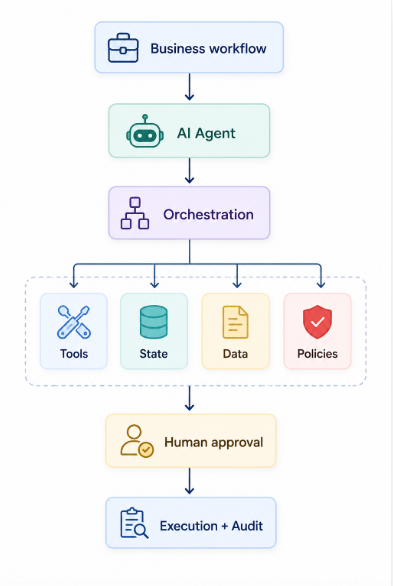
The important part is everything around the model.
An agent can produce a convincing answer in a prototype and still be unsuitable for production if nobody can determine what tool it called, what data it accessed, why an action happened, or how to recover when something fails.
That is why enterprise agent orchestration deserves to be evaluated as an operating layer, not just a developer feature.
Framework vs Platform vs Vertical Agent
These categories overlap, but they are not interchangeable.
| Type | What it mainly provides | Typical use |
|---|---|---|
| Agent framework | Development and orchestration primitives | Build custom agent workflows |
| Agent platform | Runtime, deployment, governance and operations | Run agents across an organization |
| Vertical agent | Prebuilt business capability | Automate a specific function |
| Cloud agent runtime | Managed infrastructure and services | Deploy and operate agents at scale |
LangGraph is a good example of the framework model. Its capabilities include stateful workflows, durable execution and human-in-the-loop patterns. CrewAI focuses on agents, crews and flows, while its enterprise offering adds governance, deployment and operational capabilities. If you want a broader look at the agent-building category, our guide to best AI agent building platforms compares several approaches and platforms.
Microsoft Agent Framework sits closer to the framework and orchestration side of this distinction. Its workflow capabilities include sequential, concurrent, handoff, group-chat and Magentic orchestration, along with checkpoints, human-in-the-loop controls and observability.
A platform can sit above these development primitives and take responsibility for more of the production environment.
That distinction is useful when comparing LangGraph vs CrewAI vs vendor platforms. A framework may give your developers more control, but your team may still need to build or select the surrounding deployment, identity, monitoring and governance layer.
Human-in-the-Loop Controls
Human-in-the-loop should mean more than sending a notification to an employee.
For consequential actions, the system should be able to pause execution, present the relevant request, collect an approval or rejection, and continue from the appropriate point.
Microsoft Agent Framework supports approval-required tools that can pause a workflow until a human responds. Its checkpoint mechanism can also preserve pending requests so the workflow can resume later.
CrewAI also provides human-in-the-loop capabilities as part of its platform offering.
For an enterprise buyer, the useful questions are:
- Can the agent pause before a sensitive action?
- Can a person reject or modify the action?
- Is the approval recorded?
- Can the workflow resume without starting over?
- Can different actions require different approval levels?
A good approval system should make the decision understandable to the reviewer. An "Approve" button without useful context is not much of a control.
Permissions and Action Auditing
Agent permissions deserve the same attention as application permissions.
An agent may have access to CRM records, financial systems, internal documents, email, ticketing systems, or production APIs. The important question is not simply whether the platform has security features. It is whether access can be restricted to what a particular agent and task actually require.
Enterprise agent infrastructure increasingly combines identity, authorization and observability so administrators can understand which agent accessed which resource and what happened during execution.
A useful enterprise audit trail should answer:
| Audit question | What you want to know |
|---|---|
| Who initiated the task? | User or service identity |
| Which agent acted? | Agent or workflow identity |
| What could it access? | Granted permissions |
| Which tool was called? | Exact action |
| Was approval required? | Approval status |
| What happened afterward? | Result, error or rollback |
This is one of the areas where a platform can provide considerably more value than an agent framework alone.
Evaluation Requirements
Agent evaluation is different from checking whether a chatbot gave a correct answer.
An enterprise agent may need to select the correct tool, follow a business process, respect permissions, recover from an API failure, and know when to ask a person for help.
A useful evaluation programme should therefore measure:
- Task completion
- Tool selection accuracy
- Incorrect or unnecessary actions
- Policy violations
- Human escalation
- Recovery from failures
- Latency
- Token and infrastructure cost
Agent observability and evaluation tools can trace workflows, tool calls and intermediate steps rather than looking only at the final response.
The key is to evaluate the whole workflow, not just the final text response.
AI Agent Platform Comparison
There is no single platform that wins every enterprise scenario.
| Option | Strong fit | Main consideration |
|---|---|---|
| LangGraph | Stateful, controlled workflows | More infrastructure may remain with your team |
| CrewAI | Multi-agent workflows and faster development | Enterprise capabilities depend on its platform layer |
| Microsoft Agent Framework | Microsoft-oriented and custom agent workflows | Still requires decisions around production infrastructure |
| Amazon Bedrock AgentCore | Managed production runtime and agent services | Usage-based cloud costs |
| LangSmith | Evaluation, tracing and agent operations | It complements frameworks rather than replacing every platform layer |
LangSmith has a free Developer plan, a Plus plan listed at $39 per seat per month, and custom Enterprise pricing. Usage-based charges can also apply to traces and platform resources.
CrewAI currently lists a free Basic plan with 50 workflow executions per month and a custom-priced Enterprise plan. Enterprise adds capabilities such as SSO, RBAC, workload identity, policies, deployment options and governance.
Amazon Bedrock AgentCore uses consumption-based pricing with no upfront commitment or minimum fee. Runtime, memory, gateway, observability and other capabilities are metered according to usage.
Those pricing models are fundamentally different. Comparing a per-seat developer plan with a consumption-priced runtime does not tell you which solution will cost less for a production workload.
Failure Modes to Plan For
Agent systems fail in ways that ordinary applications do not.
The agent can select the wrong tool, send incorrect parameters, misunderstand its objective, lose state during a long workflow, or take an action that was technically allowed but operationally inappropriate.
Five failure modes deserve particular attention.
- Wrong tool selection
The agent chooses an available tool that does not fit the task.
- Correct tool, wrong input
The API call is valid, but the parameters are incorrect.
- Excessive permissions
The agent can access systems or data that the workflow does not actually require.
- Interrupted execution
A model call, API, worker, or external service fails halfway through the workflow.
- Weak human approval
A reviewer is asked to approve an action without enough information to understand its consequences.
These failures should be part of platform evaluation. Do not wait until production to discover that the system has no useful recovery or audit path.
Build, Buy or Orchestrate?
Build makes sense when agent behavior is a core part of your product and your engineering team needs control over the underlying workflow.
Buy makes more sense when the business problem is well understood and the value comes from deploying a working capability rather than maintaining agent infrastructure.
Orchestrate sits between the two.
You can use a framework such as LangGraph or CrewAI for custom agent logic while relying on additional services for deployment, evaluation, observability, identity, or governance.
That hybrid approach is often more practical than treating "build" and "buy" as completely separate choices.
The decision can be reduced to one question:
Which layers are strategically important enough for your company to own?
If the answer is "the agent's business logic," do not automatically build the runtime, observability and governance stack from scratch.
If the answer is "our production controls and infrastructure," do not choose a platform simply because its visual agent builder is easy to use.
FAQs
Which AI agent platform is best for enterprise?
There is no universal best platform. Enterprises should compare orchestration, deployment, permissions, human approval, observability, evaluation, integrations and operating costs against their actual workflow requirements.
LangGraph vs CrewAI vs vendor platforms: what is the difference?
LangGraph and CrewAI are primarily developer-oriented agent frameworks and orchestration tools, although CrewAI also offers an enterprise platform. Vendor platforms and cloud runtimes generally provide more of the production layer around deployment, governance, identity and operations.
How do you audit agent actions?
Record the initiating identity, agent or workflow identity, tool calls, permissions, approval events, inputs, outputs, errors and execution traces. The audit trail should allow an administrator to reconstruct what happened after the fact.
Should an enterprise build or buy an AI agent platform?
Build when custom agent behavior is strategically important and your team is prepared to own the infrastructure. Buy when reducing operational work and getting enterprise controls quickly matters more. A hybrid approach can be the better option when you want custom orchestration without building every production capability yourself.
Is an AI agent framework enough for production?
Not necessarily. A framework can provide the core development and orchestration layer, but production systems may still need deployment, identity, access control, observability, evaluation, auditing and recovery mechanisms.
What should enterprises evaluate first?
Start with the workflow rather than the vendor. Define what the agent can access, what actions it can take, which actions require approval, how success will be measured, and what happens when the workflow fails. Then compare platforms against those requirements.


