AI agent building platforms have quickly become essential business tools.
In 2026, teams are no longer asking if they should use AI agents, but how quickly they can deploy them without disrupting workflows or increasing costs.
From my experience with automation tools, many people either expect too much from AI agents or underestimate how complex setup can be. Traditional automation feels rigid, while custom-built agents require time, technical effort, and ongoing maintenance.
This is why AI agent building platforms matter today. They sit between no-code automation and fully custom AI systems. Whether you are a solo founder automating support, a marketer building lead qualification agents, or a company testing multi-agent workflows, the right platform affects speed, cost, and reliability.
In this guide, you will learn what AI agent building platforms are, why they matter in 2026, how to build AI agents without deep coding, and which platforms are truly worth using. The insights are based on real usage, with honest pros and cons– not marketing promises.
Table of Contents
What is AI Agent Building Platforms?
AI agent building platforms are tools that allow you to design, deploy, and manage autonomous or semi-autonomous AI agents that can perform tasks, make decisions, and interact with tools, APIs, and data sources. Unlike simple chatbots or rule-based automations, AI agents can reason, adapt, and handle multi-step workflows.
A modern AI agent platform typically combines large language models, workflow logic, memory, tool calling, and integrations into one environment. Many platforms now position themselves as no-code AI agent builders, allowing non-developers to create agents visually. Others focus on enterprise AI agents with governance, security, and scalability built in.
From my experience, the biggest value of these platforms is not intelligence alone, but orchestration. The ability to connect data, actions, and reasoning into one controllable system is what separates serious AI automation platforms from basic prompt tools.
Why AI Agent Building Platforms Matter in 2026
In 2026, businesses are overwhelmed with tools, dashboards, and fragmented automation. AI agents act as glue. They do not replace software, they operate it. This shift is why best AI agent platforms 2026 searches are growing fast.
Another reason is cost efficiency. Hiring engineers to build custom agents from scratch is expensive and slow. No-code AI agent builders let teams test ideas quickly, fail fast, and iterate without large upfront investment. On the enterprise side, AI agents reduce operational load by handling repetitive analysis, reporting, and customer interactions at scale.
Most importantly, AI agent building platforms enable experimentation. I have seen teams discover unexpected use cases once agents are live, such as internal knowledge assistants evolving into workflow controllers. This flexibility is difficult to achieve with rigid automation tools.
Why businesses are shifting from workflows to autonomous agents
Businesses are shifting from traditional workflows to autonomous AI agents because rule-based automation is too rigid for today’s fast-changing work environment. Unlike fixed workflows that need constant setup and human input, autonomous agents can understand context, make decisions, and adapt in real time. They don’t just execute tasks—they manage entire processes, reduce manual effort, and scale operations without increasing costs. This shift allows teams to work faster, stay flexible, and focus on higher-value work while AI agents handle complex, repetitive operations independently.
Key Features to Look for in AI Agent Building Platforms
- No-code / low-code agent creation
- Multi-agent orchestration
- Tool & API integrations
- Long-term memory and context handling
- Human-in-the-loop controls
- Security, permissions, and compliance
- Deployment options (cloud vs self-hosted
Best AI Agent Building Platforms in 2026- (Core Section)
- Auto-GPT–style platforms
- LangGraph-based platforms
- CrewAI platforms
- OpenAI Assistants-based builders
- Enterprise AI agent platforms
- Open-source agent frameworks
Use Cases of AI Agent Platforms in 2026
- Customer support agents
- Sales and lead qualification agents
- Marketing campaign agents
- Research and data analysis agents
- DevOps and internal tooling agents
- Personal productivity agents
Comparison Table, Top AI Agent Building Platforms in 2026
| Tool | Pricing | Best For | Key Feature |
|---|---|---|---|
| AutoGen Studio | Free / Open-source | Developers, researchers | Multi-agent collaboration |
| CrewAI | Free / Paid plans | Task-based agent teams | Role-based agents |
| Zapier Agents | Paid (Zapier plans) | Business automation | App integrations |
| LangGraph | Open-source | Advanced developers | Stateful agent workflows |
| Peltarion | Enterprise pricing | Large organizations | Secure AI deployment |
5 Best AI Agent Building Platforms
1. AutoGen Studio
Website: https://microsoft.github.io/autogen
Overview
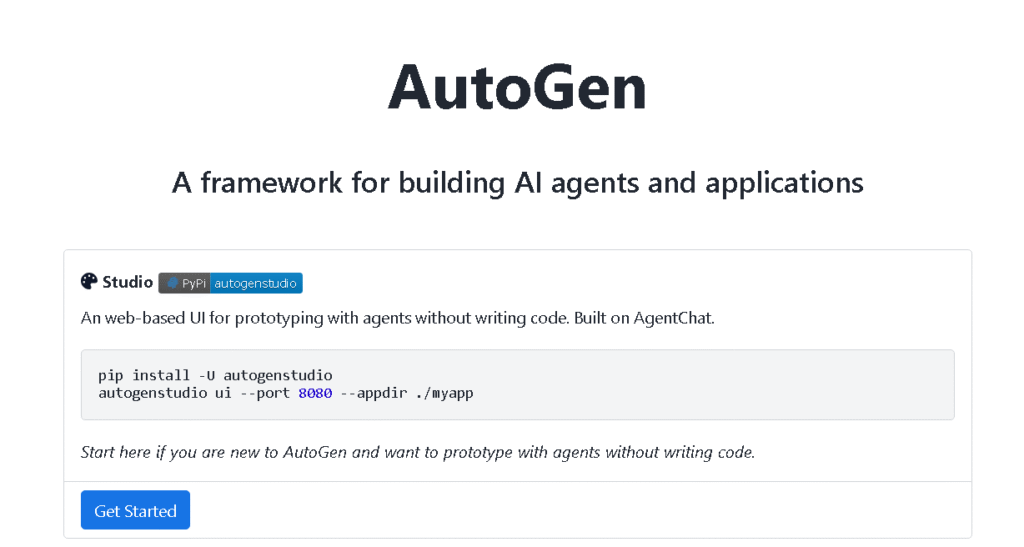
AutoGen Studio is an open-source AI agent building platform designed for creating multi-agent systems that collaborate to solve complex problems. It is not beginner-friendly in the traditional sense, but it is powerful if you want fine-grained control. I have found AutoGen particularly useful for experimenting with how agents talk to each other rather than just responding to users. This makes it more of a research and prototyping tool than a plug-and-play business solution.
Key Features
- Multi-agent conversations and coordination
- Open-source flexibility
- Strong LLM orchestration logic
Best For
Developers, AI researchers, and teams exploring advanced multi-agent AI systems.
Pros & Cons
| Pros | Cons |
|---|---|
| Extremely flexible and customizable | Requires technical knowledge |
| Ideal for multi-agent experiments | No polished UI |
| Free and open-source | Not business-user friendly |
2. CrewAI
Website: https://www.crewai.com
Overview
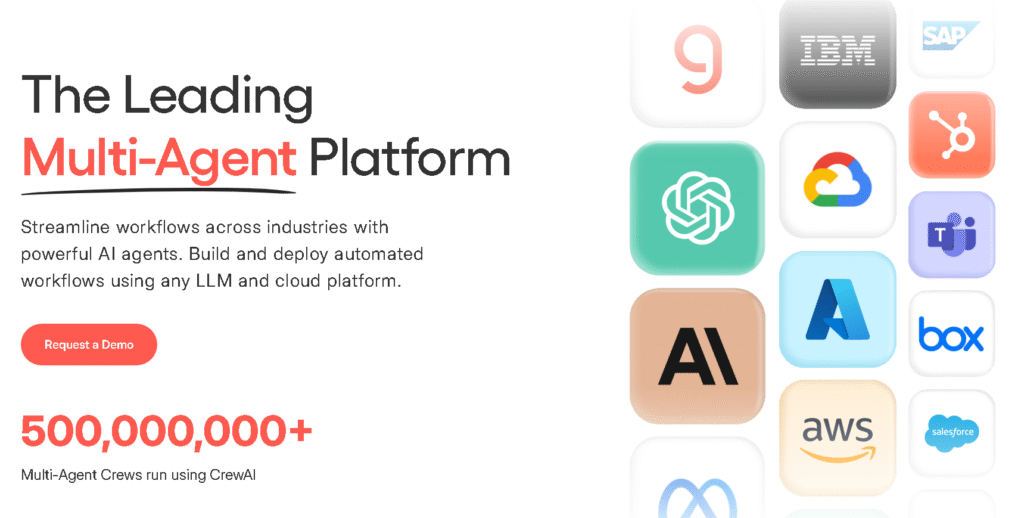
CrewAI focuses on structured collaboration between AI agents, each with a defined role and responsibility. This platform shines when you want agents to behave like a team rather than a single assistant. In practice, I found CrewAI surprisingly intuitive once the role-based concept clicks. It sits nicely between no-code and developer-first tools, making it appealing for startups experimenting with AI automation platforms.
Key Features
- Role-based AI agents
- Task orchestration
- Modular agent design
Best For
Startups, product teams, and automation builders creating task-focused agents.
Pros & Cons
| Pros | Cons |
|---|---|
| Clear agent role structure | Limited enterprise controls |
| Fast to prototype workflows | Smaller integration ecosystem |
| Good balance of control and simplicity | Scaling requires planning |
3. Zapier Agents
Website: https://zapier.com
Overview
Zapier Agents extend Zapier’s automation ecosystem into AI-driven workflows. If you already use Zapier, this is one of the easiest ways to build AI agents without coding. From personal experience, Zapier Agents excel at practical business use cases like CRM updates, email handling, and lead routing. However, they are more constrained than dedicated agent frameworks.
Key Features
- Deep app integrations
- Natural language automation
- Reliable execution
Best For
Non-technical teams, marketers, operations managers.
Pros & Cons
| Pros | Cons |
|---|---|
| Massive app integration library | Less flexible agent logic |
| Easy to use | Pricing scales quickly |
| Reliable automation | Limited multi-agent behavior |
4. LangGraph
Website: LangGraph

Overview
LangGraph is built for developers who need stateful, complex agent workflows. It allows you to design agents that remember context across steps and branches. This is not a no-code AI agent builder, but if you are serious about building production-grade agents, LangGraph is extremely capable. In my experience, it rewards careful design and punishes shortcuts.
Key Features
- Stateful agent workflows
- Graph-based logic
- Deep LangChain integration
Best For
Developers building advanced, long-running AI agents.
Pros & Cons
| Pros | Cons |
|---|---|
| High control and reliability | Steep learning curve |
| Ideal for complex logic | Developer-only tool |
| Strong open-source community | Requires maintenance |
5. Peltarion
Website: https://peltarion.com
Overview
Peltarion targets enterprise AI agent deployment with a focus on security, governance, and compliance. It is less about experimentation and more about operationalizing AI at scale. From what I have observed, Peltarion works best when AI agents are part of regulated workflows where auditability matters more than speed.
Key Features
- Enterprise-grade security
- Scalable deployment
- Governance and monitoring
Best For
Large enterprises, regulated industries, AI operations teams.
Pros & Cons
| Pros | Cons |
|---|---|
| Strong compliance features | High cost |
| Scales well | Less flexible for small teams |
| Enterprise support | Slower experimentation |
How to Build AI Agents Step by Step
Building AI agents starts with defining the task clearly. Most failed agents fail because the problem definition is vague. Next, choose whether you need a no-code AI agent builder or a developer-first platform. Then, connect tools and data sources carefully, testing each step in isolation.
In real projects, I recommend starting with a single-agent workflow before moving to multi-agent systems. Complexity compounds fast and debugging AI agents is harder than debugging code. Platforms like Zapier Agents simplify this, while tools like LangGraph require deliberate design.
Resources You May Find Helpful
- Explore more AI Chatbot Tools Powered by LLMs on our platform
- Read our detailed guide on AI Lead Generation Tools
- Check out 5 AI Automation Tools for beginners
- Check out more at tooljunction, we share honest AI tool reviews and tutorials to help you choose the right tools for your creative projects.
FAQs: AI Agent Building Platforms
1. Which is the best AI agent building platform in 2026?
There is no universal best option. Zapier Agents work well for business automation, while LangGraph and AutoGen suit technical teams. The best AI agent platforms 2026 depend entirely on your skill level and use case.
2. Can I build AI agents without coding?
Yes. No-code AI agent builders like Zapier Agents and some CrewAI workflows allow non-technical users to build functional agents, though advanced logic still benefits from technical input.
3. Are AI agent platforms expensive?
Costs vary widely. Open-source tools are free but require time and expertise. Commercial AI automation platforms charge for reliability, integrations, and support.
4. Do AI agents replace employees?
No. In practice, AI agents replace repetitive tasks, not decision-making roles. Teams that treat agents as assistants see better results than those expecting full autonomy.
Conclusion
AI agent building platforms are becoming foundational tools rather than experimental toys. In 2026, the real advantage comes from choosing platforms that match your technical capacity and business goals, not from chasing the most hyped solution. No-code AI agent builders lower entry barriers, while enterprise AI agents enable scalable automation with control.
If you are serious about AI automation, start small, test responsibly, and scale only what proves value. Explore different platforms, learn how to build AI agents thoughtfully, and treat agents as evolving systems. For more in-depth comparisons and practical guides, explore our other AI tools blogs and stay ahead of the curve.
ToolJunction simplifies AI adoption for businesses and creators. We provide trusted reviews and practical tutorials to help you select and apply the right tools for growth and productivity.