

The notion of artificial intelligence (AI) in Retail isn't a future-facing technology anymore; it's an active, day-to-day tool that helps keep retailers competitive, agile, and customer-focused. While simultaneously enhancing customer experience and optimising supply chain processes, AI is influencing the way the world does business as well as influencing how businesses operate and grow.
This article will discuss the current application of AI in Retail, examples of current functioning use cases providing benefits today, and how Retailers can implement AI solutions.
What Artificial Intelligence Means for Retail Today
Understanding the influence and potential of AI in Retail is critical as businesses adapt to an increasingly digital landscape.
Artificial intelligence has become a practical tool in modern retail, helping businesses analyze data, automate processes, and improve decision-making. Understanding its role today provides a foundation for using AI effectively across retail operations.
The role of AI in Retail
Artificial intelligence in Retail today is defined as a group of computer programs that utilize complex mathematical computations to examine large amounts of user-generated information for the purpose of identifying patterns and making calculations or recommendations without needing a lot of human involvement.
AI provides retailers the ability to quickly connect the dots between processed information and how it may impact the retail marketplace. When retailers collect vast amounts of information from numerous sources, including suppliers, sales records, inventory systems, customer interactions, etc., they are able to use this data through the application of AI to convert it into useful retail-based insights that allow them to make quick, real-time transactional productivity decisions while continuing to maintain a high personalized level of service.
Key benefits of AI in retail
AI offers quantifiable benefits for retail operations, such as:
- Customized client experiences on a large scale
- Automation-based operational efficiency
- Improved decision-making through real-time information
- Decreased expenses by reducing inefficiencies and waste
- Revenue growth through more intelligent merchandising, pricing, and promotions
AI assists retailers in satisfying customer demands for speed, relevance, and convenience as consumer expectations rise.
Real-Life Use Cases of AI in the Retail Industry
Everyday solutions that help retailers deal with common business problems are what define how artificial intelligence can be used in retail, from improving personalised experiences to optimising supply chain operations. The following examples demonstrate some of the many ways that AI technology can add value to retailers.
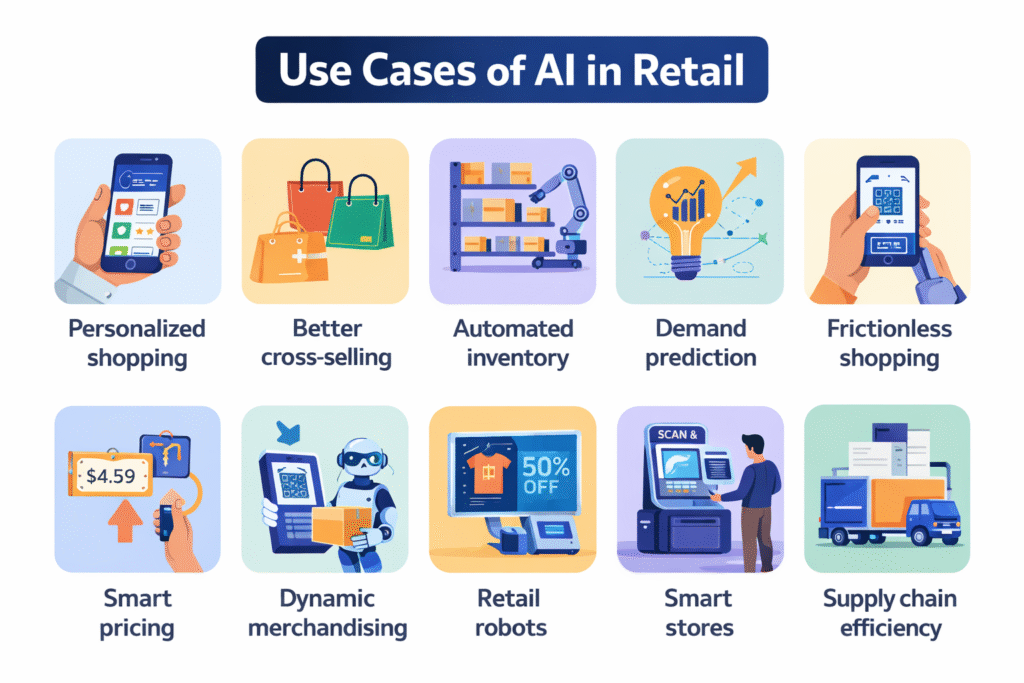
Personalized shopping
Retailers can provide personalised shopping experiences to their customers by leveraging AI technology. AI systems can automatically enable retailers to create a tailored shopping experience based on the customer's shopping behaviour, purchase history and preferences. Recommendation engines enable customers to receive suggestions for products, content and promotions that they will find relevant to them. The increase in customer engagement, conversion rates and customer loyalty that is seen with personalisation can be substantial.
Enhanced cross-selling
Artificial intelligence indicates the links between products and customer purchasing behaviour. As an example, if a buyer acquires a cellular phone, artificial intelligence will recommend other products that can be used with the cellular phone, such as headphones and protective cases. The identified products that customers have been matched with are highly relevant to what is being purchased and are more representative of true relationships.
Automated inventory management
With the use of artificial intelligence, retailers can manage their inventory without having to perform manual tracking. Artificial intelligence will identify slow-moving inventory, keep track of stock levels, and send alerts when restocking inventory is required. Automated inventory management improves cash flow by preventing inventory excesses or stock-outs, while allowing retailers to have the right amount of products available for their customers.
Forecasting future demand
Forecasting is the process of predicting consumer purchases. Thus, using historical sales data, seasonable trends, and external factors such as weather patterns and promotional opportunities, artificial intelligence can accurately forecast future consumer demand. Retailers can better plan their production, labor, and inventory based on accurate demand prediction and avoid wasting time or missing sales opportunities.
Reducing friction in the shopping process
As well as having smart shopping technologies enable cashier-less checkouts, biometrics (fingerprint and facial recognition), and smart payment systems. Retailers are providing consumers with a shopping experience that makes it easy for them to pick up products and walk out the door without having to line up for check out.
Intelligent pricing
With artificial intelligence retailers can analyze current pricing in their local market, track the price‐purchasing behaviours of consumers in their respective markets and correlate these purchasing behaviours with seasonal fluctuations in product demand. Artificial intelligence can therefore create real-time suggestions for competitive pricing while also preserving sufficient profit margins.
Dynamic merchandising
AI leverages customer behaviors and sales metrics to identify products that will be emphasized on websites, physical stores and also help guide retailers to set up their categories effectively.
Retail robots
Many retailers are utilizing AI robots to perform many of the mundane tasks traditionally performed by people, including inventory checks, shelf scanning, cleaning and assisting customers with their shopping needs. This has resulted in decreased labor expenses, improved operational efficiencies and a greater amount of time for store associates to engage in higher-value customer-focused interaction.
Smart stores
Smart stores leverage Internet of Things (IoT) technology, along with AI tools to assess customer traffic and analyze in-store behaviors, along with optimizing store layout. The insights garnered from the data will allow retailers to gain a better perspective on how customers navigate within their retail environment, what sections of the store grab customers' attention, and ultimately what changes to make in order to create the best possible shopping experience for their customers.
Supply chain efficiency
Through the use of AI for increased visibility within supply chain networks and improved response to unexpected disruptions, retailers are able to enhance delivery speed, reduce transportation costs, and improve overall supply chain performance.
How Retailers Can Adopt AI
To have a successful AI implementation into the retail industry, retailers must approach their adoption of Artificial Intelligence (AI) in a structured way where the technology aligns with retailer's business objectives. The focus should be on the strategic elements, the data available for implementation and a phased approach to allow retailers to reduce their risks while obtaining sustainable results.
Start with a plan
Retailers should first establish specific objectives for the AI implementation, such as enhancing customer personalization, optimizing inventory levels and improving supply chain effectiveness. Establishing a clear, strategic plan that ties together AI activities with quantifiable outcomes will enable retailers to limit certain types of implementations and avoid fragmented implementation of AI within their company.
Select the Right Partner
AI implementation in retail frequently calls for both technical know-how and a thorough comprehension of the difficulties unique to the sector. Aligning AI models with actual operational needs is crucial, according to teams with experience developing AI-driven retail solutions, like those at Cleveroad, which has worked on data analytics, personalization, and automation use cases. It is easier to integrate solutions like demand forecasting or intelligent recommendations into current workflows when one is familiar with retail data, scalable system architecture, and production-ready AI.
Utilize high-quality data
Data quality is crucial to AI systems. Retailers must have access to precise, organized, and regularly updated data from a variety of sources, such as supply chain platforms, POS systems, and customer interactions. AI models can produce accurate insights and forecasts when the data is clean.
Use a pilot to test
Retailers should test concepts through pilot projects before implementing AI throughout the company. Before implementing AI solutions more widely, teams can assess performance, pinpoint hazards, and improve models by testing them on a smaller scale.
Pay attention to your customers
In the end, AI should improve rather than complicate the consumer experience. AI-powered initiatives are more likely to be successful in the long run for retailers who prioritize customer needs like convenience, relevance, and transparency.
Wrapping Up
Retailers today cannot afford to put off adopting AI; they must start considering it an essential element of their overall strategy for success. Retailers are using AI in various ways (i.e. through consumer personalization, predictive pricing, inventory management, etc.) to further innovate and improve operations within their organizations.
Retailers that do the most thorough job of thoughtfully utilizing AI, concentrating on producing tangible benefits/real value to their businesses and keeping their customers at the centre of their innovative activities can expect to outperform other retailers in today's rapidly evolving retail environment; the earlier retailers adopt and fully implement AI strategies the better positioned they will be to be an innovator in their market versus being forced into a reactive role.


