

An AI agent can generate an answer in seconds, but that answer is only as useful as the information it can access. When an agent needs current product data, live prices, company information, documentation, or content from websites without convenient APIs, it needs a reliable way to retrieve and process web data. That is where AI web scraping APIs become useful.
The challenge is that these tools do different jobs. Some return search results, others extract page content, and some handle JavaScript rendering, crawling, proxy management, or structured data extraction. This guide compares 10 AI web scraping APIs and related web data platforms for developers building AI agents, RAG pipelines, research assistants, and automated workflows. The focus is on practical capabilities, pricing models, integration options, and the trade-offs that matter when selecting a tool.
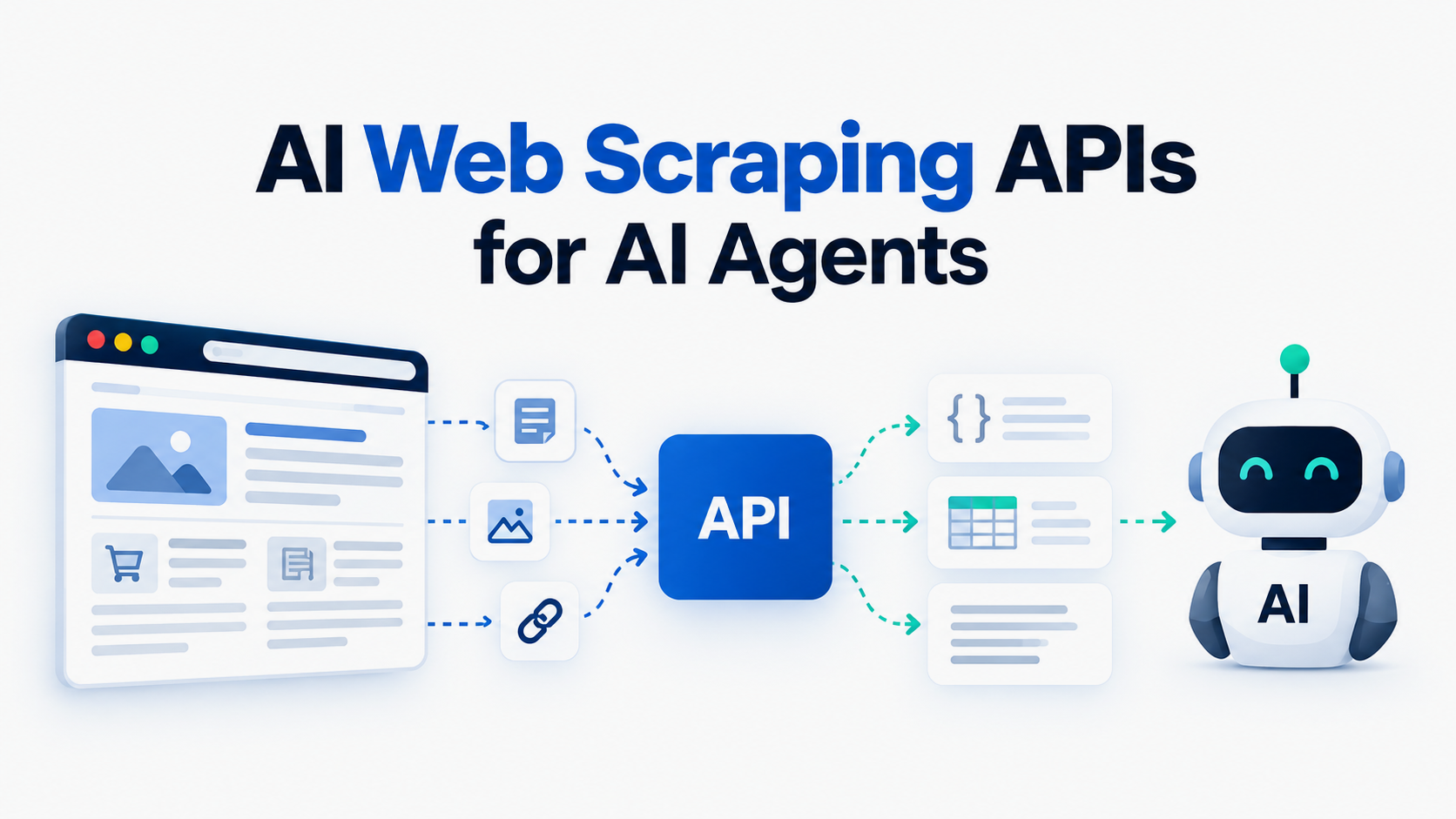
What is AI Web Scraping APIs?
AI web scraping APIs are services that let software retrieve information from websites and return it in a format an application or AI system can process. Depending on the product, an API may fetch a page, render JavaScript, crawl multiple URLs, extract structured fields, search the web, or return cleaned content in formats such as HTML, Markdown, or JSON.
For AI agents, the useful distinction is between finding information and extracting information. A search API helps an agent discover relevant pages. A scraping API retrieves content from a known URL. A crawling platform can follow links across a site, while a structured extraction service may turn a product page into fields such as name, price, availability, and description.
These categories overlap, but they are not interchangeable. A research agent may need search and page extraction. A shopping agent may need structured product data. A monitoring system may require scheduled crawling and change detection. A developer building a self-hosted RAG pipeline may prefer an open-source crawler over a managed API.
If your workflow also requires an agent to interact with websites, rather than only retrieve their content, it is worth comparing these tools with AI browser automation platforms. Browser automation and web scraping solve related but different problems.
How We Selected These Tools
We selected tools based on their relevance to AI agent workflows, documented extraction and crawling capabilities, support for JavaScript-heavy websites, API usability, structured output, integration options, deployment flexibility, pricing transparency, and practical use cases. The list includes both managed services and an open-source framework because developers may need different levels of infrastructure control. Product capabilities and pricing can change, so readers should verify current limits and plans before committing to a production workflow.
Quick Comparison of AI Web Scraping APIs
| Tool | Main strength | Pricing model | Free option |
|---|---|---|---|
| Firecrawl | Scraping, crawling, and structured extraction | Credit-based plans | Free plan available |
| Apify | Actors, automation, and reusable scrapers | Platform plans and usage-based billing | Free usage available |
| Bright Data | Scraper APIs, proxy infrastructure, and datasets | Usage-based and subscription plans | Limited free options on selected products |
| Tavily | Search, extraction, and research-oriented APIs | Credit-based plans | Free credits available |
| Diffbot | Automated extraction and knowledge-oriented data | Subscription plans | Free plan available |
| ScrapingBee | JavaScript rendering and proxy handling | Credit-based plans | Free credits available |
| ScraperAPI | Managed proxies, rendering, and simple API access | Request or credit-based plans | Free trial or credits available |
| Zyte API | Extraction and browser-based web data access | Usage-based pricing | Trial availability varies |
| fastCRW | Scrape, crawl, extract, and MCP support | Free and paid plans | Free option available |
| Crawl4AI | Open-source Python crawling and Markdown output | Open source | Yes |
The 10 Best AI Web Scraping APIs for AI Agents in 2026
1. Firecrawl
Firecrawl is designed for developers who need to bring website content into AI applications without building the entire crawling and cleaning pipeline themselves. Its API supports web scraping, crawling, mapping, and structured extraction, with output formats suited to applications that need readable content rather than raw browser responses.
For AI agents, Firecrawl is particularly relevant when the workflow starts with a URL or a website and needs clean content for summarization, retrieval, research, or tool use. Its extraction features can also help developers request specific data from pages instead of passing an entire document to a language model.
Firecrawl offers integrations and tooling aimed at AI development workflows, including support for agent-oriented frameworks and MCP-based usage. Developers should check the current documentation for the exact integration and feature availability they need.
Best for: AI agents, RAG pipelines, and research applications that need clean web content, crawling, and structured extraction through one service.
Pricing: Firecrawl uses credit-based plans. Its official website lists a free plan, while paid usage depends on the selected plan and consumption. Check the current pricing page for credit limits and overage terms.
2. Apify
Apify is a broad web automation and data collection platform built around reusable cloud programs called Actors. These Actors can perform scraping, crawling, browser automation, data extraction, and other tasks. Developers can use existing Actors from the platform's marketplace or build their own for a more specific workflow.
This flexibility makes Apify different from a single-purpose scraping endpoint. An AI agent can call an Actor to collect data from a website, retrieve the resulting dataset, and use that data in a downstream analysis or decision-making step. Teams can also schedule tasks and connect outputs to other systems.
Apify supports a range of scraping approaches, including browser-based workflows for websites that require interaction or JavaScript execution. The exact behavior depends on the Actor being used, so buyers should evaluate the individual Actor and its documentation rather than treating the entire marketplace as one uniform product.
Best for: Developers and teams that need customizable scraping workflows, scheduled jobs, reusable automation, or access to a marketplace of prebuilt scrapers.
Pricing: Apify combines platform plans with usage-based costs. The total cost depends on compute, storage, proxy usage, and the Actors or features used. A free usage allowance is available, subject to the current plan terms.
3. Bright Data
Bright Data provides a wider web data infrastructure stack that includes Web Scraper APIs, proxy services, browser access, SERP APIs, and ready-made datasets. Its scraping products are designed for businesses that need to collect web data across different websites, locations, and volumes.
For AI agents, Bright Data is useful when the data-access problem is more complicated than fetching a publicly accessible page. Projects may need geographic targeting, proxy management, browser rendering, or a reliable collection layer for repeated requests. Its dataset offerings can also be relevant when buying prepared data is more practical than building a scraper from scratch.
The platform covers several products, so it is important to select the service that matches the workflow. A SERP API, Web Scraper API, proxy product, and dataset subscription address different needs and have different cost structures.
Best for: Businesses and engineering teams collecting web data at scale, especially when proxy infrastructure, geographic access, or multiple data products matter.
Pricing: Bright Data offers different pricing models across its products, including usage-based and subscription options. Its Web Scraper API has published pay-as-you-go and monthly pricing, while other products may use bandwidth, request, or dataset-based billing.
4. Tavily
Tavily is primarily focused on search and web retrieval for AI applications. Its APIs are designed to help language models and agents find relevant web information, extract content, and support research-oriented workflows. That makes it an important option for agents that need to discover sources before processing them.
Tavily is not simply a traditional page scraper with an AI label. Its strongest fit is often a research or retrieval workflow in which an agent formulates a query, receives relevant results, and uses extracted content to construct an answer. Its extraction and crawling capabilities can extend that workflow when an application needs more than search results.
For developers building research agents, the distinction matters. If the agent needs to search broadly across the web, Tavily may be more relevant than a URL-only scraper. If the application needs to extract thousands of records from a defined set of product pages, a dedicated scraping or structured extraction platform may be a better fit.
Best for: AI search, research agents, retrieval workflows, and applications that need web discovery combined with content extraction.
Pricing: Tavily uses credit-based pricing and offers a free allowance. Costs depend on the API operations and plan selected, so check the current limits before estimating production usage.
5. Diffbot
Diffbot focuses on turning web pages into structured data. Its products include automated extraction, crawling, and knowledge-oriented web data capabilities. Rather than requiring developers to write custom selectors for every page type, Diffbot uses automated analysis to identify and organize information from supported web content.
This approach is useful when an AI system needs consistent entities and fields instead of a large block of unprocessed HTML. For example, a business intelligence application may need article metadata, product information, company details, or other structured records that can be stored and queried before being passed to an AI model.
Diffbot is more closely aligned with structured web intelligence than with a minimal “fetch this URL” API. Buyers should review its extraction types and supported data models to confirm that the output matches their application.
Best for: Teams that need structured web data, automated content extraction, knowledge graphs, or business intelligence workflows.
Pricing: Diffbot offers subscription plans, including a free plan and paid tiers. Its pricing varies by product and usage limits. Crawl API availability and other advanced capabilities depend on the plan.
6. ScrapingBee
ScrapingBee is a web scraping API that handles common infrastructure challenges such as proxy rotation and JavaScript rendering. Its interface is aimed at developers who want to send requests to a managed API rather than operate their own browser and proxy stack.
JavaScript rendering is important for websites where the initial HTML response does not contain the content an agent needs. ScrapingBee's browser-rendering capabilities can help retrieve content that appears only after page scripts execute. That makes it relevant for product pages, dashboards, listings, and other dynamic websites, subject to the provider's supported features and target-site behavior.
ScrapingBee is a relatively straightforward choice when the application already knows which URLs it needs to retrieve. Developers should still determine whether they need raw HTML, rendered content, screenshots, or additional parsing logic downstream.
Best for: Developers who need a managed scraping API with JavaScript rendering and proxy handling without maintaining browser infrastructure.
Pricing: ScrapingBee uses credit-based plans. Its official pricing information lists paid plans beginning at $19 per month and free credits for testing, with limits varying by plan and request type.
7. ScraperAPI
ScraperAPI provides a managed interface for web scraping, handling infrastructure such as proxy rotation, request routing, and JavaScript rendering. It is intended to reduce the amount of work developers need to do to retrieve content from websites that may otherwise require custom scraping infrastructure.
For an AI agent, ScraperAPI can serve as a retrieval tool that accepts a URL and returns page content for later processing. It can fit workflows such as monitoring public listings, collecting web pages for analysis, or feeding a downstream parser or language model.
Its appeal is its general-purpose design. Developers who do not need a complete crawling platform or a specialized structured data product may prefer a simpler API layer. However, the application may still need to handle parsing, deduplication, validation, and storage itself.
Best for: Developers looking for a general-purpose managed scraping API with proxy and rendering capabilities.
Pricing: ScraperAPI offers credit or request-based plans, including a free allowance or trial depending on the current offering. The effective cost depends on request volume and advanced request features.
8. Zyte API
Zyte API is designed for automated web data extraction and provides access to capabilities such as browser rendering and structured extraction. It is part of Zyte's broader web data tooling, which has a long history in large-scale web crawling and scraping infrastructure.
Zyte API is relevant to AI applications that need more than a raw HTTP response. Depending on the request and supported extraction mode, the service can help retrieve page content or structured data while handling parts of the browser and access infrastructure. This can reduce the amount of site-specific scraping code a team must maintain.
Its pricing approach is particularly important to understand because the cost can vary with the type of request and extraction method. A lightweight HTML request and a browser-rendered or automatically extracted request may have different resource requirements.
Best for: Engineering teams building automated extraction workflows that need managed browser capabilities and structured web data access.
Pricing: Zyte API uses usage-based pricing. The amount charged depends on factors such as the type of request, successful responses, browser rendering, and automatic extraction. Check the current pricing documentation for the applicable cost model.
9. fastCRW
fastCRW is positioned around web scraping workflows for AI agents and developers. Its documented capabilities include scraping, crawling, search, mapping, extraction, and MCP support, making it relevant to applications that need to connect web data retrieval with agent tooling.
The platform's agent-oriented positioning is useful for developers who want web access to be exposed as callable tools rather than building separate integrations for every operation. A workflow might use search to discover pages, scrape to retrieve content, crawl to collect related pages, and extract to return information in a more structured form.
Its MCP support is particularly relevant to developers building tool-using agents, although the exact setup, available tools, and limits should be checked in the current documentation. The platform also offers a self-hosting option, which may matter to teams that want more control over deployment and infrastructure.
Best for: Developers building AI-agent workflows that need multiple web operations, including scraping, crawling, extraction, and MCP-based tool access.
Pricing: fastCRW offers a free option and paid plans. The current pricing structure and limits should be checked directly before selecting a plan for production use.
10. Crawl4AI
Crawl4AI is an open-source web crawling framework built for AI-related data collection. It is designed to help developers crawl websites and produce content that can be used in LLM and RAG workflows, including Markdown-oriented output and browser-based crawling capabilities.
Unlike the managed services in this list, Crawl4AI is primarily a framework that developers can run and configure themselves. That makes it appealing when infrastructure control, customization, and self-hosting are more important than having a vendor manage the entire scraping layer.
It can be useful for building a custom ingestion pipeline where the developer controls crawling behavior, content processing, storage, and integration with the language model or retrieval system. The trade-off is that the team takes on more responsibility for deployment, maintenance, scaling, and handling website-specific issues.
For developers working with documents and web content together, the output may also feed into a downstream parsing or retrieval workflow. The distinction between crawling and parsing remains important, since collecting content is only one part of preparing data for an AI application.
Best for: Developers who want an open-source, self-hosted crawling framework for AI data pipelines and RAG applications.
Pricing: Crawl4AI is open source. There is no required SaaS subscription for the framework itself, although hosting, compute, browser execution, proxies, and maintenance can create operational costs.
How to Choose the Right AI Web Scraping API
Start with the job your agent needs to perform. If it needs to discover sources and answer research questions, a search-oriented API such as Tavily may be a closer fit. If it already has URLs and needs clean page content, Firecrawl, ScrapingBee, ScraperAPI, or a similar extraction service may be more appropriate. If the application needs structured records from different page types, consider a platform such as Diffbot or a custom extraction workflow on Apify.
Next, check how the target websites behave. Static HTML is relatively straightforward, but JavaScript-rendered pages, bot protections, geographic restrictions, and session-dependent content can change the architecture. Browser rendering and proxy support may help, but they also affect cost and reliability. Run a small test against the actual websites your agent will use rather than relying only on feature lists.
Finally, compare the output and operating model. Does the API return HTML, Markdown, or structured JSON? Can it crawl multiple pages? Does it offer webhooks, SDKs, or MCP support? Will your team need to host the crawler? How are failed requests, rate limits, retries, and usage charges handled? These details often matter more than a low introductory price once the workflow reaches production.
Pricing and Cost Considerations
AI web scraping APIs use different billing units, so comparing monthly prices alone can be misleading. One provider may charge credits for requests, another may charge for records or page loads, and an open-source framework may have no subscription cost but still require servers, browsers, proxies, and maintenance.
Browser rendering is another cost factor. A simple request that retrieves server-rendered HTML may be cheaper than a request that launches a browser, executes JavaScript, waits for content, and returns a rendered page. Structured extraction, proxy usage, crawl depth, and data storage can also affect the final bill.
Before choosing a provider, estimate the number of pages, the frequency of requests, the percentage of JavaScript-heavy sites, and the amount of data returned per operation. For a production agent, also account for retries, failed requests, monitoring, and downstream processing. The lowest advertised plan is not necessarily the lowest-cost option for a complete workflow.
FAQs
What is an AI web scraping API?
An AI web scraping API is a service that retrieves and processes website content for use in applications such as AI agents, research assistants, and RAG systems. Depending on the provider, it may support page scraping, crawling, JavaScript rendering, search, or structured data extraction.
How is an AI web scraping API different from an AI search API?
An AI search API primarily helps an application discover relevant information and sources. A scraping API generally retrieves content from a known URL, while a crawling API can collect content across multiple pages. Some products, such as Tavily, combine search and extraction capabilities, but their strongest use cases may differ from those of dedicated scraping platforms.
Are there free AI web scraping APIs?
Yes. Several providers offer free plans, free credits, or trials, and open-source frameworks such as Crawl4AI can be used without a required SaaS subscription. Free usage usually comes with limits on requests, credits, compute, or features. Hosting and infrastructure costs may still apply to self-hosted tools.
Can these APIs scrape JavaScript-rendered websites?
Some can. Tools such as ScrapingBee, ScraperAPI, Zyte API, Bright Data, and selected Apify Actors offer browser-rendering or JavaScript-handling capabilities. Support varies by product and request type, so developers should test the target websites and confirm whether the required content is available after rendering.
Can AI web scraping APIs return structured data for agents?
Yes, depending on the service. Some APIs provide structured extraction features that return fields or JSON, while others return HTML, Markdown, or cleaned text that must be parsed by the application. Structured output is useful when an agent needs predictable fields rather than an entire page.
Final Verdict
The right AI web scraping API depends on what your agent needs to do with web data. Firecrawl is relevant for clean content extraction and crawling, Apify for customizable scraping workflows, Bright Data for broader web data infrastructure, and Tavily for search-oriented retrieval. Diffbot focuses on structured web intelligence, while ScrapingBee, ScraperAPI, and Zyte API are useful options for managed scraping and browser-based access. fastCRW is worth examining for agent-oriented scraping workflows, and Crawl4AI offers an open-source route for developers who want to manage their own crawling stack.
Rather than choosing by popularity or headline pricing, test a shortlist against your actual websites, output requirements, and expected request volume. The best fit is the tool that supplies the right data in a usable format while keeping infrastructure, cost, and maintenance within your project's limits.


