

Two LLM observability platforms can show you traces, evaluate model outputs, and track what happens inside an AI application, yet feel completely different once you actually build with them.
That difference matters more in production than it does in a feature comparison.
A small prototype might only need to know whether an LLM call succeeded. A production system has more going on. There may be several model providers, retrieval steps, tool calls, prompts, agents, and users generating thousands of traces. When something goes wrong, you need to know where it happened and why.
That's where the Langfuse vs LangSmith comparison gets interesting. Both cover observability and evaluation, but they come from different directions. Langfuse puts more emphasis on open source LLM observability, flexibility, and self-hosting. LangSmith is closely tied to the LangChain and LangGraph ecosystem and extends beyond tracing into the wider agent development workflow.
So the better question isn't which platform has the longer feature list. It's which one fits the way your team actually builds and operates AI applications.
Table of Contents
Langfuse vs LangSmith at a Glance
| Langfuse | LangSmith | |
|---|---|---|
| Positioning | Open-source, framework-agnostic observability | LLM and agent engineering platform |
| Best fit | Multi-framework and self-hosting needs | LangChain and LangGraph teams |
| Cloud | Yes | Yes |
| Self-hosting | Yes | Enterprise/self-hosted options |
| Pricing model | Usage-based | Seat + usage |
| Strong point | Flexibility and data control | Deep ecosystem integration |
The table gives you the quick answer. The more useful comparison starts when you look at how each platform approaches the underlying data. LangSmith is particularly useful for teams working with LangChain and LangGraph, while Langfuse takes a more framework-agnostic approach. If you're building these kinds of workflows, our guide to AI agent building platforms covers the main platforms and approaches.
Positioning and Data Model
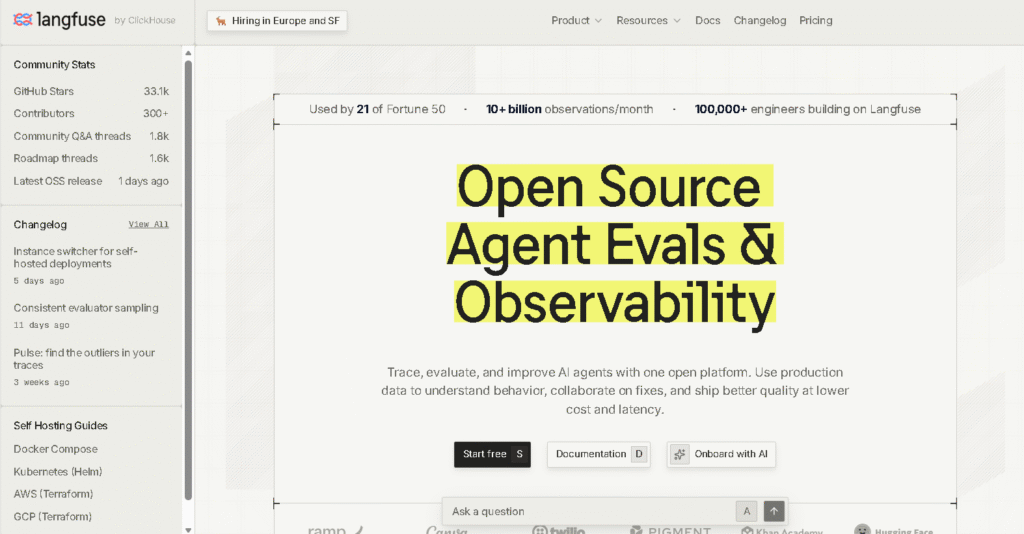
Langfuse is primarily built around observability. Its model is designed to capture what happens during an LLM application run, including traces, observations, generations, and related usage information. The framework-agnostic approach is useful when an application doesn't live entirely inside one ecosystem.
That can make a difference for teams using different model providers or frameworks. You aren't necessarily choosing your observability layer based on the framework you happened to use for one part of the application.
LangSmith takes a different route. It sits much closer to the LangChain and LangGraph ecosystem, so its value isn't limited to watching an application after it's running. It connects tracing with development, testing, evaluation, prompts, datasets, and agent workflows.
That's a meaningful distinction.
If your team is already building heavily with LangChain or LangGraph, having those pieces in one environment can reduce friction. If your stack is more mixed, Langfuse's framework-agnostic approach may be more attractive.
Neither model is automatically better. The choice depends on what you want your observability platform to sit next to, and how much of your existing AI stack is tied to a particular ecosystem.
Tracing Depth and Production Visibility
Once an AI application reaches production, basic request logs aren't enough.
You may need to follow a request from the initial user interaction through an LLM call, retrieval step, tool execution, and final response. You also want useful details such as latency, token usage, cost, sessions, and intermediate operations. These workflows become especially important when you're dealing with AI agents, where a single request can involve multiple steps, tools, and model calls. Our guide to how AI agents works breaks down how those systems operate.
Both Langfuse and LangSmith provide this kind of tracing and visibility, but their integrations shape the experience differently.
Langfuse organizes application activity around traces and observations, making it suitable for monitoring LLM calls across different frameworks. LangSmith provides detailed tracing for LangChain and LangGraph workflows, which can be particularly useful when an application contains chains, agents, tools, and multiple intermediate steps.
So when comparing LLM observability tools, don't just ask whether a platform supports tracing. Ask how much work you'll need to do to get the trace information you actually care about.
That question becomes much more important once your application has enough moving parts to make debugging painful.
Evaluation Tooling
Observability tells you what happened. Evaluation helps you decide whether the result was actually good.
Both Langfuse and LangSmith support evaluation workflows, including datasets, experiments, automated scoring, LLM-as-a-judge approaches, and human feedback. The difference is less about whether a particular evaluation method exists and more about where it fits into the development workflow.
LangSmith has a particularly natural connection between datasets, experiments, evaluations, and LangChain or LangGraph applications. A team can use examples from its application, run experiments against them, compare results, and use the same environment while developing agent workflows. That makes it convenient when evaluation is closely tied to the LangChain ecosystem.
Langfuse takes a broader observability approach. Its evaluation capabilities can be used with traces and datasets without requiring the application to be built around one particular framework. That can be useful when a team has a mixed stack or wants its evaluation layer to remain independent from its application framework.
The practical choice is therefore fairly straightforward. If your development workflow already revolves around LangChain or LangGraph, LangSmith can keep more of the evaluation process in one ecosystem. If you want evaluation alongside a more framework-independent observability layer, Langfuse gives you more flexibility.
Human feedback can also become important here. Automated scores are useful for running evaluations repeatedly, but production feedback can reveal problems that a predefined test set misses. For either platform, the useful question is how easily your team can connect those signals back to the traces and datasets you're already working with.
Self-Hosting and Licence Terms
Self-hosting changes the Langfuse vs LangSmith decision considerably.
Langfuse has an open-source offering that can be self-hosted, giving teams the option to run the observability stack on their own infrastructure rather than sending observability data to a hosted service. That also makes Langfuse relevant for organizations that want more direct control over where their traces and related data are stored.
There is an important distinction, though: open source doesn't mean every Langfuse feature is available under the same terms. The documentation you collected shows that some enterprise capabilities, including audit logs, are part of the Enterprise Edition even for self-hosted deployments.
LangSmith is primarily presented as a hosted cloud platform in the pricing structure shown here. Its Enterprise offering includes self-hosted and hybrid deployment options for organizations with advanced hosting, security, and support requirements.
So the question isn't simply "Is Langfuse open source?" It is also "Which edition and deployment model provides the controls my organization needs?"
SSO, RBAC and Audit Logs
Security requirements can quickly change which pricing tier makes sense.
Both platforms provide enterprise-oriented controls, but the exact availability depends on the plan. SSO and role-based access control matter when several people need access to the same projects without giving everyone the same permissions.
Audit logs are a particularly clear example. In the Langfuse documentation you reviewed, audit logs aren't available on Hobby, Core, or Pro. They're available in Enterprise, while self-hosted audit logging is listed as an Enterprise Edition feature.
That means a team with compliance, security investigation, or detailed administrative audit requirements can't evaluate Langfuse purely on its lower cloud plan prices. The same principle applies to LangSmith, where enterprise controls are tied to its Enterprise offering.
For a small development team, these features may not matter yet. For a company handling sensitive production data, they can be part of the basic platform requirement rather than an optional extra.
Pricing at Scale
The pricing screenshots make the difference between the two models easier to see.
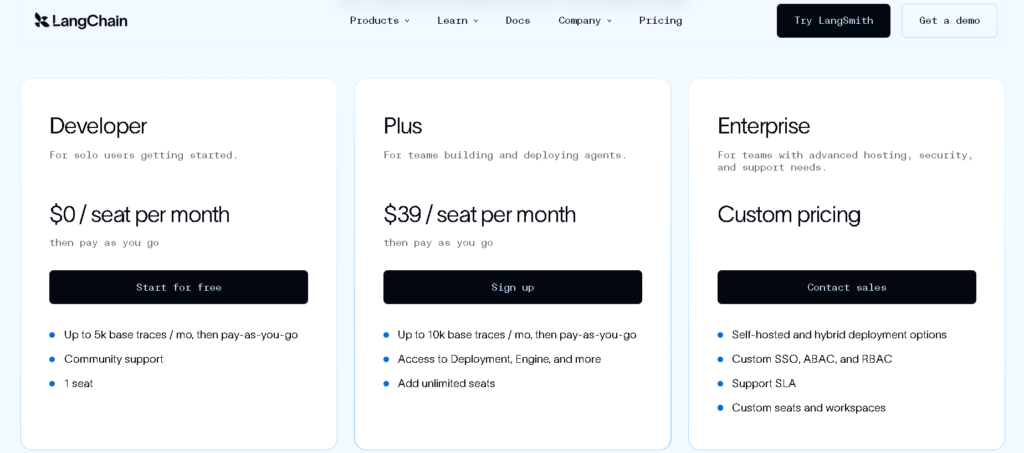
For LangSmith, the Developer plan is $0 per seat per month and includes up to 5,000 base traces per month, with one seat. The Plus plan costs $39 per seat per month and includes up to 10,000 base traces per month. Enterprise pricing is custom.
Langfuse starts with a free Hobby plan that includes 50,000 units per month. Its Core plan is $29 per month with 100,000 units included, while Pro is $199 per month with 100,000 units included. Enterprise is shown at $2,499 per month, with additional usage charged according to the platform's unit-based pricing.
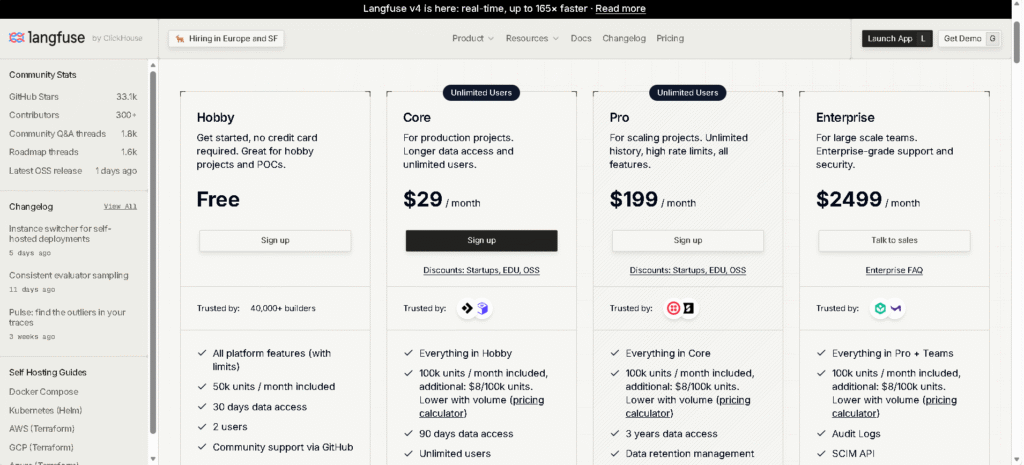
The headline prices don't tell the whole story. LangSmith combines seat pricing with usage, while the Langfuse plans shown here are structured around usage and allow unlimited users on the paid tiers shown.
That can matter once a team grows. Adding five developers doesn't necessarily have the same pricing impact as increasing application traffic. A small team with high trace volume and a larger team with moderate usage can therefore reach very different costs depending on the pricing model.
The right comparison is not simply "$29 versus $39." You need to consider users, traces or units, retention requirements, and the features your team actually needs.
Migration Cost and Switching Risk
Price isn't the only switching cost.
Existing instrumentation, SDK integrations, stored traces, evaluation datasets, prompts, team workflows, and framework dependencies can all make migration more expensive than the subscription itself.
That is why the better platform on paper isn't always the better platform to move to. The closer either tool is to your existing development workflow, the less disruption you'll create when the observability layer changes.
Langfuse vs LangSmith: Which One Should You Pick?
The better choice becomes clearer once you stop comparing feature checklists and look at how the platform fits into the application you're already building.
Choose Langfuse if:
- You want open-source LLM observability and the option to self-host.
- Your application uses multiple frameworks, model providers, or tools.
- Keeping greater control over where observability data is stored matters.
- You don't want your platform choice to depend heavily on the LangChain ecosystem.
- You prefer a pricing structure that isn't primarily based on the number of seats.
- You want to start with a hosted option but keep self-hosting available as your requirements change.
Langfuse is particularly attractive when observability is meant to sit independently from the rest of the application stack. A team could be using different frameworks today and change parts of that stack later without making its observability platform the central dependency.
Choose LangSmith if:
- Your application already uses LangChain or LangGraph.
- Agent development is a major part of your workflow.
- You want tracing, datasets, experiments and evaluations closely connected.
- Your developers would benefit from staying inside the LangChain ecosystem.
- A managed platform is preferable to operating the observability infrastructure yourself.
- Your team values an integrated development and evaluation workflow more than framework independence.
The distinction matters most for teams that are already far into development. If you're building a LangGraph agent and using LangSmith throughout development, moving to a framework-independent tool may add unnecessary separation between your application and evaluation workflow.
The reverse is also true. If your stack isn't centered on LangChain and you care about self-hosting or keeping the observability layer independent, Langfuse is the more natural starting point.
So the practical recommendation is fairly simple: if your priority is open-source flexibility, self-hosting and framework independence, Langfuse is the stronger starting point. If your application is already deeply tied to LangChain or LangGraph, LangSmith has the stronger ecosystem advantage.
Langfuse vs LangSmith: Quick Decision Table
| If you care most about… | Pick |
|---|---|
| Open-source observability | Langfuse |
| Self-hosting | Langfuse |
| Multi-framework stack | Langfuse |
| LangChain/LangGraph integration | LangSmith |
| Agent development workflow | LangSmith |
| Evaluation + development workflow | LangSmith |
| Unlimited users on paid plans shown | Langfuse |
| Existing LangChain investment | LangSmith |
FAQs
Is Langfuse really open source?
Yes. Langfuse provides an open-source offering that can be self-hosted. Its cloud plans are separate from the self-hosted model, and some advanced capabilities, such as audit logs, are reserved for Enterprise Edition.
Does LangSmith work outside LangChain?
Yes. LangSmith isn't limited to applications built with LangChain. However, its strongest ecosystem advantage comes from its integration with LangChain and LangGraph, particularly for teams building and evaluating agent workflows.
Which supports on-prem?
Langfuse provides a self-hosting option through its open-source offering. LangSmith also provides self-hosted and hybrid deployment options, but the pricing page shown here places those advanced hosting options under its Enterprise offering.
Which is cheaper at scale?
There isn't one universal answer. Compare your expected usage, seats, retention requirements and required features. LangSmith combines seat pricing with usage, while Langfuse's shown paid plans use usage-based pricing with unlimited users.
Final Verdict
Langfuse and LangSmith solve the same broad problem, but they're optimized around different priorities. Langfuse makes more sense when open-source flexibility, self-hosting and framework independence matter. LangSmith is the stronger fit when LangChain, LangGraph and the broader agent development workflow are already central to your stack.


