

Document parsing APIs help developers convert PDFs, scanned files, presentations, spreadsheets, and other unstructured documents into machine-readable content. Unlike basic OCR tools, modern document parsers can preserve headings, tables, reading order, page structure, figures, and metadata.
For teams building LLM and retrieval-augmented generation (RAG) applications, the right parser can improve search quality, extraction accuracy, citations, and processing costs. This guide compares the best document parsing APIs based on document support, structure preservation, RAG compatibility, extraction features, pricing, and developer experience.
If you want to compare broader document-processing platforms that combine parsing, extraction, and workflow automation, see our guide to the best Document AI platforms of 2026.
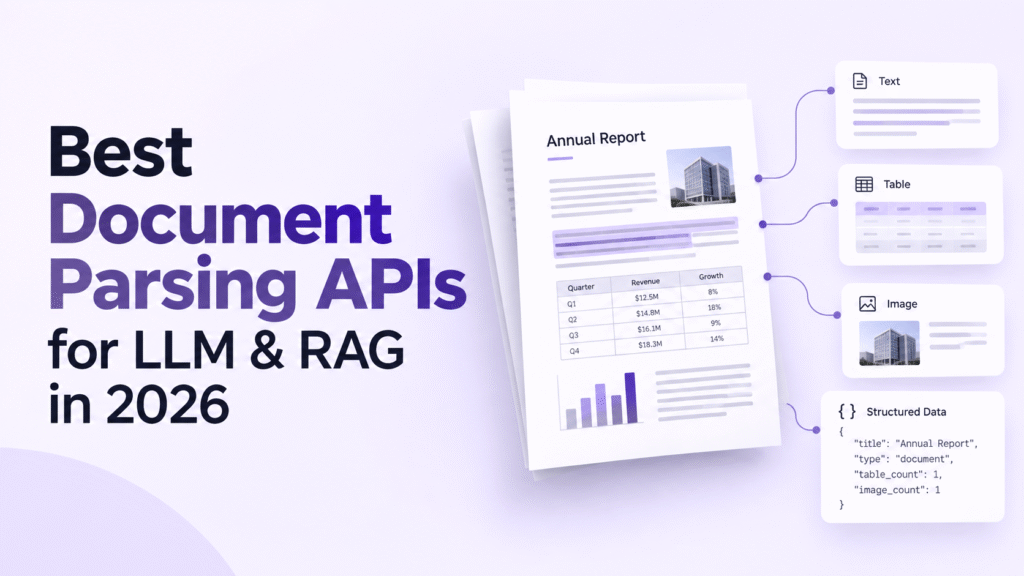
Table of Contents
What Are Document Parsing APIs?
A document parsing API extracts useful information from files and converts it into formats such as Markdown, JSON, HTML, plain text, or structured document elements. Depending on the provider, it may also identify tables, forms, images, headings, lists, formulas, and page-level references.
OCR focuses mainly on recognizing text from images or scanned pages. Document parsing goes further by understanding how that text is organized. This makes parsing APIs useful for RAG pipelines, document search, knowledge bases, invoice processing, contract analysis, and enterprise automation.
How We Selected These Tools
We compared these APIs based on parsing quality, support for complex documents and tables, structured output, LLM and RAG integrations, scalability, deployment options, pricing transparency, and developer experience. Vendor-reported benchmark results are treated as company claims, and actual performance may vary according to document type, scan quality, language, and processing mode.
Quick Comparison
| Tool | Best For | Primary Strength |
|---|---|---|
| Reducto | Complex documents and production RAG | Parsing, extraction, and citations |
| LandingAI ADE | Visually complex documents | Layout-aware document understanding |
| LlamaParse | RAG and LlamaIndex workflows | LLM-focused document parsing |
| Unstructured | Enterprise ingestion pipelines | Partitioning, enrichment, and connectors |
| Mistral OCR | Multilingual OCR and AI workflows | Cost-transparent structure-aware OCR |
| Docling | Open-source and self-hosted workflows | Advanced PDF understanding |
| Mathpix | Scientific and mathematical documents | Equations, formulas, and technical content |
| Firecrawl | Web and content ingestion | AI-ready content extraction |
| Amazon Textract | AWS-native document processing | Forms, tables, and OCR |
| Google Document AI | Google Cloud document workflows | OCR and specialized processors |
10 Best Document Parsing APIs in 2026
1. Reducto
Reducto is a document-processing platform designed to parse complex files and convert them into structured content for AI applications. It supports PDFs, images, spreadsheets, presentations, and office documents.
Its capabilities include text and layout extraction, table processing, document splitting, classification, structured extraction, and source-level references. These features make it useful for RAG systems where retrieved information needs to remain connected to the original page or document region.
Best for: Production RAG systems, document intelligence applications, and complex extraction workflows.
Pricing: Reducto offers a free usage allowance and usage-based pricing. Its standard rates include $10 per 1,000 pages for Parse and $20 per 1,000 pages for Extract. See the official Reducto pricing page for current rates.
2. LandingAI ADE
LandingAI Agentic Document Extraction (ADE) is designed to process documents where visual layout and relationships between elements are important. It can handle tables, forms, figures, multilingual content, and visually complex pages.
ADE supports parsing, field extraction, list extraction, table extraction, figure summaries, visual grounding, and document classification. Its visual approach is useful for documents that are difficult to process accurately with basic text extraction.
Best for: Financial documents, technical reports, forms, and visually complex PDFs.
Pricing: LandingAI ADE uses a credit-based model. The Explore plan includes free credits, while paid credit packs start at $250 per month in the US. Details are available in the official ADE pricing documentation.
3. LlamaParse
LlamaParse is a document parsing service built for LLM and RAG applications. It is closely integrated with the LlamaIndex ecosystem and offers parsing modes designed for different document complexity and cost requirements.
The service is useful for extracting content from PDFs and other files while preserving information such as tables, layouts, and document structure. Its integration with LlamaIndex makes it easier to connect parsing with indexing, retrieval, and agent workflows.
Best for: Developers building RAG applications with LlamaIndex.
Pricing: LlamaParse uses a credit-based pricing model, with different parsing modes consuming different amounts of credits. Current plans and allowances are listed on the official LlamaIndex pricing page.
4. Unstructured
Unstructured provides document-processing tools for preparing unstructured content for search, analytics, and generative AI applications. It supports document partitioning, cleaning, enrichment, chunking, and ingestion from multiple data sources.
The platform includes open-source tooling as well as hosted and enterprise options. It can identify elements such as titles, paragraphs, lists, tables, and other document components, making it useful for organizations processing content from different repositories.
Best for: Enterprise ingestion pipelines, knowledge bases, search systems, and RAG workflows.
Pricing: Unstructured provides open-source tools alongside hosted and enterprise offerings. Review the official Unstructured pricing page for current plan and usage details.
5. Mistral OCR
Mistral OCR is an OCR and document-understanding API that extracts content from documents while retaining useful structure. It is designed for scanned files, multilingual documents, tables, images, and other content used in AI workflows.
The API can return structured output and supports JSON and JSON Schema response formats through its OCR endpoint. It is suitable for developers who want to add document understanding to an existing application without managing their own OCR infrastructure.
Best for: Multilingual OCR, scanned documents, and cost-sensitive AI document workflows.
Pricing: Mistral lists OCR at $4 per 1,000 pages. Check the official Mistral pricing documentation for current rates and model details.
6. Docling
Docling is an open-source document-processing toolkit that supports advanced PDF understanding and multiple document formats, including DOCX, PPTX, XLSX, HTML, images, LaTeX, and EPUB.
It can preserve page layout, reading order, table structure, code, formulas, and image information. Docling exports content to formats such as Markdown, HTML, JSON, and DocTags, making it useful for RAG and custom document-processing pipelines.
Best for: Open-source, self-hosted, and customizable document-processing workflows.
Pricing: The Docling library is free to use under its stated open-source license. Developers can access the project through the official Docling GitHub repository.
7. Mathpix
Mathpix is a specialized OCR and document-conversion API for scientific, mathematical, and technical content. It is designed to recognize equations, tables, diagrams, handwriting, and complex technical notation.
Mathpix can convert images, PDFs, DOCX files, and PPTX files into formats such as LaTeX, Markdown, MathML, HTML, DOCX, and line-level JSON. This makes it useful for scientific publishing, research archives, education platforms, and technical knowledge bases.
Best for: Scientific papers, mathematical documents, equations, and technical content.
Pricing: Mathpix charges $0.002 per image and $0.005 per PDF page at its standard usage levels. Its asynchronous Files API has separate pricing. See the official Mathpix API pricing page.
8. Firecrawl
Firecrawl is an AI data-ingestion platform primarily focused on crawling websites and converting web content into formats suitable for LLMs and RAG applications. Its parsing capabilities are useful for teams combining online documents, web pages, and knowledge sources.
Firecrawl can help developers collect and clean content without building separate extraction logic for every website. It is particularly relevant for research assistants, enterprise search, documentation ingestion, and web-based knowledge systems.
Best for: Web content extraction, online research, documentation ingestion, and web-based RAG.
Pricing: Firecrawl offers plan-based and usage-based pricing. Current credit limits and API plans are available on the official Firecrawl pricing page.
9. Amazon Textract
Amazon Textract is an AWS service that extracts text and structured information from scanned documents. It supports text detection, forms, tables, queries, signatures, and other document-analysis features.
Textract is useful for invoices, receipts, applications, forms, identity documents, and business records. Its integration with Amazon S3, AWS Lambda, and other AWS services makes it practical for organizations already using the AWS ecosystem.
Best for: AWS-native OCR, forms processing, tables, and business-document automation.
Pricing: Amazon Textract uses feature-specific, per-page pricing. Costs depend on whether you use text detection, forms, tables, queries, signatures, or other analysis features. See the official Amazon Textract pricing page.
10. Google Document AI
Google Document AI is a cloud document-processing platform that provides OCR, layout parsing, form processing, custom extraction, and specialized document processors.
Depending on the selected processor, it can extract text, tables, entities, form fields, page geometry, and other structured information. It is suitable for invoices, contracts, procurement documents, identity records, and other business workflows.
Best for: Organizations building document-processing applications on Google Cloud.
Pricing: Google Document AI uses processor-based pricing. Enterprise Document OCR is listed at $1.50 per 1,000 pages for the stated usage tier, while other processors have different rates. Check the official Google Document AI pricing page for current costs.
How to Choose the Right Document Parsing API
Start by identifying the documents your application will process. Simple text-based PDFs may only require OCR, while contracts, financial reports, research papers, and scanned forms may need layout preservation, table extraction, citations, and structured output.
For RAG applications, prioritize Markdown or JSON output, reading-order accuracy, metadata, page references, and compatibility with your retrieval framework. For structured business workflows, check whether the API supports schema-based extraction, classification, and field validation.
Document parsing is only one part of a RAG architecture. The extracted content must also be stored and retrieved efficiently, which makes the choice of vector database important. Our vector database comparison covers options such as Pinecone, Weaviate, Qdrant, and pgvector.
You should also compare the complete processing cost. Some providers charge per page, while others use credits, processors, or separate charges for extraction, classification, and advanced analysis. Test shortlisted tools with real documents before moving to production.
Frequently Asked Questions
What is a document parsing API?
A document parsing API converts files into machine-readable content such as text, Markdown, JSON, tables, metadata, and structured document elements.
What is the difference between OCR and document parsing?
OCR recognizes text from images or scanned pages. Document parsing also identifies structure, reading order, tables, headings, forms, figures, and other document elements.
Which document parsing API is best for RAG?
LlamaParse, Reducto, Unstructured, and Docling are relevant options for RAG because they support structured document processing and can be integrated into retrieval pipelines. The best choice depends on your document types and framework.
Can document parsing APIs extract JSON?
Yes. Many document parsing APIs return document elements in JSON or support schema-based extraction for specific fields and entities.
Can these APIs process scanned PDFs?
Many of them support scanned PDFs through OCR or document-understanding models. Results depend on image quality, language, handwriting, page layout, and document complexity.
How much do document parsing APIs cost?
Pricing varies by provider. APIs may charge per page, image, document, credit, processor, or operation. Advanced features such as tables, extraction, classification, and private deployment may add to the total cost.
Final Verdict
Document parsing APIs serve different needs. Reducto is suited to complex document workflows that require parsing, extraction, and citations. LandingAI ADE focuses on visually complex documents, while LlamaParse is a strong option for LlamaIndex-based RAG applications.
Unstructured is useful for larger ingestion pipelines, Mistral OCR provides a cost-transparent OCR option, and Docling offers open-source flexibility. Mathpix is particularly relevant for scientific and mathematical content. Amazon Textract and Google Document AI remain practical choices for teams building within AWS or Google Cloud.
Before choosing a provider, test it against your own documents and compare accuracy, output quality, integration effort, security requirements, and total processing cost.


